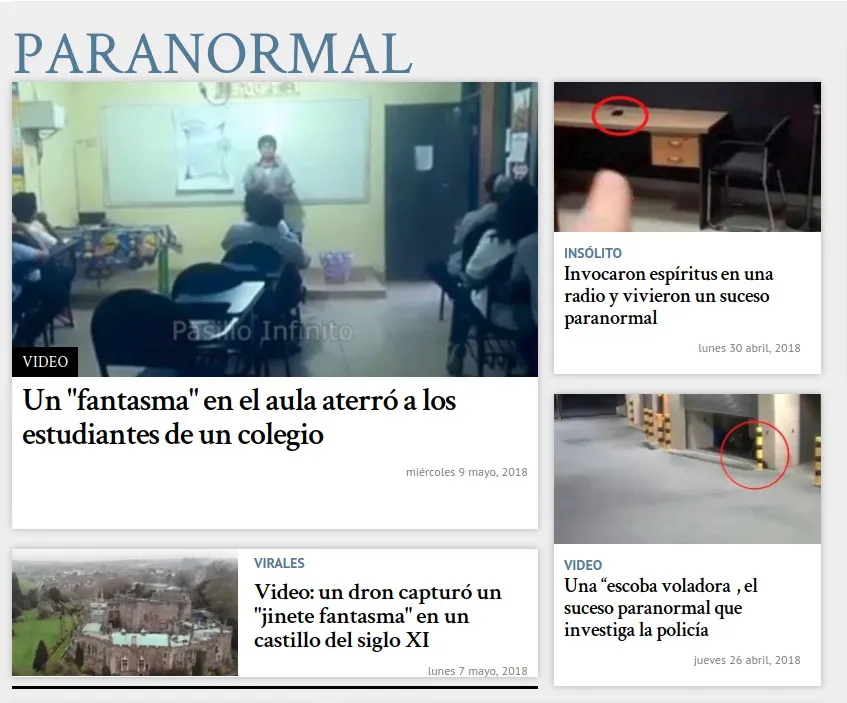
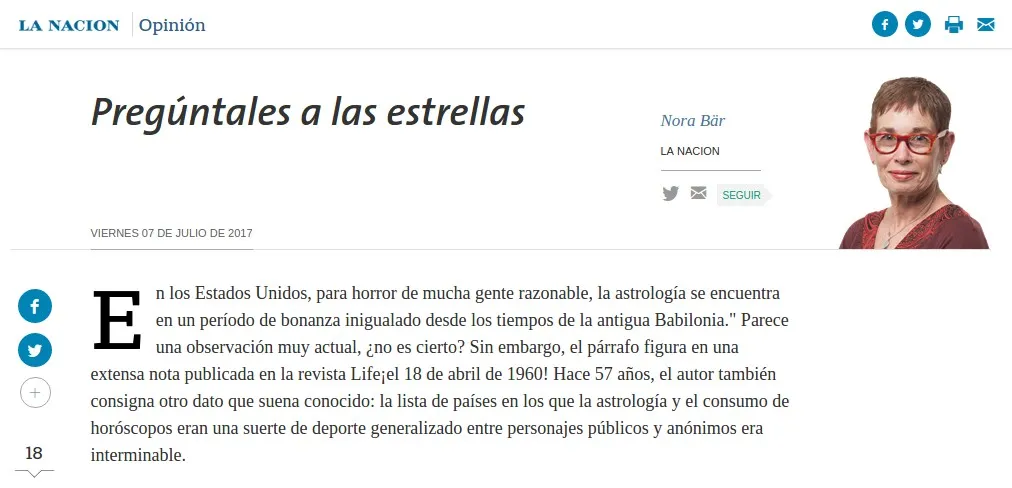
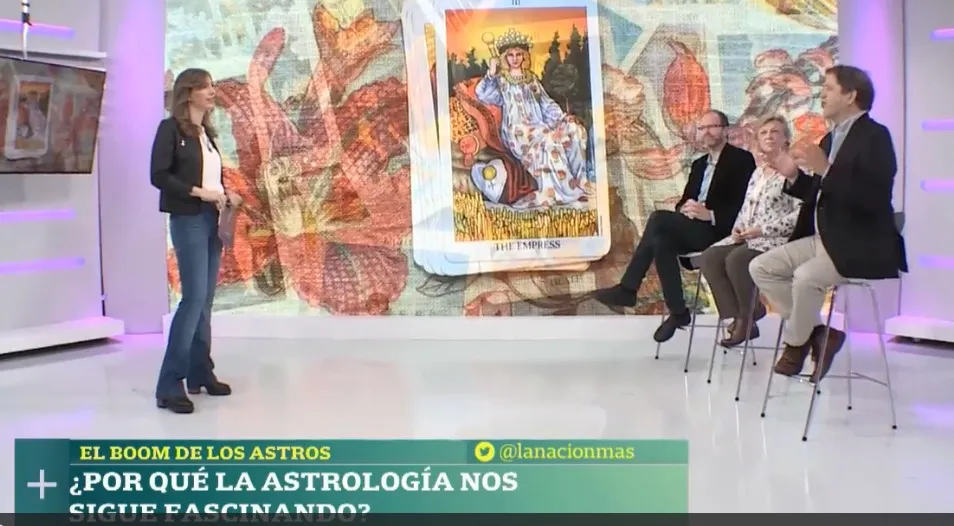
A reflection on the journalism of nonsense.
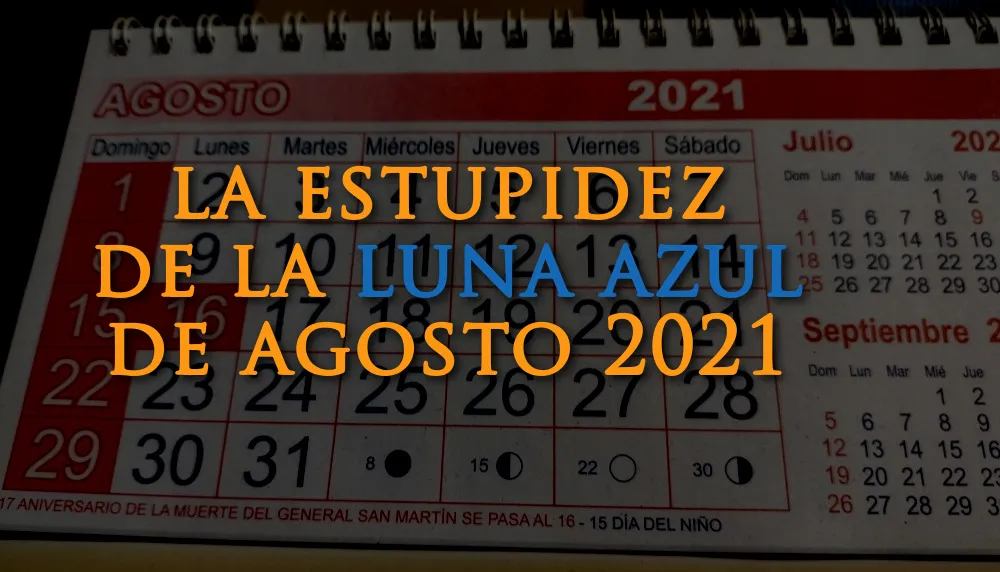
Online media have been reporting for several days about the supposed "astronomical phenomenon" of the Blue Moon. I will take just a few examples, but there are many more:
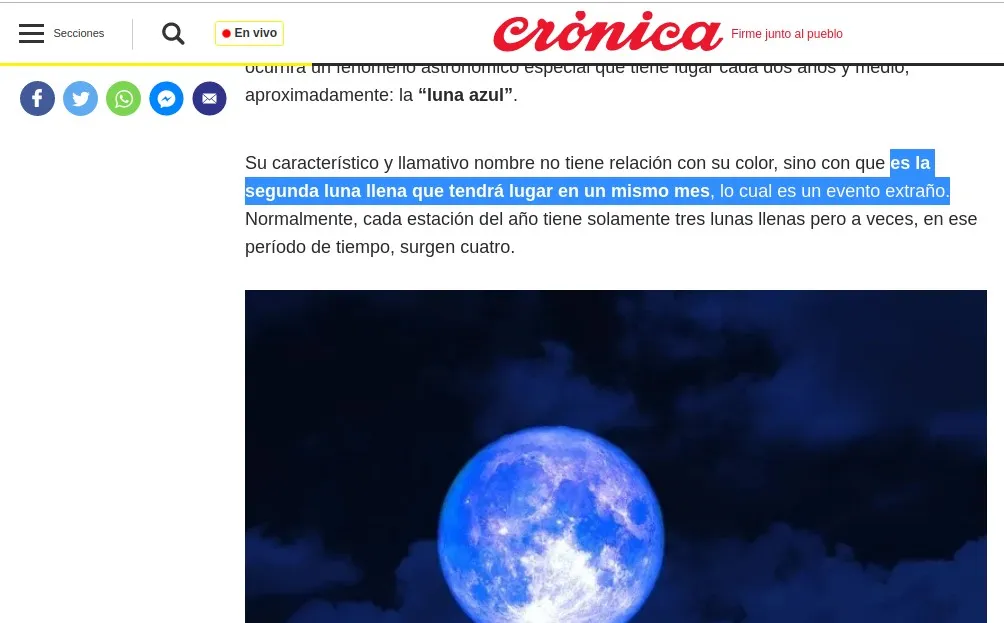
Diario Crónica of Argentina, 08-20-2021 (bold emphasis is mine):
During the night of Sunday, August 23 and the early morning of Monday, August 24 (?) a special astronomical phenomenon will occur that takes place approximately every two and a half years: the "blue moon."
Its characteristic and striking name has no relation to its color, but rather to it being the second full moon that will take place in the same month, which is a rare event. Normally, each season of the year has only three full moons but sometimes, in that period of time, four arise.
"Full moons are separated by 29 days, while most months are 30 or 31 days long, so it is possible to fit two full moons in a single month," explained NASA about this curious event of the night sky.
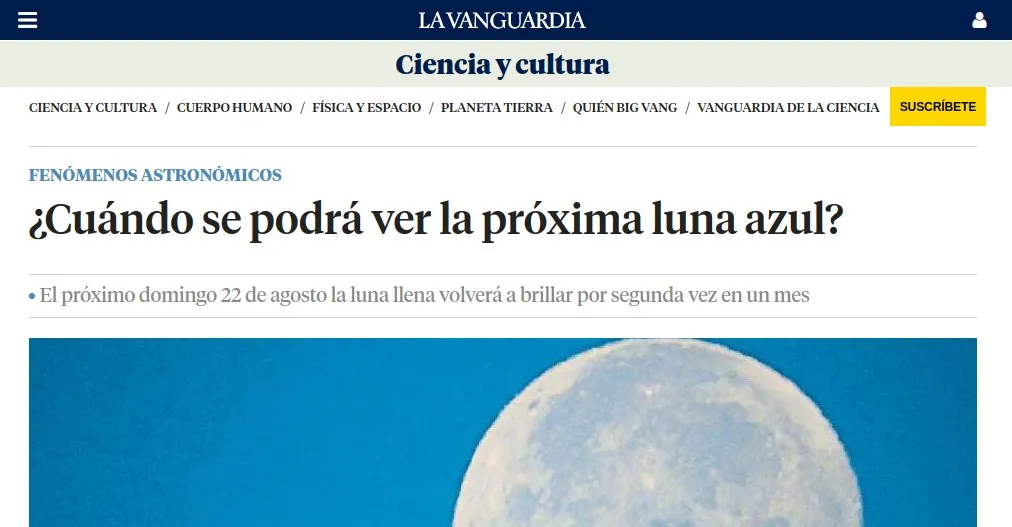
Diario La Vanguardia, Spain, 08-21-2021:
The phenomenon of the second full moon of the month returns sooner than expected. Next Sunday, August 22, the so-called blue moon will shine in the sky and will be at its peak at 14:02 hours.
As NASA explains, the blue moon occurs when full moons are separated from each other by 29 days, that is, one or two days less than usual. (?)
Infobae, 08-18-2021:
What does the blue moon consist of? As we all know, the lunar cycle is not synchronized with the calendar, which is why, every so often, there are two full moons in the same month, and for this year it will occur during the night of August 22 and early morning of August 23.
"The full moon of August 22 is what is known as a seasonal blue moon, since it is the third full moon of four in this season; normally, in each season there are only three. This happens every two and a half to three years," indicates NASA.
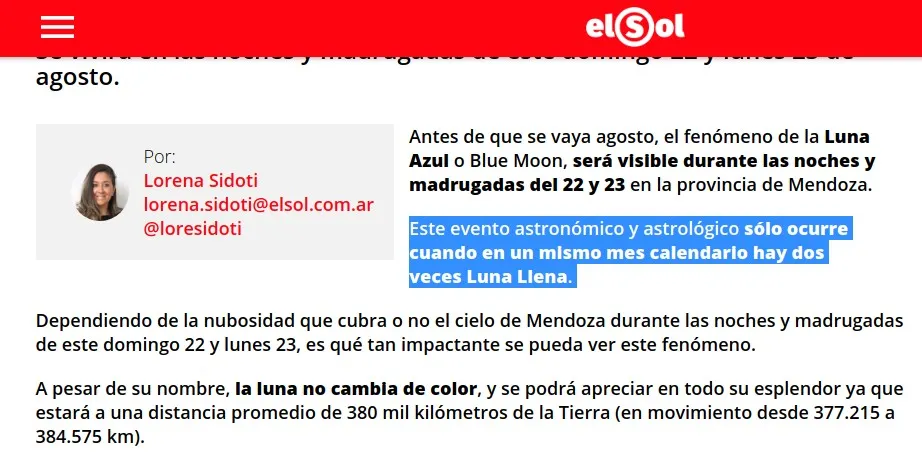
Elsol.com.ar, 08-21-2021
This astronomical and astrological (?) event only occurs when there are two Full Moons in the same calendar month.
It is called a Blue Moon when the same season sees four full moons, and in the case of the August full moon, it will be the third occasion that the satellite will shine with all its apogee in the night sky.
The first full moon of winter 2021 was on June 24, right with the change of season, which allows for three others in just 3 months: July 24, August 22, and September 21, precisely hours before the astronomical autumn begins.
ANALYSIS
1-On one hand, it is said that the Blue Moon is when two full moons occur in the same month. In some cases, "calendar month" is indicated. If that is true, then what was the first full moon of August 2021? Answer: there was no other earlier one in the same month.
In the fourth example cited, the dates of the recent full moons are indicated: one in June, another in July, one in August. There are not two in the same month. That is possible to occur, for example, it happened in October 2020 (1st and 31st). But that is not what is happening this month.
One might then ask: why do the journalists or writers of these texts say there will be two full moons in August, when there won't be?
2-In some examples it is also indicated that it is a seasonal phenomenon, that is, 4 full moons in the same season. In the Southern Hemisphere, it has been winter since June 21, so the August full moon will be the third, not the fourth, which will be seen on September 21.
3-It is also indicated that the full moon will be seen on the night of the 22nd and the early morning of the 23rd. Could it be that they count both dates as different?
The Full Moon is a configuration similar, though not identical, to a lunar eclipse, which always occurs at Full Moon. This configuration assumes that the Earth is between the Sun and the Moon, meaning there is a separation of 180º between the star and the satellite. This, at the same time, has the consequence that when the Moon rises, the sun sets. Approximately the full moon rises at 18 h, when the Sun sets, crosses the sky in apparent motion for about 12 hours and sets at 6 h, when the Sun rises. These are approximate values. Therefore, ALWAYS the moon rises during one civil day and sets on the next civil day, at Full Moon, in all full moons. It is not counted as two full moons, but as one.
4-It is reiterated in these "news" items that there will be a second full moon in August, and in the same text, that each full moon is separated from the previous one by 29 days. If the supposed second full moon of August is on the 22nd, and the previous one was 29 days earlier, how can it be that the first one was also in August?
Do the writers of these texts know how to add and subtract?
5-Perhaps another definition of "month" is being taken, like "period of 30-31 days". In that case, there are ALWAYS two full moons per month and therefore, this "news" ceases to be news.
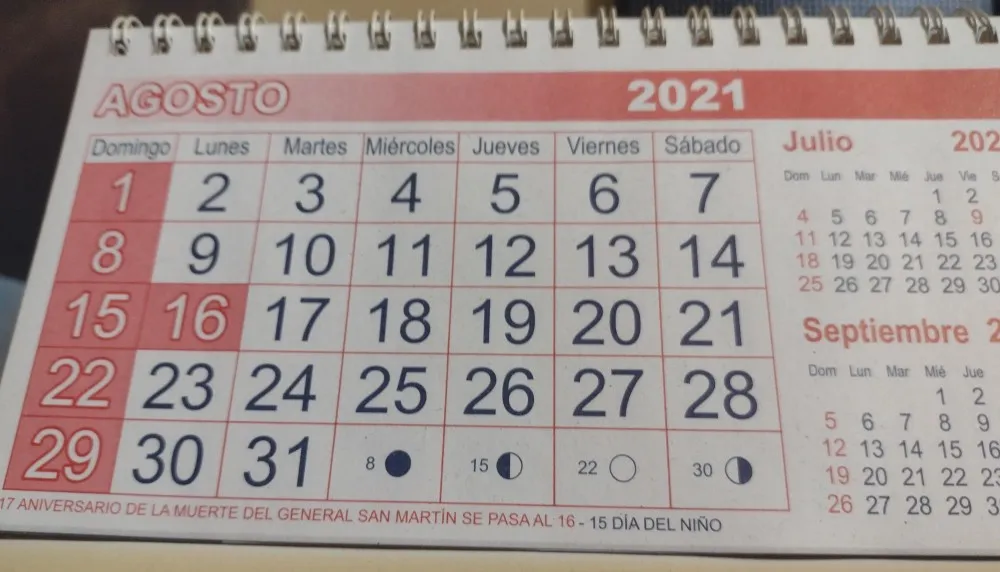
6-Don't journalists have a calendar with the lunar phases at hand? It's not very hard to realize:
7-One could easily talk about this bad journalism by virtue of the so-called clickbait. I allow myself to make a critical apology of the term here.
This English word whose possible translation into Spanish is "ciberanzuelo" refers to sensationalist titles of digital content. Every text, even if not digital, requires a title. It is logical that such a title be "striking". It wouldn't make much sense to write a book whose title is: "This book is rubbish." So there is nothing wrong with trying to make the title attractive. Ultimately, it is an element we use to choose one discourse over another.
Therefore, it makes no sense to be against doing such a thing. Any title of books, movies, scientific papers, news, must be attractive. That in itself is not a problem or something that is wrong. The problems are others:
1-That the title says one thing and the content says another, a "false" title. However, sometimes it can make sense to do it, without that meaning to deceive anyone.
2-That the title is sensationalist assumes that it exaggerates unnecessarily, thus generating disappointment. For example, when it is said that an object will pass "very close" to the planet and then the content indicates that it will do so at 2 million km.
3-So, regardless of the intentions, what matters is whether what is said is true or false, unnecessarily exaggerated or not.
I refer to a recent video from the Veritasium YouTube channel on the topic of clickbait, very instructive.
SYNTHESIS
If we take as the definition of a month any period of 30-31 days, and each phase of the Moon occurs every 29 days, then there are always two full moons every 30 days.
If we use the definition of a calendar month, that is, as it appears on calendars, then it is VERY EASY to notice that in August there will be, tomorrow, one full moon and no other.
The concept of Blue Moon is used to indicate two full moons in the same calendar month, something that does not occur in August 2021, although it has occurred. The next time will be in March 2023.
Another associated concept is Seasonal Blue Moon, which implies 4 full moons in the same season of the year. In the case of the August 2021 full moon, it is the third, since the fourth will be on September 20 (spring, the September equinox, will be on the 22nd).
The Blue Moon, when it occurs, is the same as any other full moon. There is nothing "strange" about it, only that it is infrequent.
To know this, you don't need advanced or specific knowledge. It's enough to know how to look for a calendar with the lunar phases. This is pure and simple bad journalism. I will not mention the incredible stupidities said about the supposed astrological consequences, which have no sense of reality.
Finally, the Moon will have nothing "blue" about it. The news, either. They are all yellow.☉
Sources and related links
- August blue moon: What is this astronomical event and when can it be seen?
https://www.cronica.com.ar/mundo/Luna-azul-de-agosto-Que-es-este-suceso-astronomico-y-cuando-podra-verse-20210820-0024.html - When will the next blue moon be seen?
https://www.lavanguardia.com/ciencia/ciencia-cultura/20210821/7673878/cuando-podra-ver-proxima-luna-azul.html - Blue moon: what is this phenomenon and when can it be seen in Colombia
https://www.infobae.com/america/colombia/2021/08/18/luna-azul-que-es-este-fenomeno-y-cuando-podra-verse-en-colombia/ - Blue Moon in Pisces: when it can be seen in Mendoza and how it influences each sign
https://www.elsol.com.ar/mendoza/luna-azul-en-piscis-cuando-se-podra-ver-en-mendoza-y-como-influye-a-cada-signo - Clickbait is Unreasonably Effective
https://www.youtube.com/watch?v=S2xHZPH5Sng&ab_channel=Veritasium