A cycle of 4 virtual talks that will be given on the last Friday of each month at 19 h.
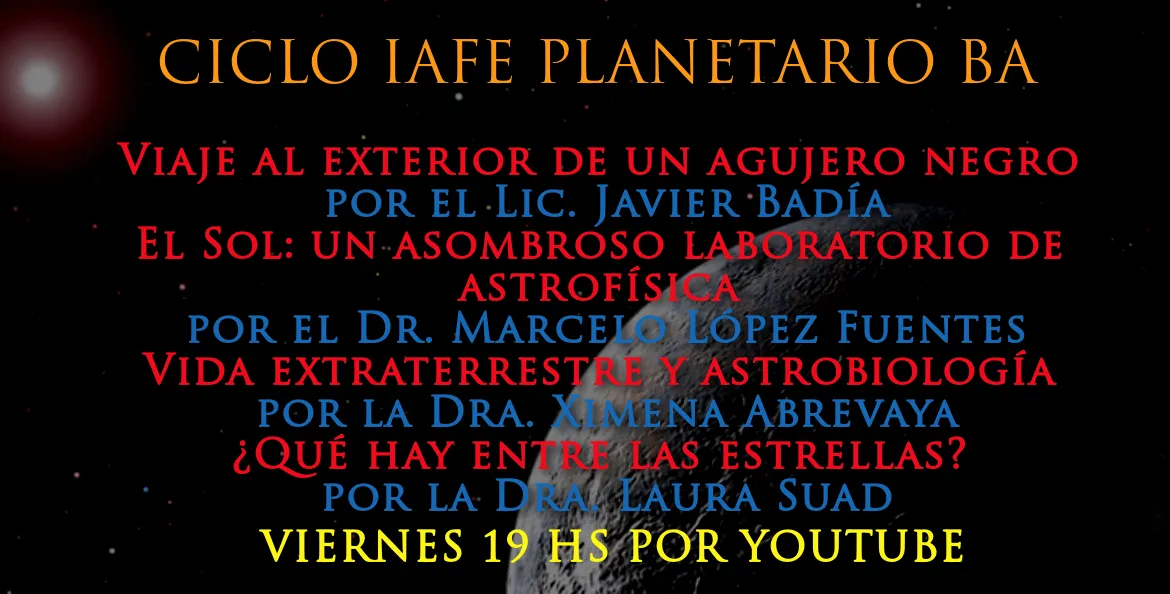
A cycle from the Institute of Astronomy and Space Physics (IAFE) with the city's Planetarium begins.
The talks will be streamed live on the Planetarium's YouTube channel and will be recorded afterwards. No prior registration is required.
It is an excellent opportunity to learn about astronomy and meet Argentine professional astronomers explaining what they know from their research.
Friday, August 27 - 19:00 h
Journey to the exterior of a black hole by Lic. Javier Badía
I propose a journey to the exterior of a black hole, because about the interior... little is known. The famous and only image of one of them, with its humble blurry red ring around a dark circle, is the result of decades of work and theoretical and experimental research on the environment of a black hole, which seems taken from science fiction: light can orbit eternally without ever retracing its own steps, while a ring of gas at millions of degrees is slowly swallowed and where clocks seem to run slow for an Earth observer. The interior of a black hole captivates with its mystery, but the exterior brings surprises that surpass imagination.
Javier Badía
He is a Licentiate in Physics from the University of Buenos Aires and is currently a CONICET doctoral fellow, working for 3 years at IAFE in the Gravitation Group. He is also a professor in the Physics program at the Faculty of Exact and Natural Sciences of UBA.
Friday, September 24, 19:00 h
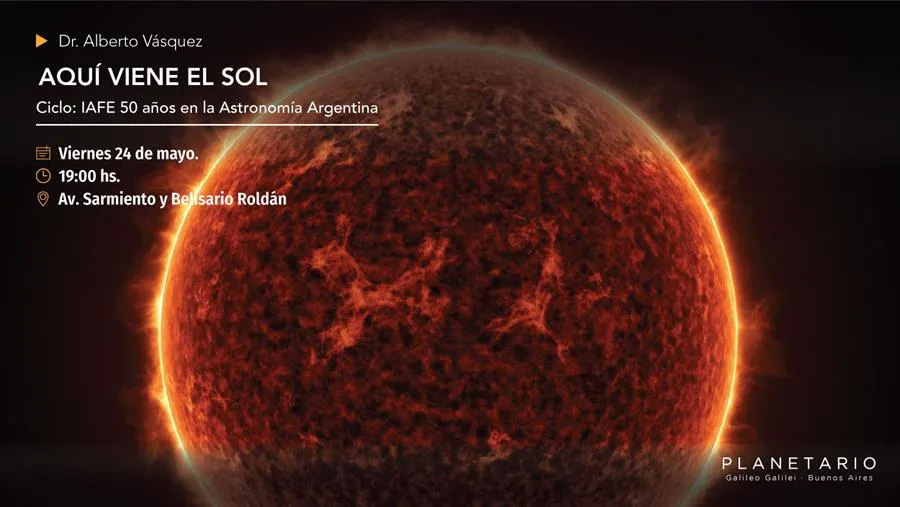
The Sun: an amazing astrophysics laboratory by Dr. Marcelo López Fuentes
Although the Sun is a fairly common star, there are two things that make it special for us: it is close enough to study phenomena that are undetectable in other stars, and its behavior has, for obvious reasons, a much more direct impact on our lives. In this talk, we propose to review our current knowledge about the Sun and look at it as a laboratory for physics under extreme conditions through the impressive observations obtained with state-of-the-art solar telescopes.
Marcelo López Fuentes
He is an Independent Researcher of the National Scientific and Technical Research Council (CONICET) at the Institute of Astronomy and Space Physics (CONICET-UBA)
He carried out scientific experiences at international research centers: at the Naval Research Laboratory (NRL) and NASA Goddard Space Flight Center in the United States, and at the Paris Observatory, France. His research topics are: solar activity, solar magnetic structures, and the dynamics of the solar corona.
Friday, October 29, 19:00 h
Extraterrestrial life and astrobiology by Dr. Ximena Abrevaya
The scientific study of the probability of the existence of life on other planets, which we generically call "extraterrestrial life," often differs quite a bit from the popular imagination. This type of study is carried out by an area of science called astrobiology, which investigates the origin, evolution, and distribution of life in the universe. In this talk, I will explain what it is about and how those of us who research in the area work, focusing on some recent advances, but also on historical aspects. I will also explain why so-called "UFOs" have nothing to do with this story.
Ximena Abrevaya
Licentiate and Doctor in Biological Sciences from the University of Buenos Aires. She is currently an associate researcher at CONICET at IAFE (UBA – CONICET). She leads the Argentine Nucleus for Astrobiology Research. She completed postdoctoral degrees at UBA and the University of Sao Paulo, in Brazil. Her research topics relate to the effects of stellar radiation and how it can limit the development of life on other planets, as well as the development of methods for life detection. She has been a visiting researcher at the University of Graz, Austria and at the Smithsonian Center for Astrophysics at Harvard University, USA. She has been engaged in public communication of science for over 15 years, receiving in 2007 the National Award for Scientific Journalism awarded by the Ministry of Science, Technology and Productive Innovation of the Nation.
Friday, November 26, 19:00 h
What is between the stars? by Dr. Laura Suad
The interstellar medium (ISM), composed of gas and dust, presents a great diversity of structures observed in different bands of the electromagnetic spectrum. The ISM is the most important component of galaxies, since stars, which are the main sources of energy, form from it. Throughout their lives, stars born with masses greater than 8 solar masses alter the interstellar medium that surrounds them, changing its physical properties. In this talk, we will see different types of structures present in the ISM, how we study them, what characteristics they have, and how the impact of some of them modifies the dynamics and structure of the Milky Way.
On the other hand, I will also comment on the installation of the LLAMA (Large Latin American Millimeter Array) radio telescope, 12 meters in diameter, whose construction is being carried out by Argentina and Brazil, in the province of Salta, at an altitude of 4,830 meters above sea level. This radio telescope will observe in a range of the electromagnetic spectrum where a large number of molecular species present in the ISM can be detected.
Laura Suad
She is a Licentiate in Astronomy from the Faculty of Astronomical and Geophysical Sciences of La Plata (FCAGLP), National University of La Plata. Doctor in Astronomy from the same faculty. She worked during her doctorate and postdoctorate at the Argentine Institute of Radioastronomy. She is currently a CONICET researcher at IAFE and is a professor at FCAGLP. Her research topic is the large structures present in the interstellar medium.
Sources and related links
- IAFE Cycle
https://planetario.buenosaires.gob.ar/ciclo-iafe - IAFE
http://www.iafe.uba.ar/ - Planetario BA YouTube
https://www.youtube.com/channel/UCe2NlfG7HtbcC_o1fb5W_cQ