A document, the product of a survey among US astronomers, has been published, indicating the path to follow in the next decade. An Argentine participated.
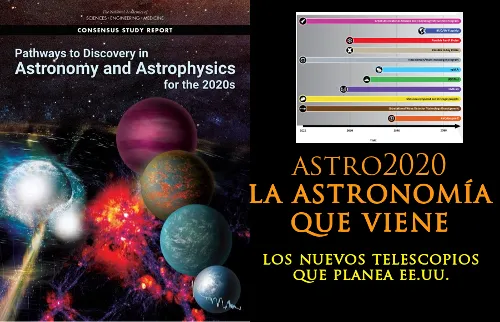
The document is titled Pathways to Discovery in Astronomy and Astrophysics for the 2020s and is the product of the Astro2020 survey among professionals who discussed the topics to research, the necessary infrastructure, that is, the next telescopes, as well as the importance of human resources.
Some key points, as a summary:
Topics
Worlds and Suns in context
Understanding the connections between stars and the worlds that orbit them, from primordial disks of gas and dust through evolution and formation, is an important scientific goal for the next decade. The effort to identify habitable worlds like Earth in other planetary systems and the search for biomarkers will play a critical role in determining if life exists out there.
New Messengers and new physics
In the next decade, a range of complementary observations, from radio to gamma rays, gravitational waves, neutrinos, and high-energy particles, will enable investigations into the most energetic processes and address big questions like the nature of dark matter, dark energy, and cosmic inflation. These greater capabilities will allow for a better understanding of neutron stars, white dwarfs, black holes, stellar explosions, and the birth of the universe.
Cosmic ecosystems
New observational capabilities across the electromagnetic spectrum, along with computing and theory, will help advance knowledge of large-scale structures.
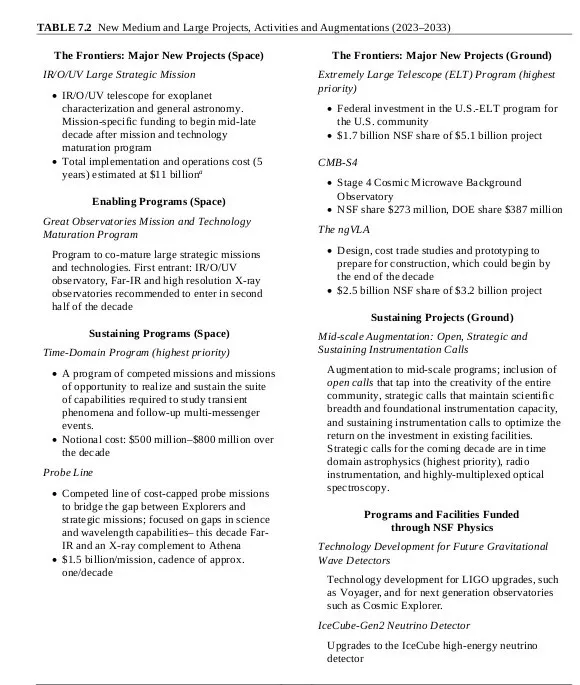
New telescopes
Next Great Observatories
The document recommends that NASA implement a new Great Observatories program (like the one that already gave rise to the Hubble, Chandra, and Spitzer space telescopes). The program would begin with a large optical-infrared-ultraviolet (IR/O/UV) space telescope. Then, far-infrared and X-ray missions.
The survey recommends a 6-meter IR/O/UV space telescope that would be used to search for biomarkers of exoplanets in habitable zones and as a new powerful astrophysical tool. It would be launched in the first half of the 2040s. It would have a cost of 11 billion dollars.
Five years after the first mission, the report recommends that NASA begin preliminary studies for a far-IR mission and a high-resolution X-ray mission, with costs of 3 and 5 billion dollars.
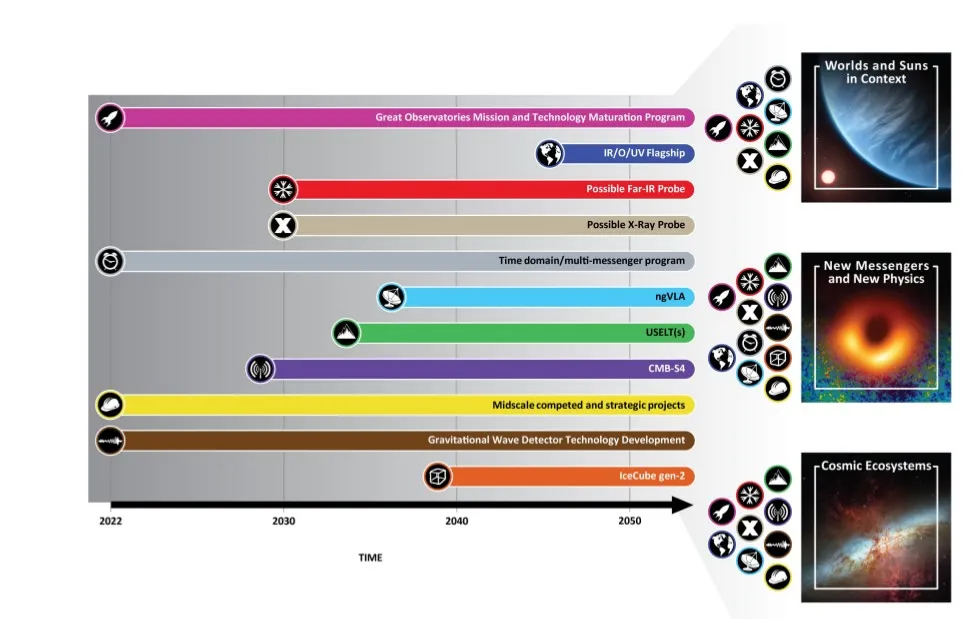
The highest priority is to invest in the Giant Magellan Telescope and the Thirty Meter Telescope, to ensure significant access to those tools for the U.S. astronomy community.
It also recommends the implementation of a Cosmic Microwave Background Stage 4 Observatory. It also indicates that the Karl Jansky VLA and the VLBA, the largest radio observatories, should be replaced by a Next Generation VLA (ngVLA), an observatory with 10 times the current sensitivity.
The report also gives importance to medium-scale projects, between 4 and 100 million dollars. Another important focus is time-domain (variable) studies and multi-messenger observations.
“Our report says that much attention should also be paid to investments in the foundations of this research, including the people who carry it out, and to ensure that the U.S. community is well equipped to capitalize on the vast amount of information that will keep it at the forefront of the global effort to understand the cosmos", said Robert Kennicutt, in charge of the survey committee.
The report includes sections on diversity and the handling of discrimination and abuse incidents. It also mentions the need to moderate the optical interference from satellite constellations and radio frequency interference, as well as climate change mitigation actions.
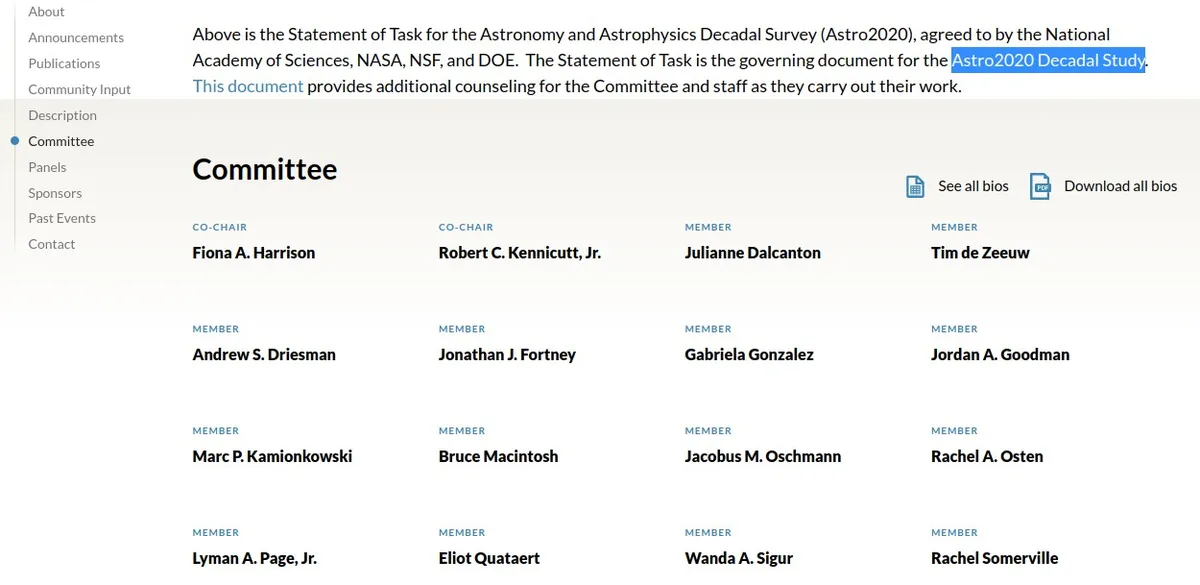
The final document is the conclusion of the Astro2020 Decadal Study survey, whose committee was composed of a number of authorities including the Argentine Gabriela González, who is a professor of physics and astronomy at Louisiana State University and was a spokesperson for LIGO.
The 616-page document can be downloaded in pdf format from the link indicated below. The page also contains an interactive report and access to the white papers, the proposals discussed in the survey.
CONCLUSIONS
1-Unlike what happens in other latitudes, here there is a published, justified, and well-documented discussion about the direction American astronomers want to take. You don't need telepathy to find out nor to be friends with the commissioner of the moment.
2-The figures mentioned may seem astronomical, of course. They are, but it must be considered that it is only a tiny fraction of that country's budget. Moreover, the figures presented here are less than 25% of the money received by Argentina from the IMF and other external lenders.
3-To do astronomy (and anything else), money is needed. Each country may spend different annual amounts according to its economic situation, but in any case, it is important that such amounts are used efficiently, considering that all new infrastructure will later require adequate maintenance. Hence the importance of a serious discussion on how to use the available funds. That discussion should be transparent, in the sense that it is not "dark." The problem is that sometimes it is so transparent that no one participates and no one sees it, it is invisible, like glass and dark matter.☉
Sources and related links
Decadal Survey on Astronomy and Astrophysics 2020 (Astro2020)
https://www.nationalacademies.org/our-work/decadal-survey-on-astronomy-and-astrophysics-2020-astro2020
About the images
Credit: NAS National Academies of Science.