Reflections on Christmas and New Year's lotteries (or any other time).
It is common to compare games of chance, like the lottery and the numbers game, to a tax on stupidity or ignorance. The comparison is made because of the low chances of winning, so the most likely outcome is to lose. I have made this comparison several times. But this analogy has three serious problems, namely:
1-Other human actions are much worse, like smoking, which is undoubtedly a waste of money, but also of health. Therefore, it is much more of a tax on stupidity than games of chance. Soon we will see a possible way to "define" stupidity that will put the issue in perspective.
2-The two central problems of games of chance are NOT the low probability of winning, so by making the analogy, the two fundamental problems of the matter are not addressed.
3-Some mathematicians have said they play the lottery and they, better than anyone, know about the low probabilities and do it anyway, since -after all- you bet little to have a remote chance of winning a lot. This is explained on the blog Gaussianos.
THE TWO FUNDAMENTAL PROBLEMS OF GAMES OF CHANCE
I-THE PROBLEM OF THE "METHOD"
The first problem is that there is no method to win. There are methods to slightly increase the probabilities, but not to win. If there were a method to win and it were known, then those who run the games would change the rules immediately. There have been in some countries, including the U.S., some not entirely well-designed lotteries, so a group of people could agree, pool a lot of money, buy tickets, and have almost the certainty of winning much more than they spent. But these are specific cases that quickly spread and the rules changed.
In this blog, I have commented before on a practice of some media outlets in Argentina. Surely something similar happens in other countries. It is a false method that consists of, before a draw, the newspaper indicating a series of numbers that would have a higher probability of coming up. They are "bets" made by the media, generally without justification. In some cases, there is a supposed justification: the "delayed" numbers, meaning numbers that have not come up for a certain amount of time and that, for some strange reason, "should" come up.
This false method is not made explicit since there is no such method; it only consists of throwing out numbers. The next day, since there are many lotteries, provincial, municipal, and national, they show how many of the numbers proposed the previous day came up, either as the first prize or as other prizes. And as is logical, many of the proposed numbers will come up. Which can give the sensation that if we follow the advice of those media, then we should be millionaires.
It is easy to see that if we paid attention to such advice, then we should bet on all the recommended numbers, let's say there are 20, both for the first prize and for other prizes, both in national lotteries and the rest. In the case of the numbers game, what you win is proportional to what you bet. Therefore, only if you bet a lot, you win a lot. As a consequence, to have greater chances of winning, you should bet a lot of money on many numbers in many numbers games to increase your chances. That is, you must be rich before betting.
It is clear that those who publish those notes do not do what they say, because if they did and were successful, they would not continue writing notes, as they would be millionaires drinking daiquiris in Cancún.
The publications include a disclaimer that compulsive gambling is a problem, but at the same time they incite to bet compulsively.
II - THE PROBLEM OF STUPIDITY
In the 1970s, an Italian economist, Carlo Cipolla, published a book on the Theory of Stupidity.
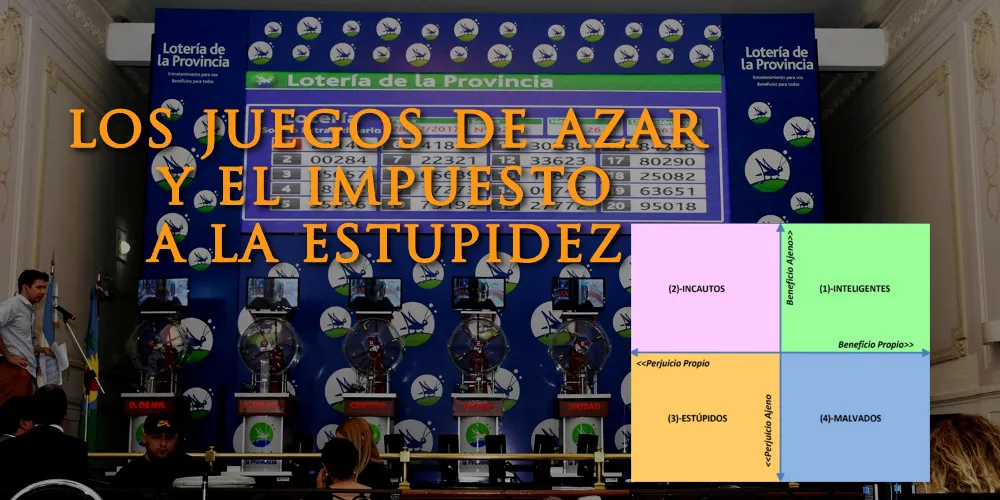
He did so by dividing human actions into four categories illustrated with Cartesian axes. Actions that generate harm for oneself go to the left. Actions that generate a benefit for oneself, to the right. Actions that generate a benefit for others, above; actions that generate harm for others, below.
If we number the quadrants as usual, it looks like this:
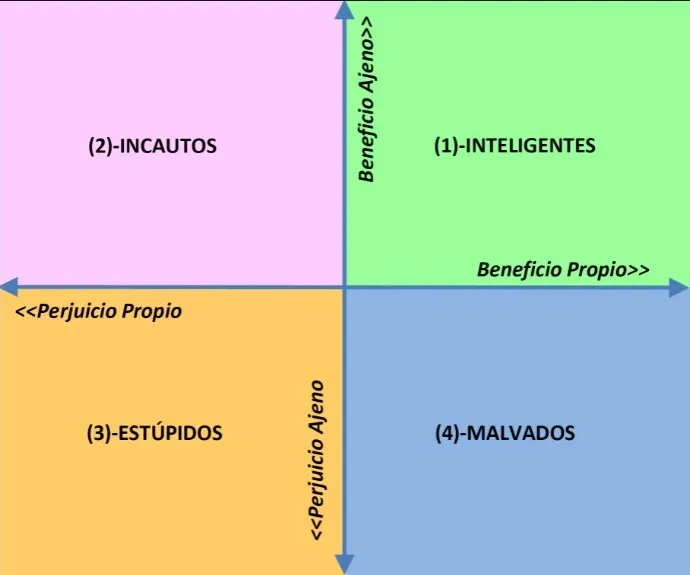
This scheme has several problems. I will show at least one: let's say a person decides to take a sabbatical year, that is, not to work. To live, they will have to have savings and spend them. That is, they will not earn money, but will lose what they have. From an economic point of view, it is a quantifiable loss. We could also calculate how much money they will fail to earn. However, the person gains time to spend with a newborn baby. The latter is difficult to quantify, especially in economic terms.
However, for activities that are strictly economic, that is, that have quantifiable benefits or harms, perhaps this scheme can be applied. In the case of situations that do not involve only economic instances and there were other types of benefits and harms, the valuation is more subjective, but we could look for some quantitative-qualitative valuation method. At least as an approximation, this simplistic scheme could serve. It is assumed that when approaching a problem we do so from a simple point of view, to then add the complications that reality generally has.
If we apply this scheme to games of chance, what can we say?
It is logical to think that in the case of the lottery and the numbers game, they are games in which the working population participates. Millionaires also use games of chance, but they go to casinos or poker games or other more elitist occasions. That millionaires play and lose does not bother me in the least. There is no harm, since they have money to spare.
What does worry me is that people who have little money lose it. In the lottery and the numbers game, if all who play are workers, since it is a zero-sum game, then what one wins is what the others lose. Therefore, it is a game in which almost everyone loses. And almost everyone are workers. The result is that one worker wins AT THE EXPENSE of the others.
In the scheme above, see where the coordinates leave it: If you win, you are evil (because you take money from others). If you lose, you are a fool.
But if no one wins (and sometimes lotteries and numbers games go unclaimed), then you know.
CONCLUSION
It's very tempting, at this time of year, to buy a lottery ticket. There's a lot of money at stake. It's tempting, I admit. But... Do you know what you would do with so much money? Wouldn't you be afraid of being robbed? I suppose so. You'd become paranoid. But, wait. Today, when we are not rich, the same thing happens to us. We also get robbed or they try to rob us even though we are poor. Well, that happens because there are poor people who take money from other poor people, with the aim of not working. If that is wrong, then everything is said.☉
Sources and related links
- Mathematical Challenges in El País – Extraordinary Christmas Challenge 2021 – A Shared Luck
https://www.gaussianos.com/desafios-matematicos-en-el-pais-desafio-extraordinario-de-navidad-2021-una-suerte-que-se-comparte/ - Carlo Cipolla
https://es.wikipedia.org/wiki/Carlo_Maria_Cipolla
About the images
Credit: Lotería de la Prov. de Buenos Aires.