Can astronomy be a way to escape and hide reality? The frenzy for eclipses.
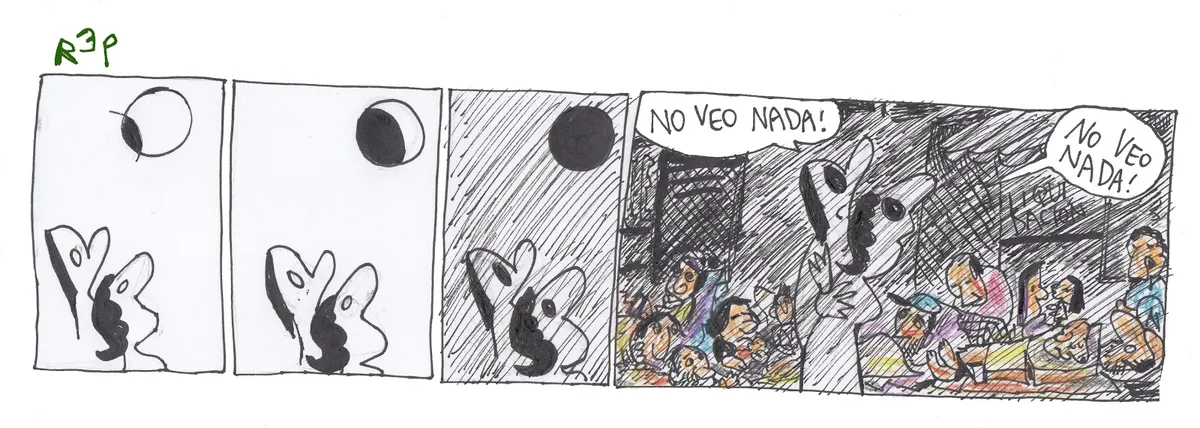
As I was told, on the day of the solar eclipse visible in Argentina and Chile, a well-known TV host began his program, at 19:00 hours, criticizing that the mass media gave coverage all day to the astronomical phenomenon instead of to another fact: that a person died of cold in Buenos Aires for sleeping on the street.
It is somewhat paradoxical that a journalist, who is usually considered "right-wing," complains about the mass media and even more so that he complains about the situation of homelessness, cold, and death of a poor person.
Let's leave aside that particular journalist, and the issue remains: is astronomy an "opium of the people"? I wasn't told that expression was used on that program, but it wouldn't be very hard to arrive at the idea if what was proposed was that the eclipse, as told by the media, served to hide (eclipse) other facts.
To answer the question, it is necessary to establish several ideas:
1-Astronomy is not something good or bad "in itself," analogous to a hammer. It depends on how it is used.
2-Professional astronomy is not "entertainment," but astronomy can be, outside the professional-academic sphere. In between is scientific outreach, which does not have to be boring, but whose purpose is to explain-teach something, it is not a pastime. But astronomy can be a pastime, just like movies or watching the sunset. That it is a pastime, in principle, is not bad at all, just like observing the Sun when it rises, reading a book, or listening to music as I am doing while writing these lines. [I'm listening to Caravan, from the album, For girls who grow plump in the night, track 7, the medley: L'Auberge Du Sanglier]
3-The media are not universities or schools. They can be used to teach and, in a few cases, they are used for that. But the widespread use is not to teach, but rather they are a means to make money, a business. And it's business that has demand, since this drives the main income of the media: advertising.
4-As a consequence of the previous point, the media (except specialized ones) are not for or against the sciences. They publish articles on science or pseudoscience as demand indicates. That's why, on the same digital media that published a lot of information about the eclipse, astrological articles are also published.
5-Eclipses, from a professional point of view, are good occasions to do research. The 1919 eclipse through which they wanted to test the theory of Relativity is famous, but there are many other possible examples. They can also be a good excuse for scientific outreach. I cannot refer to the media coverage of the last eclipse, but in previous ones the outreach content ranged from mediocre to very bad. Many outreach activities are not carried out by the mass media, but they do require the media to report on such activities to be known.
6-As a consequence of all the above, it is clear that eclipses or any other astronomical phenomenon are not in themselves a problem. In any case, the way they are used, in public and mass discourse, is the issue.
[Now listening: Genesis - Firth Of Fifth (Fiordo de Quinto)]
...
♫ He rides majestic
Past homes of men
Who care not or gaze with joy
To see reflected there
The trees, the sky, the lily fair
The scene of death is lying just below ♫
...
7.1-There seems to have been, for a few years, a "frenzy" for eclipses. One might ask what that frenzy is due to, what drives it. I don't have many answers. One possible explanation has already been addressed in this blog: the idea that astronomical phenomena are unique and unrepeatable and that life is only one and you have to see them because they don't repeat. This is as true as anything else: crossing a street is a unique and unrepeatable event, it never happens exactly the same.
7.2-A large number of people, who could not see it directly with their eyes, saw it on the internet. That is something relatively new. Broadband for transmitting HD video, live, is from a few years ago. Here I wrote a very read post about Telescopes to use via the internet. More traditional media, like TV, did not want to stay out of that "market niche."
8-That the media report on astronomical phenomena and/or broadcast them on TV is not in itself questionable. In fact, I think the opposite. The problem, in any case, is what is said, how, and how much. It is evident that when something seems to be business, it is squeezed until all the juice is extracted. There is an overdose of information that is difficult to process. The journalistic criteria among different media are not very different, so the same information circulates everywhere, leaving aside other information.
9-The frenzy for the eclipse can be measured in time. I will use the appropriate technical term, for which I apologize to readers for the specialized jargon: the frenzy lasts as long as a fart in a basket. On Wednesday, mentions of the eclipse dropped notably and today Thursday they are nil. It's like in a strike: merchants complain that they sell less because fewer people are around, but the next day they sell double.
10-The eclipse frenzy is over. Science remains the same as yesterday. That matters to few. On Wednesday the frenzy was the person who died of cold. Tomorrow no one will care anymore (unfortunately).
Conclusion
Anything can be "the opium of the people," even information about left-wing parties. Whether it is or not depends on each person. It is logical and even necessary to "escape" from reality a little. There is nothing wrong with reading novels, going to the theater, watching a movie on TV, visiting a museum, playing ball. Doing that does not necessarily imply not having a commitment to others or living in a mayonnaise jar. A very fruitful concept is that of dose. We will have to find the right dose, that which others called The law of the passage of quantity to quality.
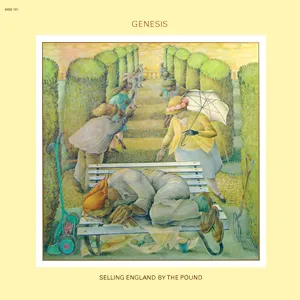
[Now playing: Genesis - I Know What I Like (In Your Wardrobe)]
The song tells the story of a lawnmower that says: "I know what I like. And I like what I know"...
Sources and related links
The frequency of the unrepeatable in astronomy https://www.noticiasdelcosmos.com/2016/06/la-frecuencia-de-lo-irrepetible-en.html
About the images
Rep comic strip, published in Página/12 http://miguelrep.blogspot.com/2019/07/blog-post_14.html
Cover of the album Selling England by the pound, Genesis, illustrated by Betty Swanwick, from Wikipedia.
https://en.wikipedia.org/w/index.php?curid=19083214