The second data release from LoTSS.
After a period of 7 years, an international team of astronomers released the second data release of a survey with LOFAR, a European radio telescope. The data form a catalog (or "map") with more than 4 million very bright objects.
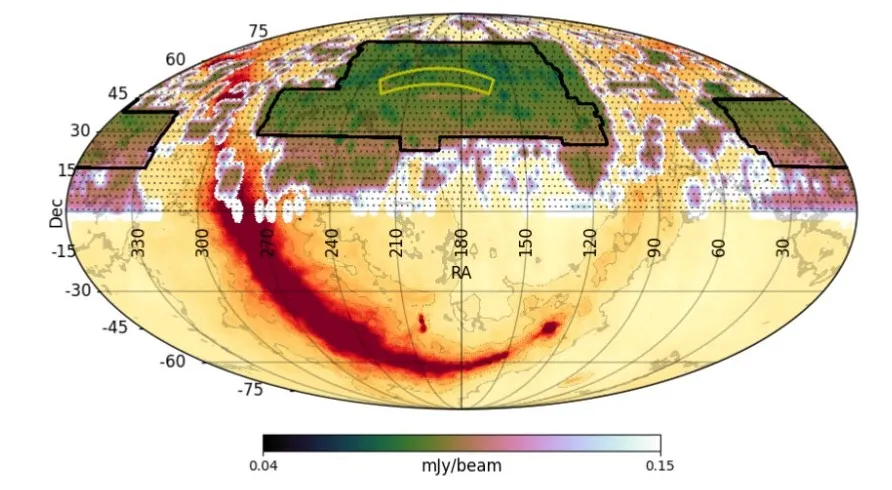
The Two-metre Sky Survey (LoTSS) was made at wavelengths between 120-168 MHz and covers 27% of the northern sky. The catalog includes 4,396,228 radio sources, generally not detected until now at those wavelengths. The data comprise almost 12 thousand files with a size of 153 TB.
To produce this catalog, special processing algorithms were used on high-performance computers in various European countries. 3500 hours (145 days) of observations were used, occupying 8 petabytes.
Astronomer Timothy Shimwell of ASTRON and Leiden University said: "It is very exciting to work on this project. Every time we create a map, our screens fill with new discoveries and objects that have never been seen before by human eyes. This release is only 27% of the entire survey and we anticipate it will lead to many more scientific advances in the future, including examining how the largest structures in the Universe grow, how black holes form and evolve, the physics governing star formation in distant galaxies, and even the most spectacular phases of the lives of stars in our own Galaxy".
In Fig. 1 (above): Status of LoTSS, sensitivity and coverage. Sensitivity is measured in microJansky (μJy/beam).
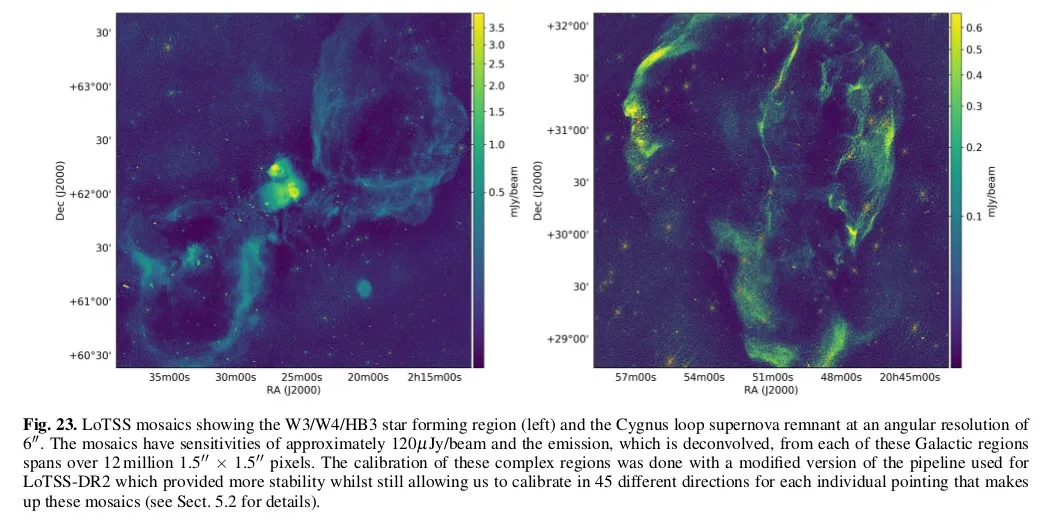
Fig. 23: Mosaics showing W3/W4/HB3 star-forming regions (right) and the Cygnus supernova remnant (left) at a resolution angle of 6". The mosaics have sensitivities of 120 uJy/beam.
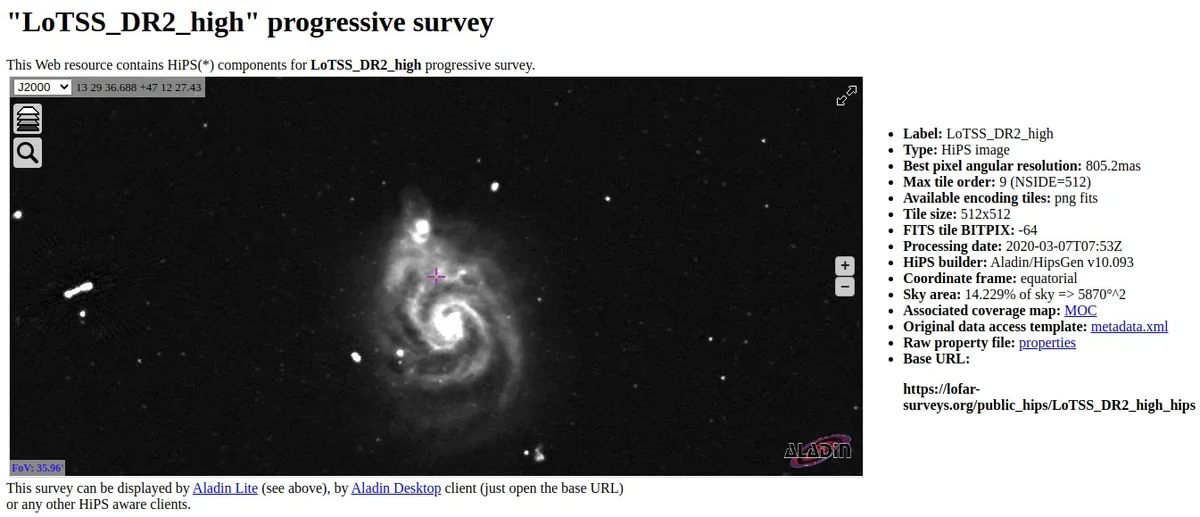
On several websites, the word catalog and the word "map" are used interchangeably. In many cases, surveys are records in a database with which, with proper manipulation, a map can be made. In this case, the catalog can be "navigated" as a map, using a web browser, using the HIPS links (see below).
The data can be used by astronomers from different countries to analyze the recorded structures and better understand natural phenomena. How many wonders are out there?☉
Sources and related links
- Flurry of new discoveries as incredible new image revealing 4.4 million galaxies is made public
https://www.astron.nl/flurry-of-new-discoveries-as-incredible-new-image-revealing-4-4-million-galaxies-is-made-public - The LOFAR Two-metre Sky Survey
T.W.Shimwell et al.
A&A Volume 659, March 2022
https://doi.org/10.1051/0004-6361/202142484 - LOFAR surveys
https://lofar-surveys.org - Public data repository
https://dx.doi.org/10.25606/SURF.lotss-dr2 - LoTSS Data Release 2 (DR2): how to navigate the data
https://lofar-surveys.org/dr2_release.html - LoTSS Data Release 2
https://www.youtube.com/watch?v=WQrSQGNdlmg&ab_channel=PaulM.Sutter
About the images
Credits: T.W.Shimwell et al.