From Tolkien's Legendarium to the Hubble.
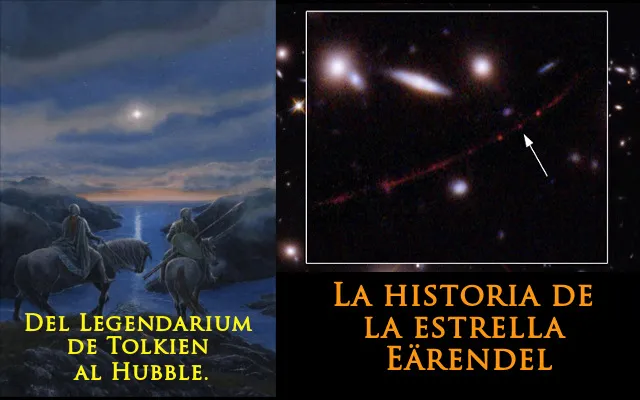
A few days ago, a photograph was released of what could be a very distant star, perhaps the oldest known so far, taken with the Hubble Space Telescope thanks to a gravitational lens. In the announcement, the star is named Eärendel, a name that comes from the literary mythology of J.R.R. Tolkien.
I The Name Game in Astronomy
Astronomers use different criteria to name astronomical objects. In the Solar System, it has been customary since ancient times to use names from Roman mythology for planets and moons. However, several moons bear the names of characters from Shakespeare's works.
For deep-space objects, such as nebulae and galaxies, their designation comes from catalogs. Two of the best known are Messier and NGC (New General Catalog). The same object can be part of more than one register. For example, the Andromeda Galaxy is Messier 31 (M31) and NGC 224.
In the case of stars, the Bayer designation is used, which consists of using the genitive of the constellation + a letter of the Greek alphabet, starting with the brightest star in the group. Alpha Orionis, however, is not the brightest in Orion. It is also known as Betelgeuse. Many stars receive proper names, generally the brightest ones visible to the naked eye. The "Three Marys," which make up Orion's Belt, are called Mintaka, Alnitak, and Alnilam. The three words come from Arabic and are synonyms for "belt." The brightest in the Hunter is Rigel, a name that comes from the Arabic Rijil, meaning foot-leg. Achernar, the brightest in Eridanus, derives from Arabic and means "at the end of the river."
Among astronomers and scientists in general, there are nerds. There is also a custom of creating projects with acronyms or initialisms so they match some nerdy word. Here we recently told about the upgrade of the neutrino observatory for the Super Kamiokande experiment, whose chosen name was GADZOOKS!, a clearly forced acronym for: Gadolinium Antineutrino Detector Zealously Outperforming Old Kamiokande, Super!. The goal was to make the acronym match the interjection used in Anglo-Saxon comics as an expression of surprise by superheroes.
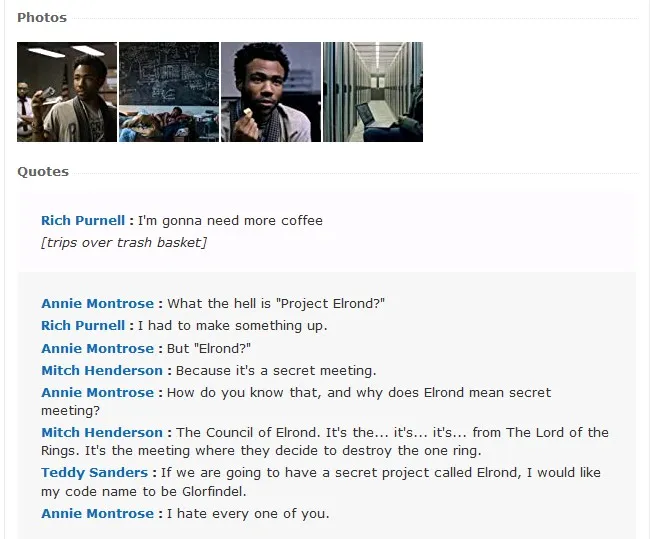
In the movie The Martian (Ridley Scott, 2015), astrophysicist Rich Purnell comes up with a maneuver that would make it possible to rescue the stranded astronaut on Mars, and when it is discussed at NASA they use the code name "Project Elrond," a reference to the secret meeting of The Fellowship of the Ring, while in the same scene the actor Sean Bean participates, who played Boromir in Peter Jackson's saga.
Elrond means "Star-dome" in Elvish and is the son of Eärendil, also called Eärendel.
II The story of Eärendil and his star
Eärendil is a peredhil or half-elf who appears in The Silmarillion. His name is from the fictional Quenya language and means "lover of the sea." He is the son of Tuor and Idril and was born in Gondolin. Later he lived in Arvernien where he married Elwing, with whom he had two sons: Elrond and Elros. With the help of a carpenter, he built the ship Vingilótë and headed West to find his parents. Meanwhile, in Arvernien his wife took possession of a Silmaril (a precious stone) for which the city was attacked, although Elwing managed to escape. With the help of the god Ulmo, Elwing grew wings that allowed her to fly to her husband's ship.
They later arrived in Valinor and he appeared before the Valar to ask for help for men and elves in Middle-earth and their struggle against Morgoth. The Valar overthrew Morgoth and blessed the ship with a bright white flame and sent it to the skies. Eärendil sailed with the Silmaril on his brow. Since then, the glow of the Silmaril can be seen in the sky as the evening star.
Later, the light of the star of Eärendil illuminated Frodo's Phial, a gift from Galadriel, which helped him on his journey to Mordor.
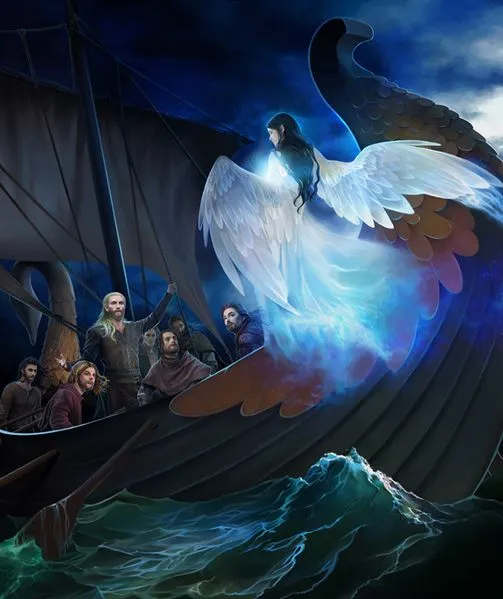
"The Voyage of Éarendel the Evening Star" is a poem by J.R.R. Tolkien, published posthumously by the author's son, Christopher Tolkien, in The Book of Lost Tales 2. Here is an attempt at a translation:
The Voyage of Éarendel the Evening Star
Éarendel arose where the shadow flows at the silent edge of the Ocean;
through the mouth of night like a ray of light where the shores are steep and dark he launched his boat like a spark of silver from the last and lonely sand;
then, on the breath lit by the burning death of day, he sailed from Westerland.
He made his way over the aftermath of the Sun's splendor, and wandered beyond many stars in his shining galleon.
On the rising tide of darkness ride the ships of the sky, and they shine the night with their sails of light as the star passes.
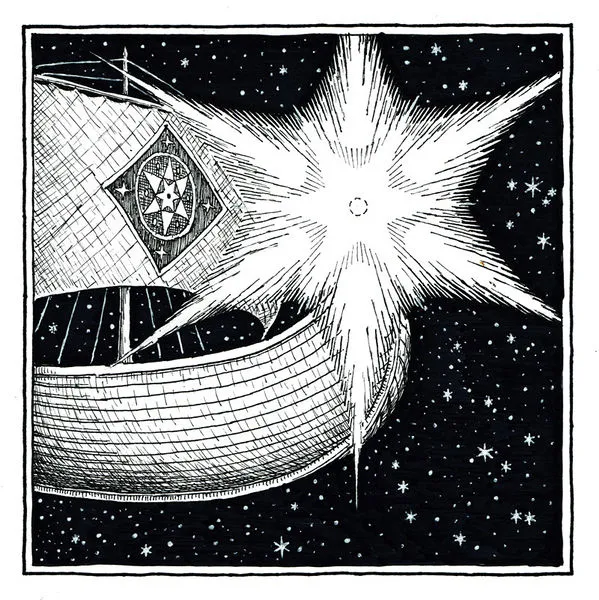
Heedless, he dives beyond these shimmering ships, by his straying spirit turned on an endless quest through the darkened West over the margin of the world;
and travels in haste through the jewelled waste and the twilight from whence he came with a heart burning in bright desire and a face in silver flames.
The Ship of the Moon of the East comes soon from the Haven of the Sun, whose white gates shine in the impending ray of the mighty silver one.
Lo! with bulging clouds like shrouds of his ship, he weighs anchor in the darkness, and with gleaming oars leaves the flaming shores in his boat of silver wood.
Then Éarendel fled from that sailor's fear beyond the pale dark land, back under the edge of the dim Ocean, and behind the world he sailed;
and he heard the joy of the people of the land and the pouring of their tears, as the world receded in a hazy cloud on his journey along the years.
Then, sparkling, he passed into the starless immensity like an island lamp in the sea, and beyond the comprehension of mortal men, he undertook his lonely walk, following the Sun in his galleon through the pathless firmament, until his light aged in cold abysses and his eager flame died out.
III The other story of Eärendel
The scientific and astronomical story of Eärendil is just beginning to be written. It is not certain that it is a star. It seems to be too small to be a galaxy or a cluster, but it could be a binary system. It is also not clear whether or not it is a Population III star.
This other story will not require Tolkien's fantasy and pen, but stellar spectra and lensing distortion. But it would not be so far-fetched to think that Hubble and other instruments are like ships with which the astronomer-argonauts of the present sail the cosmos in search of its bright treasures, like precious gems from the Ancient Middle-earth of the Universe.☉
Sources and related links
- Star of Eärendil
http://tolkiengateway.net/wiki/E%C3%A4rendil - Eärendil
https://es.wikipedia.org/wiki/E%C3%A4rendil - Hubble telescope detects Eärendel, the most distant star ever observed
https://www.csic.es/es/actualidad-del-csic/el-telescopio-hubble-detecta-earendel-la-estrella-mas-lejana-jamas-observada - Lyrics of The Voyage of Éarendel the Evening Star
https://lyricstranslate.com/es/j-r-r-tolkien-voyage-%C3%A9arendel-evening-star-lyrics.html
About the images
from Tolkiengateway, credits to Steamey, Matěj Čadil, Alan Lee.