A piece of sky full of nothing (visible).
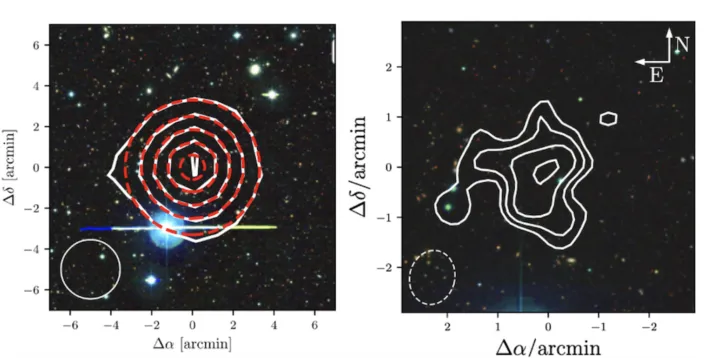
Cloud 9 was discovered in 2023 when a team of astronomers noticed an excess of neutral hydrogen (HI) without stars, near the spiral galaxy M94. The discovery was made with the FAST radio telescope, which does not have the best resolution for the case, as the cloud's diameter was calculated to be 3 arcminutes, while the instrument's resolution is 2.9. Therefore, the authors of this new study decided to observe the object with the VLA (the array of radio telescopes that appears at the beginning of the movie 2010: The Year We Make Contact).
The discoverer was astronomer Zhou. The astronomers who carried out this new work were Alejandro Benitez-Llambay and Julio F. Navarro. At the time, both astronomers held a video conference with a member of AAS, uploaded to Youtube (see link below). Although the first works in Milan, Italy and the second in Canada, both are Argentine, graduates of the Universidad Nacional de Córdoba.
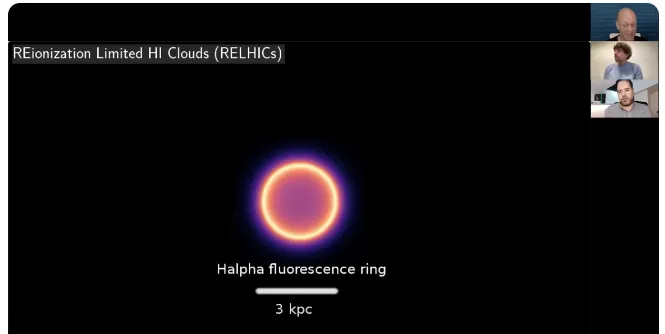
Scientists think this piece of sky, if you'll allow me the poetry, is a small dark matter halo. But astronomers like to use complicated names: they call them RELHICs, an English acronym: reionization-limited neutral atomic hydrogen clouds; in Spanish: nubes de reionización limitada de hidrógeno neutro. The object already has its entry on Wikipedia. The Argentines had done a previous work in 2023 postulating that the object was a RELHIC.
How to observe a dark matter halo without stars?
The current cosmological model, ΛCDM, includes dark energy (the lambda letter linked to the cosmological constant as a repulsive force) and cold dark matter (CDM for its acronym in English). This model predicts that dark matter can form small halos -gravitationally bound regions of matter- that contain cold gas, but no stars. While dark matter does not interact with light and therefore cannot be detected directly, cold gas reflects light at long wavelengths. Radio telescopes come to the rescue.
Using the VLA, the Argentines compared the data with the previous study. They found that Cloud-9 was a bit smaller and more irregular.
The astronomers say there are two possibilities, both very interesting: Either Cloud-9 is truly a RELHIC, a dark matter halo without stars; or it is a very faint dwarf galaxy, like Leo T. Let's recall a previous work with Navarro's participation, which we commented on here titled Microgalaxias: una galaxia con 60 estrellas (see link below).
According to the paper, Cloud-9 is located at 4.66 Mpc, about 15 million light-years.
ABOUT THE NAME
The name "Cloud 9" has several meanings. It is a Disney movie; a song by Jamiroquai (in fact, it's the name of dozens of songs!); even an xxx movie. In English, it is also used as a synonym for "feeling good, very happy".
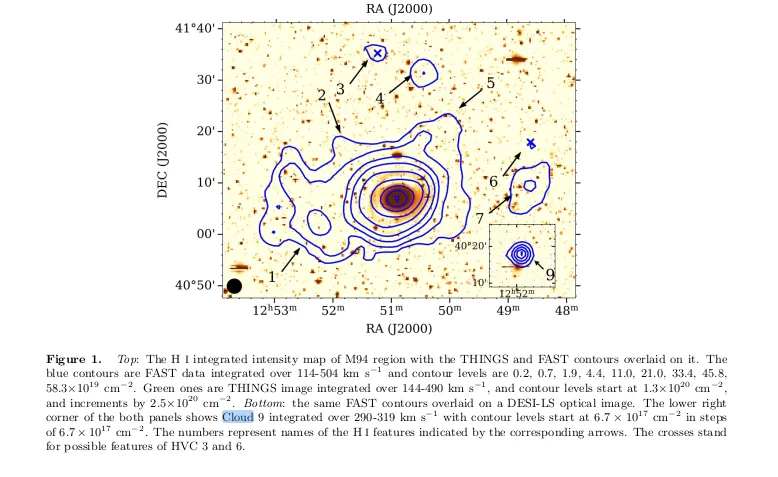
But the origin appears in Zhou's seminal work. In the region there are other clouds near M94, as seen in this figure which functions as a map of the clouds in the area.
Ah... those were the days when astronomy was studying the stars...☉
Sources and related links
- A Long, Hard Look at (Potentially) Nothing to See
https://aasnova.org/2025/04/29/a-long-hard-look-at-potentially-nothing-to-see/ - Alejandro Benitez-Llambay and Julio F. Navarro 2023 ApJ 956 1
DOI 10.3847/1538-4357/acf767
https://iopscience.iop.org/article/10.3847/1538-4357/acf767 - Alejandro Benítez-Llambay et al 2024 ApJ 973 61
DOI 10.3847/1538-4357/ad65d9
https://iopscience.iop.org/article/10.3847/1538-4357/ad65d9 - AAS Journal Author Series: Alejandro Benitez-Llambay and Julio Navarro on 2023ApJ...956....1B
https://www.youtube.com/watch?v=0sXFh6e_K6I&ab_channel=AAS - FAST reveals new evidence for M94 as a merger
Ruilei Zhou et al
https://arxiv.org/abs/2306.05080 - Microgalaxias: una galaxia con 60 estrellas
https://www.noticiasdelcosmos.com/2023/12/microgalaxias-una-galaxia-con-60.html - Cloud 9
https://en.m.wikipedia.org/wiki/Cloud-9_%28RELHIC%29
About the images
Alejandro Benitez-Llambay et al. /Youtube screenshot.