A speed problem that is often answered incorrectly. Why? It contains a singularity.
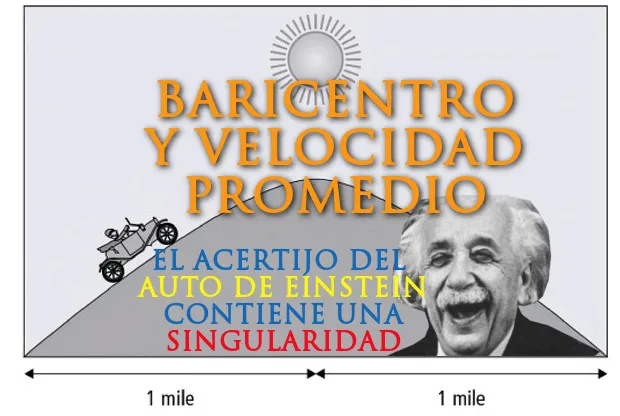
On some websites and a YouTube channel, they talk about the "Einstein's Car Riddle". They quote from the book Risk Savvy: How to Make Good Decisions by Gerd Gigerenzer, a supposed problem that was sent to the German physicist. I have not verified if that is true, but it is not important, as the problem is interesting anyway.
The problem is presented in different ways, considering it is formulated in English, with other units of measurement. It goes like this:
A car goes up a hill for 1 km, at 15 km/h. Then it must go down the hill for another 1 km stretch. At what speed should it cover the second stretch, if the final average speed is 30 km/h?
Hint: the answer is not 45 km/h.
What we will do here is see:
1-Why do we give that answer, which is incorrect?
2-A way to think about the average in relation to the barycenter.
3-We will apply point 2 to other practice problems.
4-We will apply point 2 to the original problem and solve it arithmetically.
1-WHY DO WE ANSWER THIS RIDDLE WRONG?
Probably, what we do when thinking about the problem is to find the average from the data offered in the statement:
15+x=Average 30. Since we calculate the arithmetic average by adding the values and dividing by the quantity, and since there are two km (or two stretches), then we think: 15+45=60/2=30.
But that works in some cases. The problem here is what we are dividing by, what we are "weighing". That's why it can be useful to think of the average based on the concept of barycenter used in astronomy.
2-BARYCENTER
It is the common center of mass between objects. One way to think about it is like this:
We take a broomstick (or a ruler). Where should we place our finger underneath, so that the ruler or stick stays balanced?
Since the stick or ruler is homogeneous, then, in the middle. That way, there is the same amount of matter (mass) on each side of the finger.
Thus, our finger is "halfway" between the extreme values.
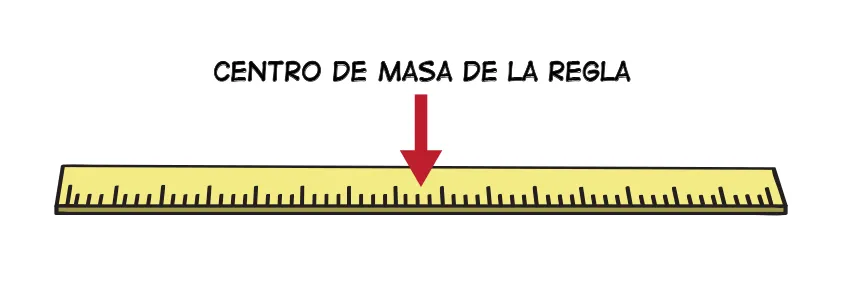
But that doesn't always work that way. If we want to do the same with the whole broom or a hammer, we must place our finger not "in the middle", but closer to where there is more mass.
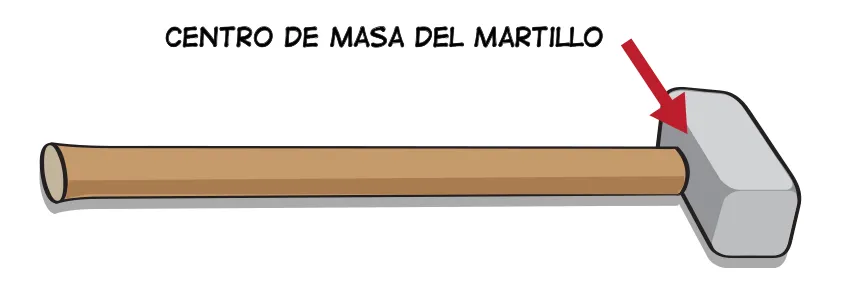
The same happens with the average. Let's see a couple of examples:
Example 1:
Ten students take a Geography exam. Half get a 4, the others, a 10.
If we use the intuitive ruler method, we put the extreme values on each side, the 4 and the 10. Since the number of students is the same, we must place the finger in the middle between both values. That "middle value", the barycenter of the grades, is 7, since it is 3 units from 4 and 3 units from 10.
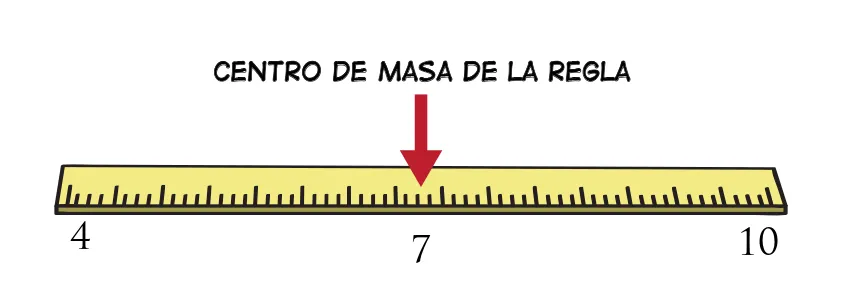
Example 2:
One hundred students take a Mathematics exam. One gets a 4, the others, a 10.
Let's think intuitively:
We put the values on the ruler, the 4 and the 10. But now we know that those with a 4 are only one and those with a 10 are 99. There is "more weight" on one side than the other. Intuitively we know that we should not place the finger "in the middle", but much closer to the value 10, since that's where the greater weight is.
If we do the math, the average is 9.94, far from the "middle value" of 7.
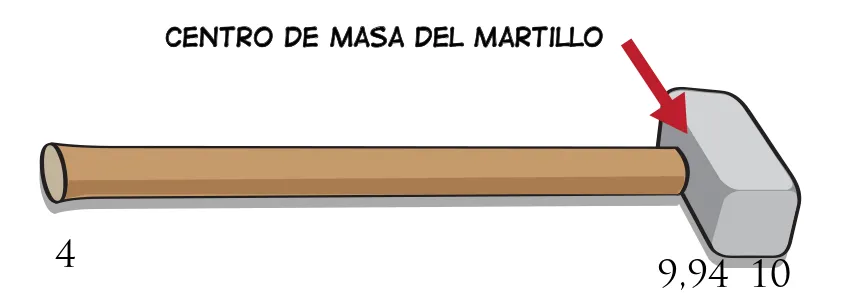
3-BARYCENTER AND AVERAGE SPEED
With average speed exercises, we must be careful about what we are weighing. The analogy of a scale is often used to consider the barycenter, similar to the example of the ruler or broomstick.
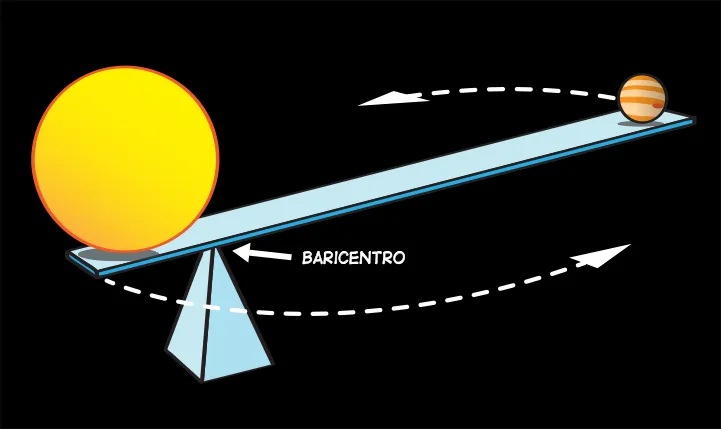
Let's see what we "balance" when evaluating speed, with an example similar to the original, with slight differences.
A car travels 50 km at 50 km/h.
Then it moves another stretch of equal length, but at 100 km/h.
What is the average speed at the end?
If we move the same distance at different speeds, what will change from one stretch to another is TIME. That is what we must consider.
In the first stretch the car needs 1 hour to travel. In the second, 0.5 hours (since it's the same distance at double the speed).
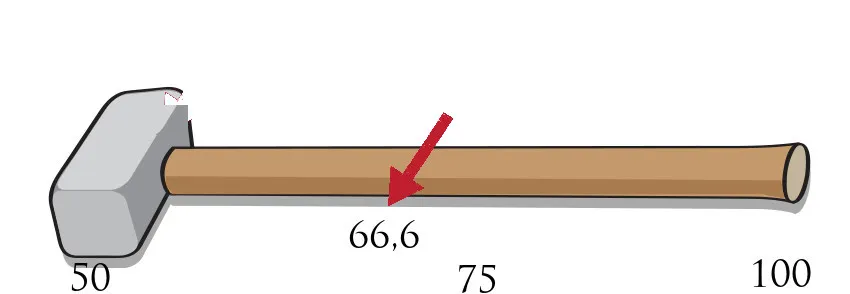
On our ruler we put the two speed values: 50 and 100. But we know we spent twice as much time in the first stretch as in the second. There is greater "mass" on the 50 part of the ruler than on the 100 part. We cannot place the finger "in the middle" (which would be 75), but it will be closer to 50 than to 100.
To calculate it with arithmetic:
V= d/t, where V is speed, d is distance, t is time.
d=100 km (the sum of both stretches).
t=1.5 hours (the sum of both times)
V=100/1.5=66.6 km/h.
To know we have done things right we can verify that, if we had done the entire journey at the same average speed, we should take the same amount of time.
That is, if v=66.6 and d=100km, t=d/v; t=100 km/66.6 km/h; t=1.5 h.
Let's apply this knowledge to solve the original problem.
4-EINSTEIN'S CAR
From the first stretch we know distance and speed, so we can calculate time.
If v=d/t, then t=d/v.
t=1 km/15 km/h t=1/15 h and since there are 60 minutes in an hour, 60/15=4 minutes.
Therefore, in the first stretch we take 4 minutes to travel 1 km at 15 km/h.
In the second stretch we must also travel 1 km. We do not know the speed or the time.
But we do know the final average speed and the total distance, so we can calculate the total time.
t=d/v t=2 km (sum of the stretches) / 30 km/h (the average speed)
t=2/30.
But, wait! 2/30=1/15, they are equivalent fractions.
That means to cover the entire distance at 30 km/h we must take 4 minutes.
But we already used the 4 minutes for the first stretch!
That implies that for the second stretch, the time must be 0. And it is obvious that it is impossible.
To finish the arithmetic:
Total time - time stretch 1 = time stretch 2
4 minutes - 4 minutes = 0 minutes
For the second stretch we now know distance and time, we can calculate speed:
v=d/t v=2 km/0
But you cannot divide by zero!
In the analogy of the ruler or the broomstick, it's as if to make it balance we had to put our finger not in the middle, but at a single point where all the mass is. It's a singularity!☉
Sources and related links
This simple math problem almost fooled Einstein: can you solve it?
https://www.elconfidencial.com/alma-corazon-vida/2020-03-12/problema-matematico-engana-einstein_2491919/
About the images
What is a barycenter?
https://spaceplace.nasa.gov/barycenter/sp/
Screenshot from Risk Savvy: How to Make Good Decisions, by Gerd Gigerenzer