What are those Little Red Dots, LRDs?
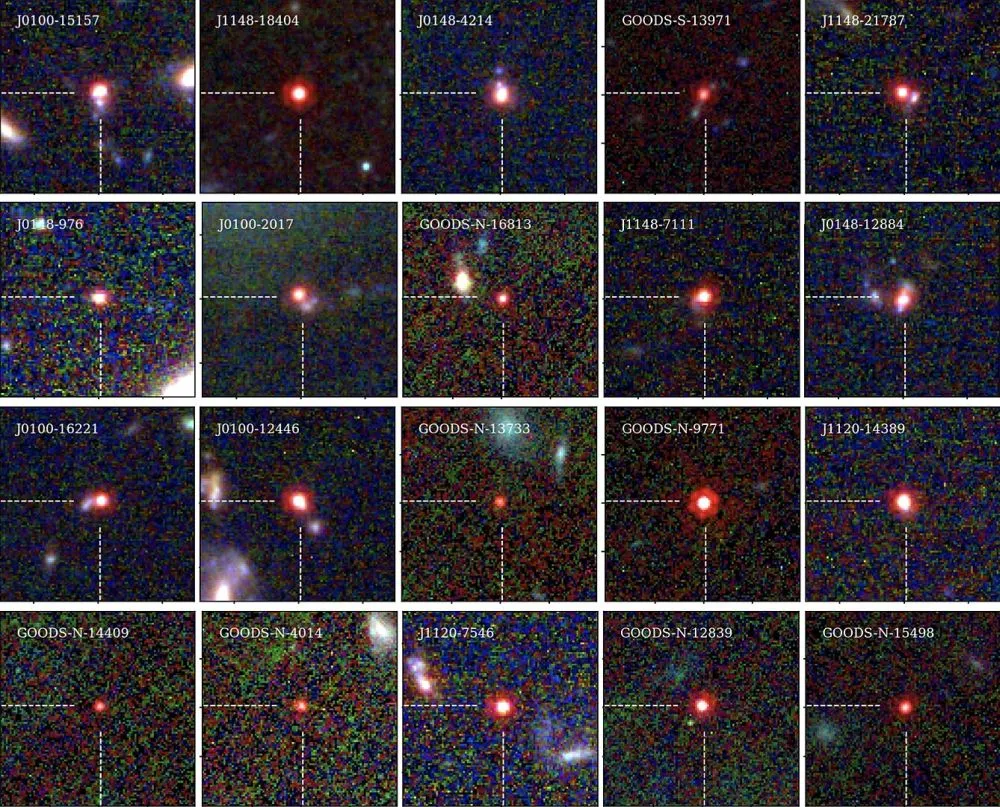
After the launch of the James Webb Space Telescope, astronomers began to collect new data, some of it surprising. Among them are the Little Red Dots (Little Red Dots). What are they?
So far, the evidence leads scientists to think they are galaxies with very luminous black holes or compact galaxies with a very high number of old stars. More than 300 are counted, with radii of no more than 500 light-years or smaller. They seem to have existed in the early universe, emerging about 600 million years after the Big Bang and disappearing 1,500 million years ago. They are not seen in the nearby universe.
Despite their size, they are very luminous. Some calculations indicate that 100 billion stars are required to reach their luminosity. That is, approximately, the same number of stars as the Milky Way, but concentrated in one hundredth of the size.
The presence of supermassive black holes could explain those extreme luminosities. Most galaxies have a black hole in their centers. One investigation found that 70% of the sample showed evidence of gas rotating rapidly, a sign of a possible black hole.
However, the supermassive black holes seen in the nearby universe have masses of 0.1% of the galaxies they belong to. In some LRDs, however, the estimated masses can climb to 10% up to 50% of their galaxies. The black holes that energize AGN (active galactic nuclei) emit light in ultraviolet and X-rays, while LRDs do not.
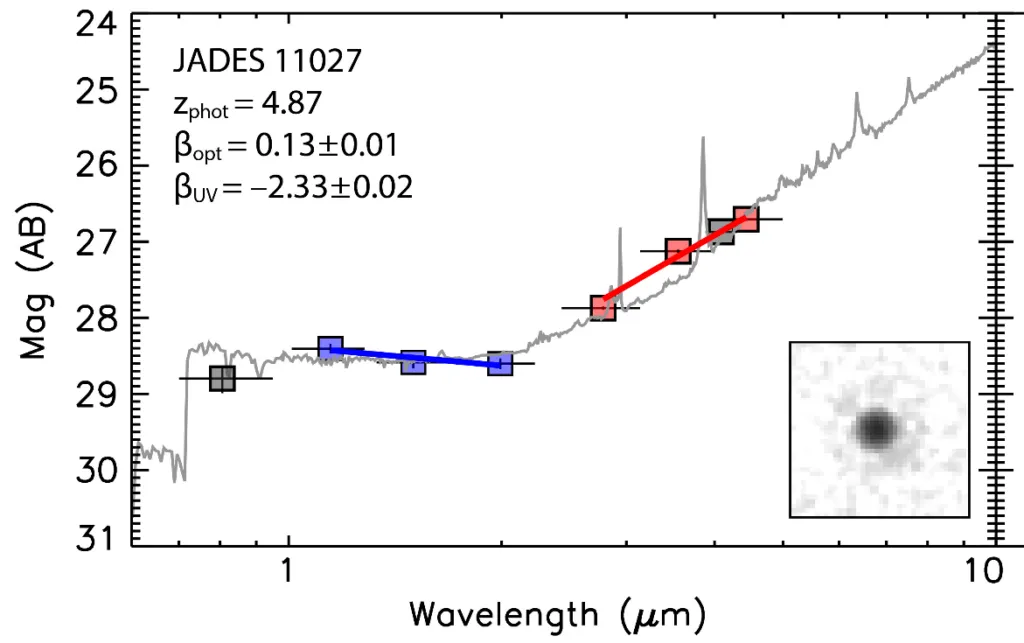
In a recent work, with a sample of 341 LRDs, using the NIRCam instrument, spectroscopy was performed and they saw a "V" shape: In optical wavelengths, the slope increases towards higher wavelengths, and in the UV, the slope increases towards lower wavelengths.
One suggested possibility is that LRDs are surrounded by dust that absorbs energetic photons, making them appear reddish. Another suggestion is that they could be supermassive black holes surrounded by very dense and turbulent gas.
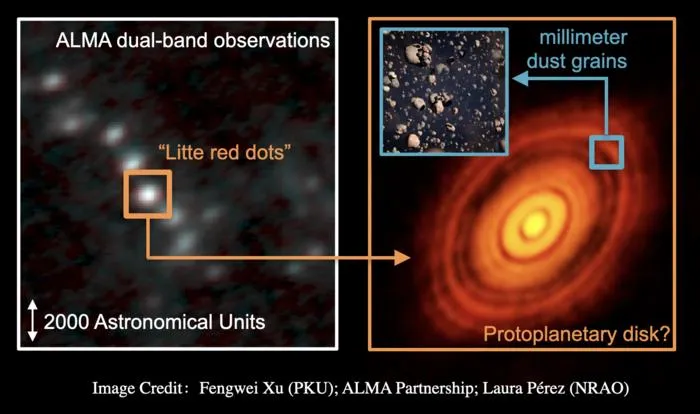
It must be said that some LRDs are indeed found in the local or nearby universe: they appear to be protoplanetary disks and have different characteristics from the "true" LRDs.
More research is needed to find a "cure" for this cosmic measles, but it seems that LRDs point to a stage in galactic evolution during the early universe.☉
Sources and related links
- The freckled universe
https://www.symmetrymagazine.org/article/the-freckled-universe?language_content_entity=und - The Deepening Mystery Around the JWST's Early Galaxies
https://www.universetoday.com/articles/the-deepening-mystery-around-the-jwsts-early-galaxies - There are Planets Forming in the Center of the Milky Way
https://www.universetoday.com/articles/there-are-planets-forming-in-the-center-of-the-milky-way - What’s growing inside out and red all over? Little Red Dots!
https://astrobites.org/2024/04/30/template-post-24/ - A population of red candidate massive galaxies ~600 Myr after the Big Bang
https://www.nature.com/articles/s41586-023-05786-2 - Newfound Galaxy Class May Indicate Early Black Hole Growth, Webb Finds
https://science.nasa.gov/missions/webb/newfound-galaxy-class-may-indicate-early-black-hole-growth-webb-finds/ - Little Red Dots: An Abundant Population of Faint Active Galactic Nuclei at z ∼ 5 Revealed by the EIGER and FRESCO JWST Surveys
https://iopscience.iop.org/article/10.3847/1538-4357/ad2345 - The Rise of Faint, Red AGN at z>4: A Sample of Little Red Dots in the JWST Extragalactic Legacy Fields
https://arxiv.org/abs/2404.03576
Kocevski, D. D., Finkelstein, S. L., Barro, G., et al.
About the images
Credit: Jorryt Matthee et al 2024 ApJ 963 129
Kocevski, D. D., Finkelstein, S. L., Barro, G., et al.