Unlike people, the solar future is written in the stars.
A few years ago, after an astronomy lecture, I heard two people wondering how astronomers managed to know "all that." They were referring to data like the distance, size, mass, and age of stars. Perhaps in the immediate future I will dedicate myself to writing four posts to explain, in a basic way, how to calculate those values.
However, knowing the future is another thing. What astronomers do is not very different from what biologists do. We know what newborn lions will be like because we know what larger lions are like. There's no need to wait for the same lion to grow up to know what it's like, but rather to study other specimens of the same species, at different periods of their life.
Stars do not have biological life; they are inert objects. "Stellar life" is actually the period of equilibrium between gravity -which causes thermonuclear fusion- and radiative pressure -through which stars shine. When the elements to fuse in the core run out, the equilibrium is lost and gravity wins.
In June of this year, the data from the third round of Gaia's publication (DR3) were released. The probe takes very precise data of the stars. From data like their apparent brightness and color, astronomers can make other calculations. This task was undertaken by Orlagh Creevey, from the Observatoire de la Côte d'Azur, France, and her colleagues.
A BIT OF HISTORY
At the end of the 19th century, from the Harvard Observatory, astronomers focused their efforts on classifying the appearance of spectral lines. They are dark lines that appear in the rainbow of colors produced when a star's light is split as it passes through a prism. Annie Jump Cannon devised a spectral classification sequence that ordered stars according to the strength of those lines. That order was related to the temperature of the stars. Antonia Maury made another classification based on the width of certain lines. Later it was found that this was related to the luminosity and age of a star.
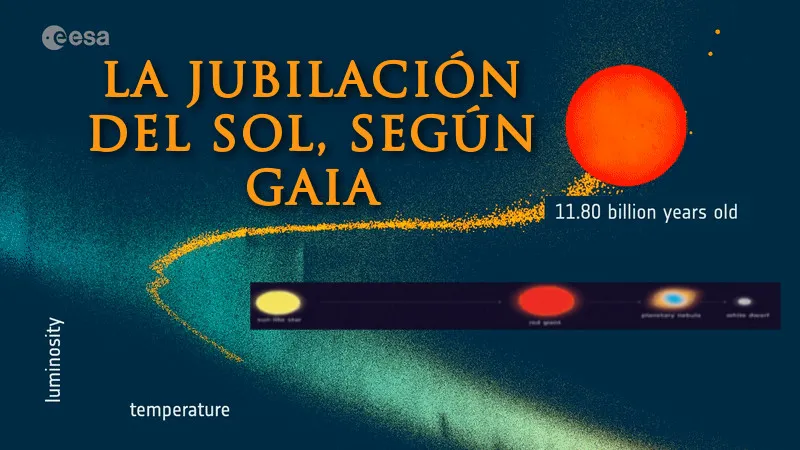
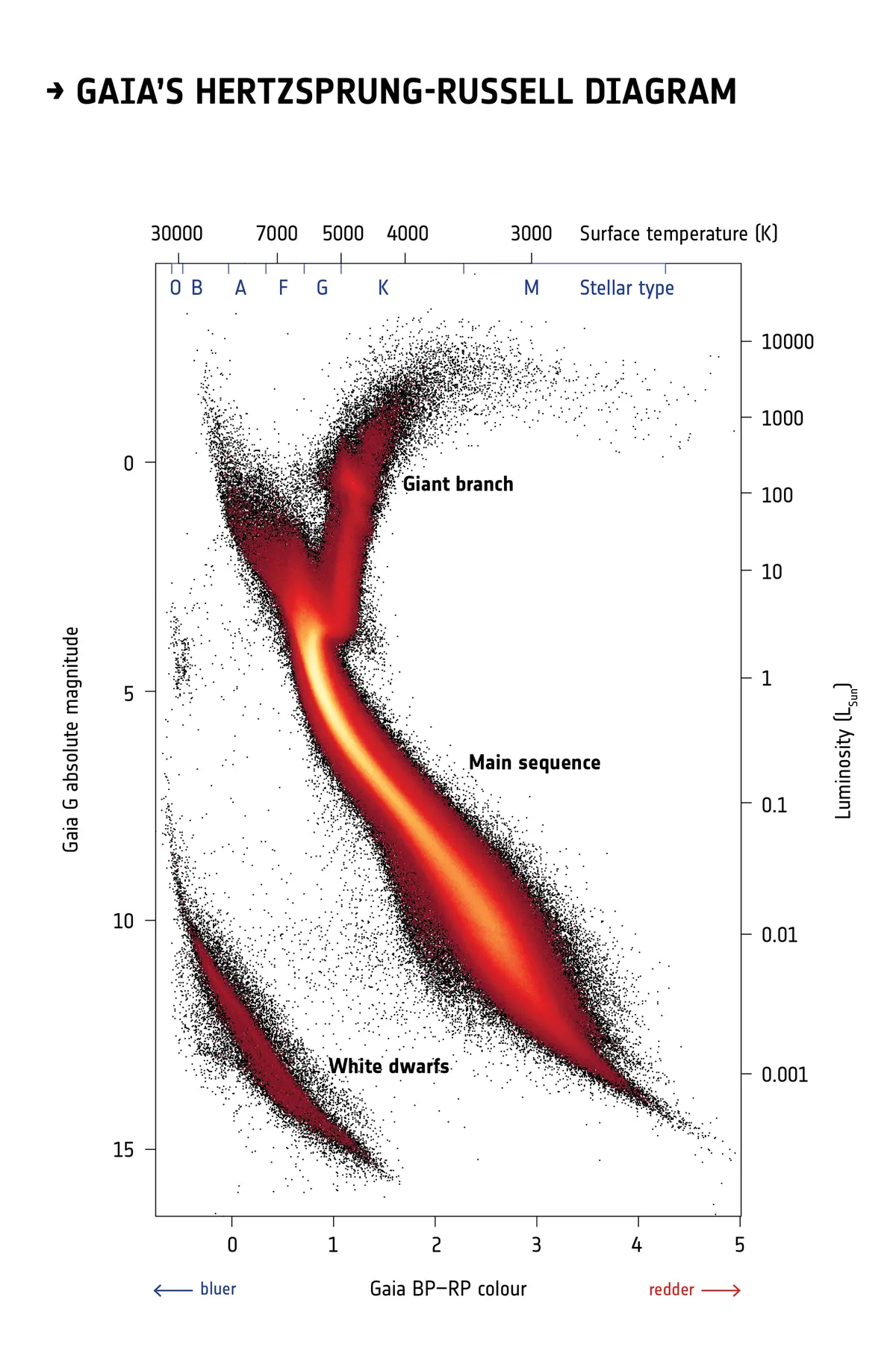
The correlation of these properties allows for making diagrams, known as HR, since they were independently developed by Ejnar Hertzsprung and Henry Norris Russell. These diagrams illustrate with data the luminosity of the stars against the effective temperature.
THE FUTURE OF THE SUN
With an age of 4.57 billion years, our Sun is in the middle of its cycle, fusing hydrogen into helium with stability. That will not last forever. When the hydrogen runs out in the core, it will swell up to become a red giant, lowering the temperature in the process. But how it happens depends on how much mass the star has and its chemical composition. This is where DR3 comes in.
Orlagh and colleagues looked for stars with temperatures between 3000K and 10,000K because they are the stars that live the longest in the galaxy and are promising for searching for exoplanets because they are more similar to the Sun, whose surface temperature is 6000K.
Then they filtered the sample to keep only those with the same mass and composition as the Sun, though with different ages. Thus, the resulting stars show the evolution of a star like our Sun in an HR diagram.
From this work it is clear that the Sun will reach its maximum temperature at 8 billion years of age, then it will cool and grow in size, becoming a red giant at 10-11 billion years. The end of the cycle will be after that phase when it becomes a white dwarf, a compact and dense object.
Many other things remain to be known, but they can continue to be investigated with the same sample: Do all Sun-like systems have planetary systems? Do they rotate at the same speed?
STELLAR RETIREMENT
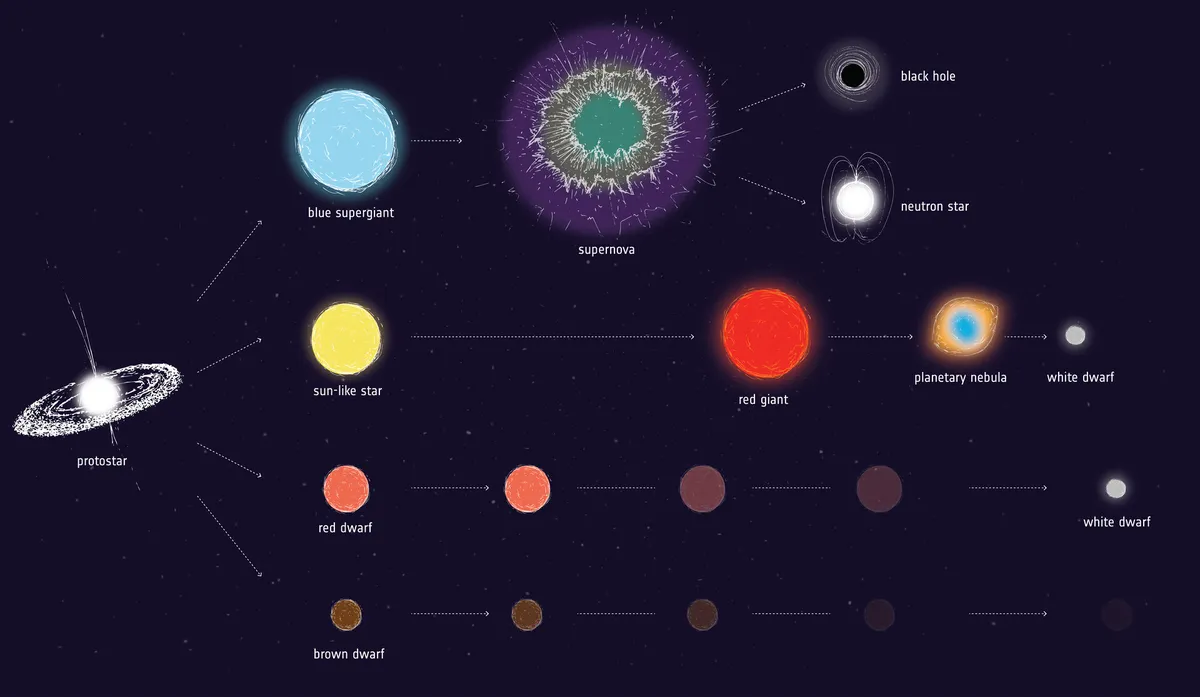
The pension system of the stars is diverse: the most massive stars end up collapsing to form black holes and neutron stars. Stars like the Sun, of spectral type G2, inflate into red giants, expel their outer layers into the interstellar medium, and a white dwarf remains as a remnant, after the planetary nebula process. This type of post-stellar object possesses less than 1.4 Solar Masses (Chandrasekhar limit). But its destiny is uncertain: white dwarfs are compact and dense objects, very low in luminosity and hot. Over time they cool down, but they could last as long as protons and become a black dwarf, wandering through space indefinitely, like a lifetime pension.
A close reference is Sirius. The brightest star in the night sky is a binary system, with one of its components -Sirius B- as a white dwarf. It has almost the same mass as the Sun, but with a size like that of Earth.
However, the Sun's remnant could approach another star and steal material from it, increasing its mass until it explodes as a Type Ia supernova. This would be a privileged retirement, bright and powerful, although the detonation would totally destroy the star.
As Roberto Juarroz says: "Each one leaves as they can (...) But everyone leaves with their feet tied, some by the path they made, others by the one they didn't make and all by the one they never will make".☉
Sources and related links
- They predict the death of the Sun by observing hundreds of millions of stars
https://www.europapress.es/ciencia/astronomia/noticia-predicen-muerte-sol-observando-cientos-millones-estrellas-20220811134317.html - Gaia reveals the past and future of the Sun
https://www.esa.int/Science_Exploration/Space_Science/Gaia/Gaia_reveals_the_past_and_future_of_the_Sun - Segunda poesía vertical -69- (1963), Roberto Juarroz
https://www.paginadepoesia.com.ar/clas_ar_juarroz.html#1963
About the images
Credit: ESA