We have traveled two orbital radii around the Sun since January 1. Congratulations!
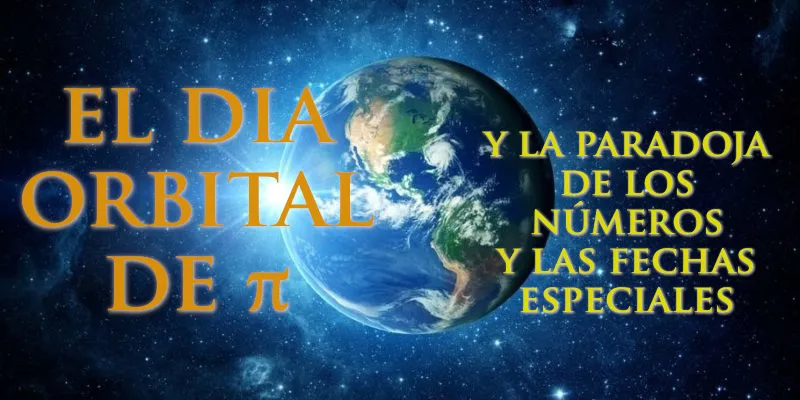
We have commented before on the Copernican Principle by which Earth is not thought of as a special place. It has also been called the Principle of Mediocrity. Applied to the Universe, it is called the Cosmological Principle, a foundational stone of the Theory of Relativity. It implies that in the Universe there is no "special" place, but that it is homogeneous and isotropic.
However, our Galaxy is special because we are here. And there are other galaxies that are special because they are very small, or very large, or the most distant or those that possess a brighter quasar or the one with the highest level of star formation. So there are interesting galaxies and others that are... boring.
However, of all the boring ones, one will be the smallest and for that reason it becomes interesting, for being the smallest of the boring ones. But then, it will no longer be boring. And the smallest of the boring ones will be another. Which for that reason will leave that category to become interesting. And so on until there are no boring galaxies left and they are all interesting. But watch out: there will then be countless galaxies that will be interesting for being all of them the smallest of the boring ones that... do not exist.
The Paradox of the mediocre Universe is like the Paradox of Interesting Numbers. If there are interesting numbers and non-interesting numbers, we could make the same reasoning and arrive at the same contradiction.
The Paradox is easily resolved: all numbers are interesting or none are. However, mathematicians do not agree. March 14 or July 22 arrives and Pi Day is celebrated, considered a "special number".
Orbital PI
Pi is the ratio between the length of a circumference and its diameter. A radian is the unit of measurement of an angle with its vertex at the center of a circle whose sides are cut by the arc of the circumference, and also that arc has a length equal to that of the radius.
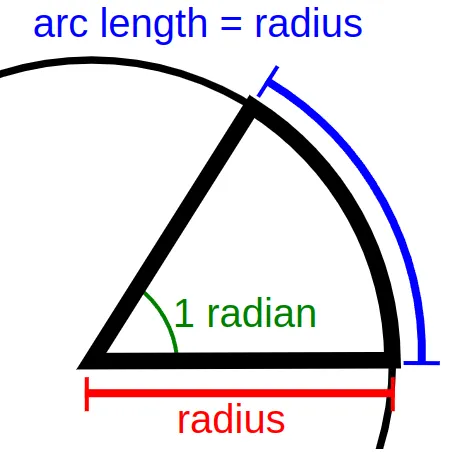
To measure the perimeter of a circle we do 2Pi * radius. That is, in the length of the circumference we can put 6.28 times the radius. That's why, 2Pi radians equals 360º and one radian is ~57º (360/6.28).
If in a circle we travel a length of two radii, then the length of that arc over the total length must be Pi.
If l is an arc equal to two radii and L is the length:
l=2r; L= 2Pi*r, then L/l=Pi.
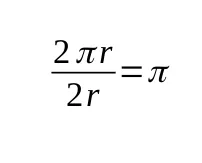
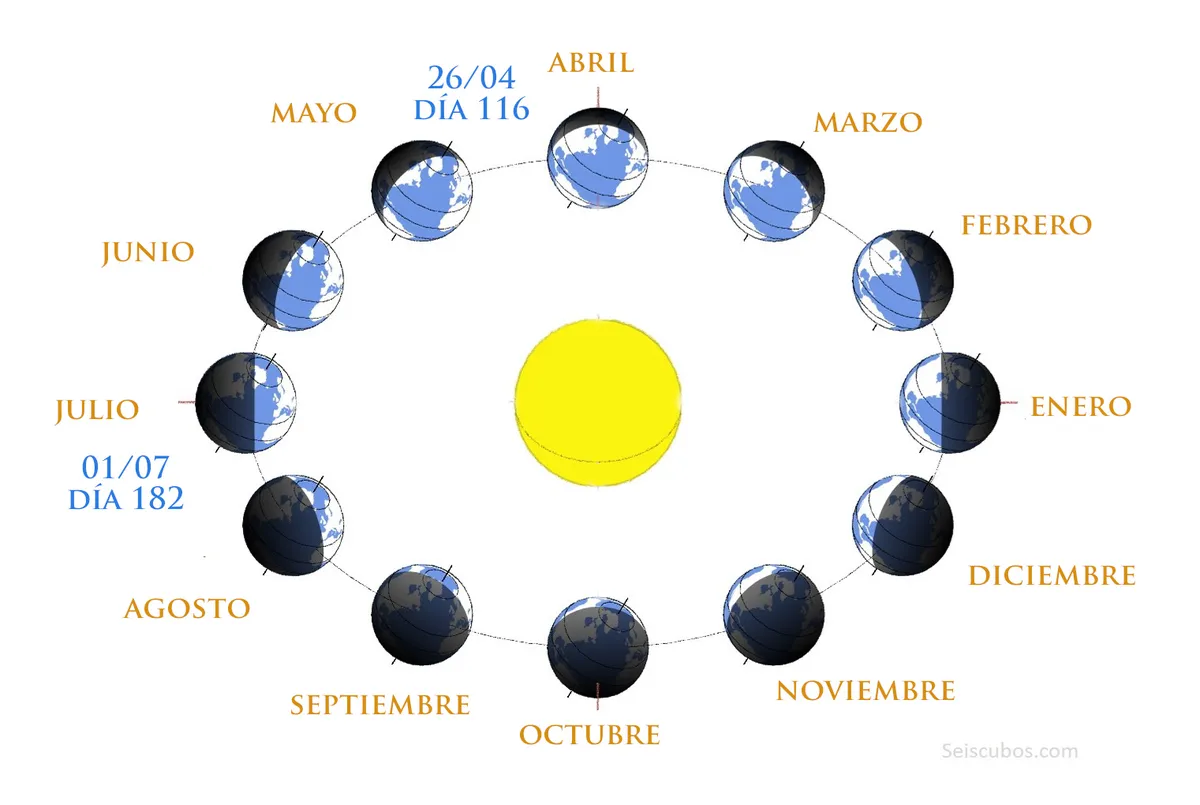
If Earth's orbit were a circle, then, by traveling a radius of length we would have one radian. Two radians, and we would have Pi as the ratio between that arc and the complete length.
If the complete perimeter around the Sun lasts 365 days, then by traveling a length equal to one radius (an Astronomical Unit) must be 365/6.28=58 days. Therefore two radii are 58*2=116 days. April 26 is the 116th day of the year. The similarity between angles and days is that in the year there are 365 days and in the circle, 360 degrees.
GIVE ME MY CALCULATIONS
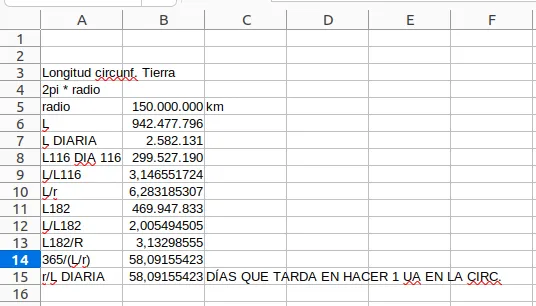
We can find orbital Pi:
Let's say Earth's orbit were a circle and therefore it moves at constant speed. The radius (R) will be 150 million km. The perimeter (L) will be 2PI*R=942,477,000 KM.
If we divide that length (L) by 365 it gives=2,582,000 km. What Earth travels per day (Ldaily).
In 116 days it travels LDAILY*116=299,527,000 km, which we will say is the length traveled on day 116 (L116).
Then, L/L116=3.14. Congratulations, friends!
Variant
Earlier we said that Earth travels one radius of length in its orbit in 58 days. 58*3.14=182.
On day 182, Ldaily*182=469,947,000 km (L182) will have been traveled.
If we do L182/R=3.14. The 182nd day of the year is July 1.
Mark it down: another nerd holiday!
Of course, we can do this with other calendars that do not have 365 days each defined by Earth's rotation. Or we could do the same for each planet: one rotation is a day, a year is the total of rotations along the orbit. Do that with Venus and you'll see it's fun.
We can find PI almost wherever we want. Measure your height. Then measure the length between your ankle and your knee. Divide the first by the second. If it's close to PI, but not quite, do the same, but measure the length from your heel to your knee. You can measure to the base of the knee or to the top, as it suits you. In this way, we find PI as well as the golden ratio, wherever we fancy. It's a method used by obscure gamblers, some mystical mathematicians, and nerds with a sense of humor.
There you have Pi, a special number. To form it, all the other natural numbers are needed which -by transition- must be special too. But, wait: Pi is a normal number.
By Bourbaki's beard!: then it cannot be special...
All numbers are special, like all dates. But some are a little more special, would say a pig that doesn't want to share the pigsty, what a pig!☉
Sources and related links
- The Numbers Paradox from Wikipedia
https://www.youtube.com/watch?v=vVVrSabJIVs - Epoch converter
https://espanol.epochconverter.com/dias/2023