In recent days, a work involving Argentine astronomers was announced in which they calculated the mass of a star in the Milky Way. But... how do astronomers "weigh" stars?
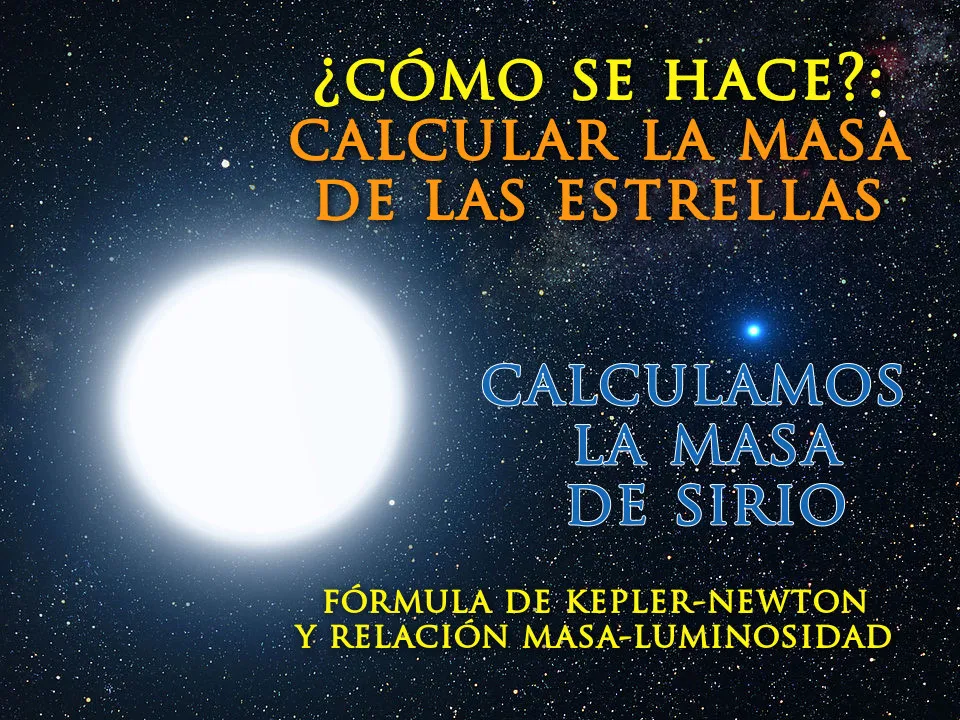
We will see next a "textbook" example, that is, a simplification that aims to give an idea of how it's done, although in professional reality, it is more difficult.
For this purpose, I will use the book "Astronomy", by OpenStax, originally written by Andrew Franknoi, David Morrison and Sidney C. Wolff, available in English under a Creative Commons license.
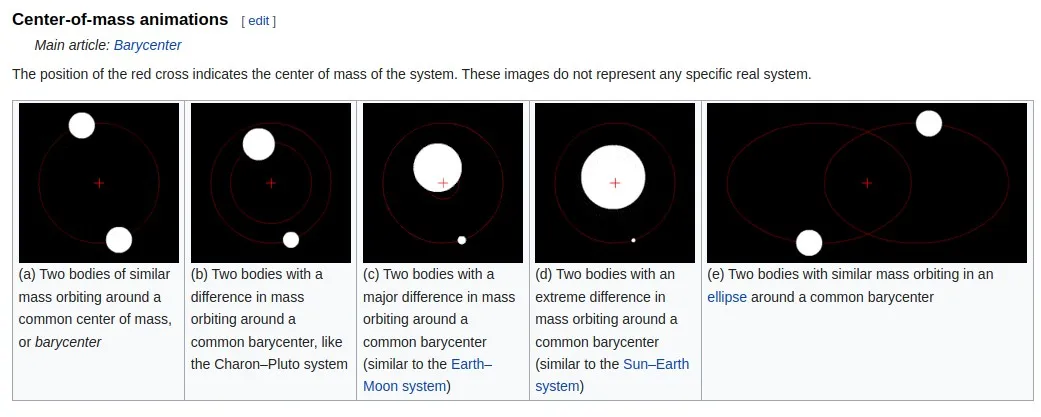
In this case, we will see how to calculate the masses of a binary system, which are very common. A binary system is a pair of stars that orbit around a common center of mass or barycenter. It can occur in different ways, depending on the mass of each component.
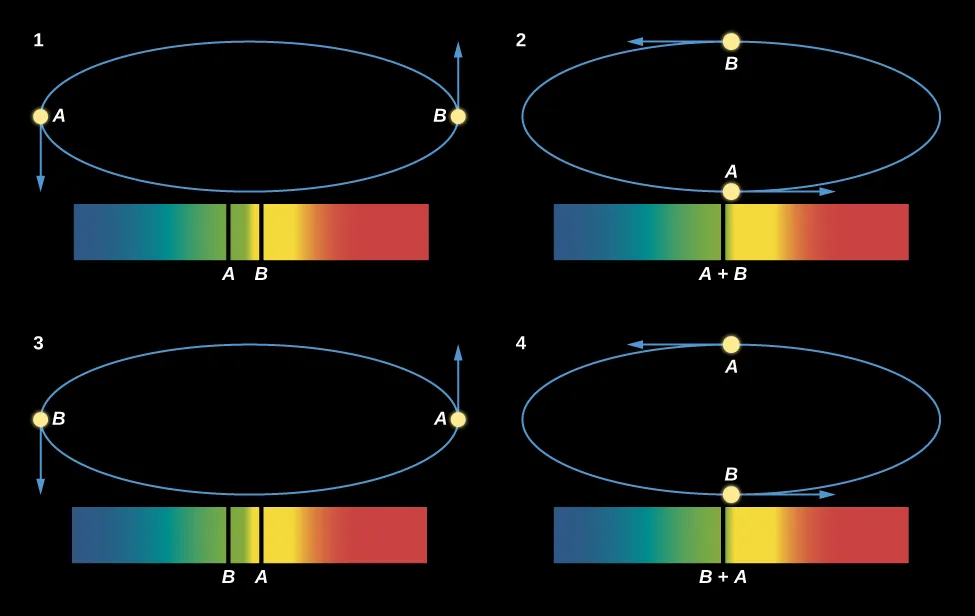
Astronomers, when pointing telescopes, pass the light through a spectrograph to obtain light spectra, by passing it through a prism and dividing the radiation into different energies or wavelengths. When a star moves away from the observer, the absorption lines are redshifted, and when it approaches, blueshifted. If the system is viewed "edge-on", that is, perpendicular to the motion, the lines add up, as shown in the following figure.
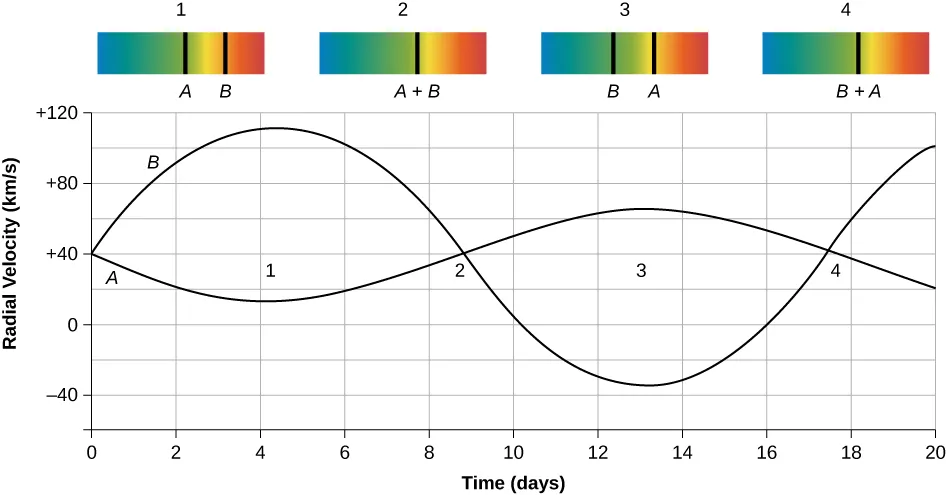
With this data, a radial velocity curve can be made. The curve graphs the radial velocities of two stars in a spectroscopic binary system, showing how the stars alternately approach and recede from Earth. Note that positive velocity implies the star is moving away from us relative to the center of mass, in this case at 40 km/s. Negative velocity implies the star is moving towards us. The positions on the curve corresponding to the previous illustration are marked with numbers (1-4).
THE KEPLER-NEWTON THIRD LAW
The mass of a binary system can be estimated using Newton's reformulation of Kepler's Third Law. The Polish astronomer found that the time a planet takes to revolve around the Sun is relative to its distance. In our binary situation, if two objects are in mutual revolution, then their period (P) is relative to the semi-major axis (D) of the orbit of one component relative to the other, according to this equation:
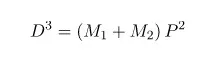
where D is in astronomical units, P is in years and M1+M2 is the sum of the masses of the two stars in solar mass units.
The Mass of the Sirius System
Sirius, the brightest star, is a binary. The one we see with the naked eye and another component located at 20 AU, with a period of 50 years.
We can put that data into our formula:
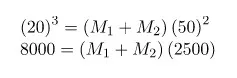
Then we solve to find the sum of masses:
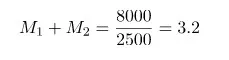
Thus, the sum of the masses of the two stars in the Sirius system is 3.2 times the mass of the Sun.
THE MASS-LUMINOSITY RELATION
In general, the more massive a star is, the more luminous it is also. This relation can be graphed like this:
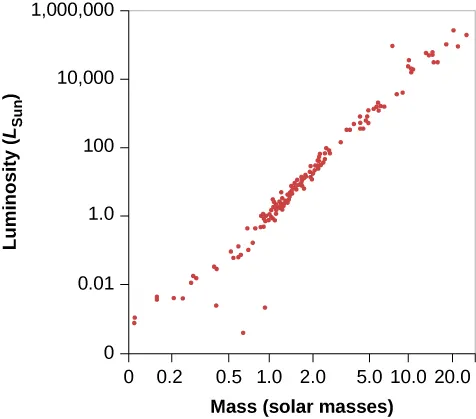
where the horizontal axis is in solar masses and the vertical axis in solar luminosity.
In mathematical terms:
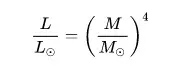
It is a good approximation to say that the luminosity (expressed in solar units) varies as the fourth power of its mass (in solar mass units, ms).
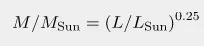
If we take the fourth root of both sides (or raise to 0.25, which is the same), we get:
THE MASS OF SIRIUS
In the previous post we talked about Sirius, a binary that has a component as a white dwarf, with the same mass as the Sun, but the diameter of Earth; while the other star is a main sequence star.
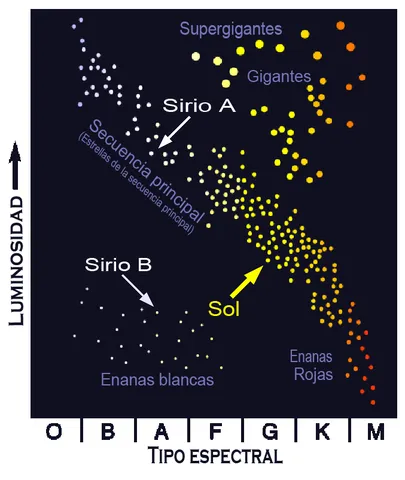
Let's calculate its mass with the mass-luminosity relation.
If we know that the luminosity of Sirius is 23 L☉, then:
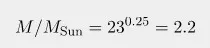
The mass of Sirius is 2.2 times the mass of the Sun. We knew before that the sum of masses was 3.2 ms, so the other component of the system must have a mass of 1.0 solar masses.
WARNING
We said at the beginning that this post has didactic purposes, and that it presents the calculation in a simplified form. Many things would need to be clarified, but the most important is that the Mass-Luminosity relation is not always obeyed, but it is a good approximation because the majority (90%) do obey it.
In upcoming posts we will continue this series How it's done: distance, size and age of stars.☉
Sources and related links
Astronomers from Argentina managed to measure the mass of one of the most massive stars in the Milky Way https://www.conicet.gov.ar/astronomos-y-astronomas-de-argentina-lograron-medir-la-masa-de-una-de-las-estrellas-mas-masivas-de-la-via-lactea/
Bibliographic reference:
Barbá, R. H., Gamen, R. C., Martin-Ravelo, P., Arias, J. I., &Morrell, N. I. (2021). Thewinkingeyeof a heftystar. WR 21a revealed as a verymassiveeclipsingbinaryby TESS. arXivpreprint arXiv:2109.06311. DOI: https://doi.org/10.48550/arXiv.2109.06311
"Astronomy", by OpenStax https://pressbooks.online.ucf.edu/astronomybc/
Mass–luminosity relation https://en.wikipedia.org/wiki/Mass%E2%80%93luminosity_relation
About the images
By NASA, ESA and G. Bacon (STScI) - http://www.spacetelescope.org/images/heic0516b/, Public Domain, https://commons.wikimedia.org/w/index.php?curid=477456
By HRD_Sonne_Sirius.png: User:Omnidoom 999derivative work: Rexmania (talk) - HRD_Sonne_Sirius.png, CC BY-SA 3.0, https://commons.wikimedia.org/w/index.php?curid=13367474