If hypervelocity stars are ejected by a gravitational interaction, does that mean gravity can be repulsive?
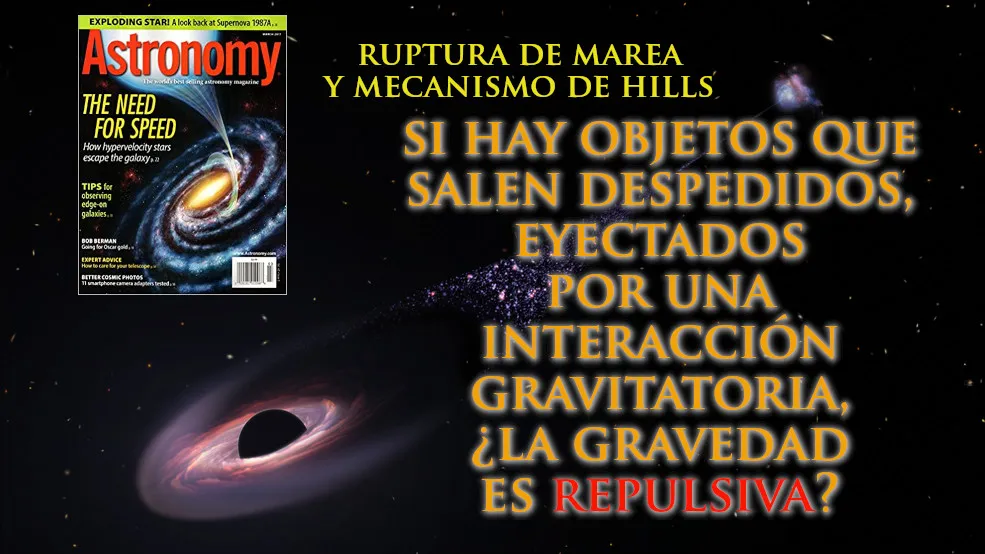
Every so often it's possible to read in the press about the discovery of hypervelocity stars, "on the run," expelled from their galaxies by a gravitational interaction. Recently, NASA published the possible finding of a trail of stars created by a black hole "ejected" at high speed by an encounter between black holes in a galaxy merger. Now it is said that it might not be a "trail of stars" created in that way, but a galaxy seen edge-on, without a central bulge.
These cases might lead one to think that as a consequence of a gravitational interaction, some objects are ejected, repelled. Does that mean gravity is repulsive?
Let's say, first of all, that an object (planet, star, black hole) could move at a higher speed without that meaning it "escapes" from its gravitational environment. For an object to break free from its environment it should accelerate to escape velocity.
That an object is "pushed" by another, in the opposite direction, can occur due to the generation of a shock wave between two bodies. That wave "sweeps" whatever is around.
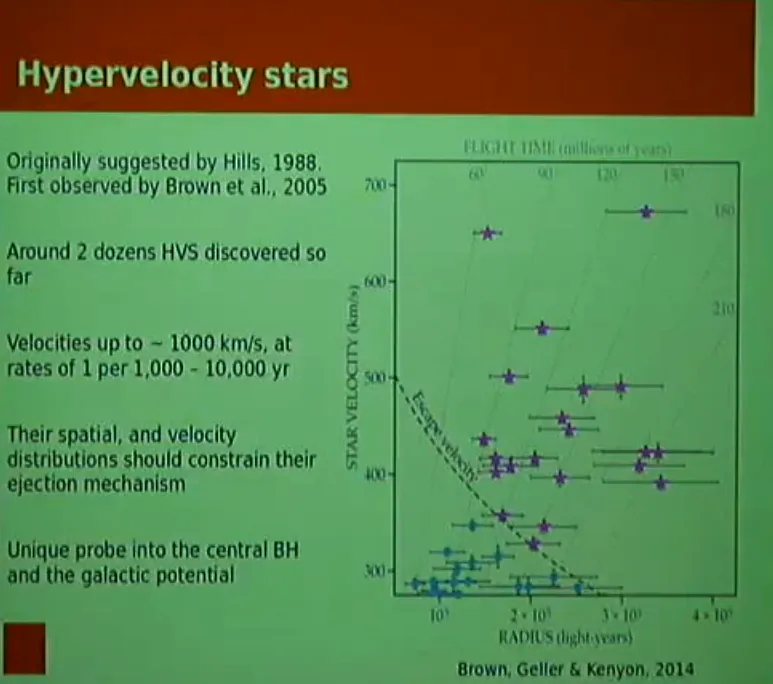
In the case of hypervelocity stars, there is a nice story: Jack G. Hills is an American astronomer (born in 1943) who in 1988 proposed a mechanism by which the central black hole of the Milky Way could accelerate nearby stars to high speeds. It is known as the "Hills Mechanism." In that work he made a calculation about a rate of hypervelocity stars that could exist in the vicinity of the galactic center, without arousing interest in the scientific community. Until in 2005 Warren R. Brown and others found hypervelocity stars in the galaxy's halo.
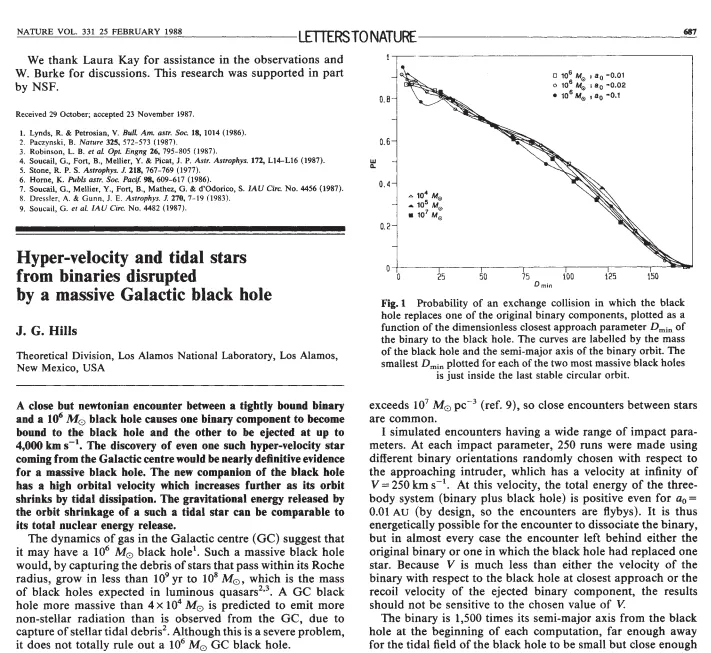
The Hills Mechanism is part of the "Three-body problem" and is a form of "tidal disruption." The tidal force is the difference an object experiences in its length due to the gravitational pull of another nearby body. The Moon exerts an attractive force on Earth more in one direction than another. That difference creates the tides.

To put it very simply: let's think of the game of tug of war. One person pulls on one side and another person on the other. If the rope breaks, what do you think will happen to both people? You already know.
Let's now say we add a third person on one side, pulling with greater force. This third person will bring the one nearby (the second) closer, who in turn will move away from the first, until the link between the first and the second breaks, resulting in the first being flung to one side and the second remaining linked to the third, on the opposite side.
In the case of hypervelocity stars, the mechanism involves a binary pair that approaches a supermassive black hole. Depending on the configuration, separation between components and distance to the black hole, one of the components can become bound to the compact object, while the other is flung away at escape velocity.
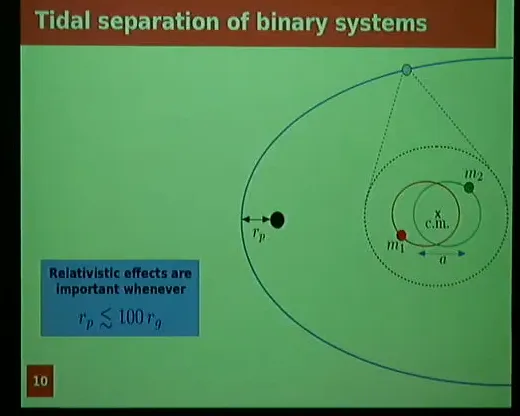
Does this mean we must answer the initial question positively? What we are saying is that the first object is "flung" to the opposite side, not because gravity is repulsive, but because the gravitational link is broken. And because Newton's three laws are true.
On YouTube there is a talk by Emilio Tejeda, from the Instituto de Astronomía UNAM, Mexico, on the topic of tidal disruption and the Hills mechanism in the S stars, those near the supermassive black hole at the center of the Milky Way. Highly recommended, see link below.
Other cases of ejection or scattering of bodies can occur in planetary systems. That raises the Grand Tack Hypothesis. In such cases, the concept of orbital resonance, which can amplify or perturb planetary orbits, must be taken into account.
So no, gravity is not repulsive, even if it seems so. It's good to remember the popular saying: "Two's company, three's a crowd... of calculations!"☉
Sources and related links
A possible case of the Hills mechanism.
https://paolera.wordpress.com/2023/02/16/un-posible-caso-de-mecanismo-de-hills/
Star Ejected by Supermassive Black Hole at Heart of Milky Way at Over 3.5 Million MPH [Video]
https://scitechdaily.com/galactic-heart-of-darkness-ejects-star-at-over-3-5-million-mph-video/
A star is expelled from our galaxy by a black hole https://blogthinkbig.com/una-estrella-expulsada-de-nuestra-galaxia-por-un-agujero-negro
Hyper-velocity and tidal stars from binaries disrupted by a massive Galactic black hole
Hills, J. G.
https://zenodo.org/record/1233107#.ZF_FWtKZOMA
Tidal breakup of binary stars at the Galactic Center. II. Hydrodynamic simulations https://arxiv.org/abs/1008.5369
Coloquio UNAM: Tidal breakup of binary stars by supermassive black holes https://www.youtube.com/watch?v=FWRDz61Yozs
A low mass for Mars from Jupiter’s early gas-driven migration
Kevin J. Walsh et al
Nature volume 475, pages206–209 (2011)
https://arxiv.org/abs/1201.5177
Tidal Disruption Events (TDEs)
https://www.transients.science/tidal-disruption-events
Discovery of an Unbound Hypervelocity Star in the Milky Way Halo
Warren R. Brown et al 2005 ApJ 622 L33 https://iopscience.iop.org/article/10.1086/429378
Hubble Sees Possible Runaway Black Hole Creating a Trail of Stars https://www.nasa.gov/feature/goddard/2023/hubble-sees-possible-runaway-black-hole-creating-a-trail-of-stars
Grand Tack Hypothesis https://es.wikipedia.org/wiki/Hip%C3%B3tesis_del_gran_viraje
About the images
NASA, ESA, Leah Hustak (STScI)
WikiHow
YouTube screenshots