With telescopes in Chile and the South Pole, CMB-S4 will study the fossil radiation with unprecedented sensitivity.
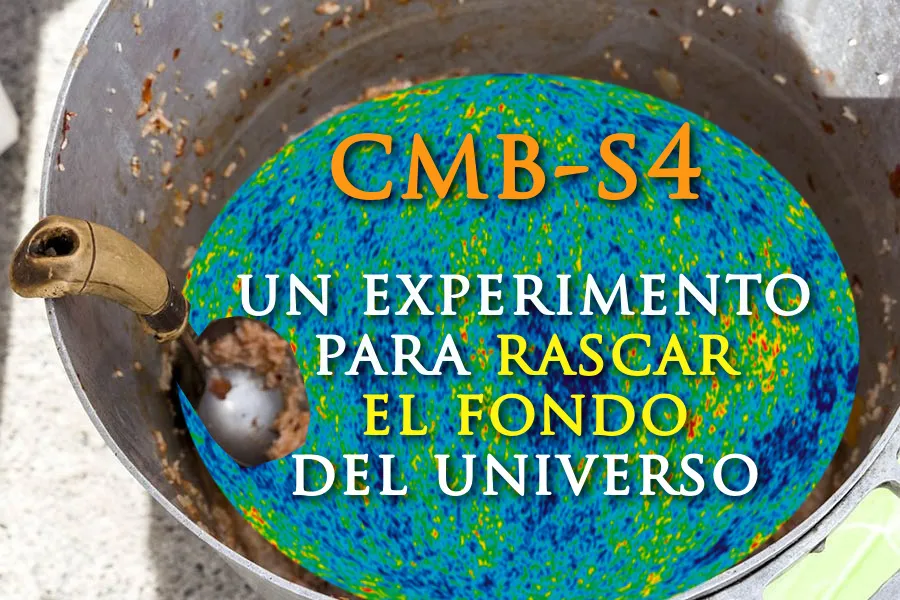
If we had to make a list of the most important discoveries in astronomy in human history, the discovery -somewhat fortuitous- of the Cosmic Microwave Background (CMB) is one of them.
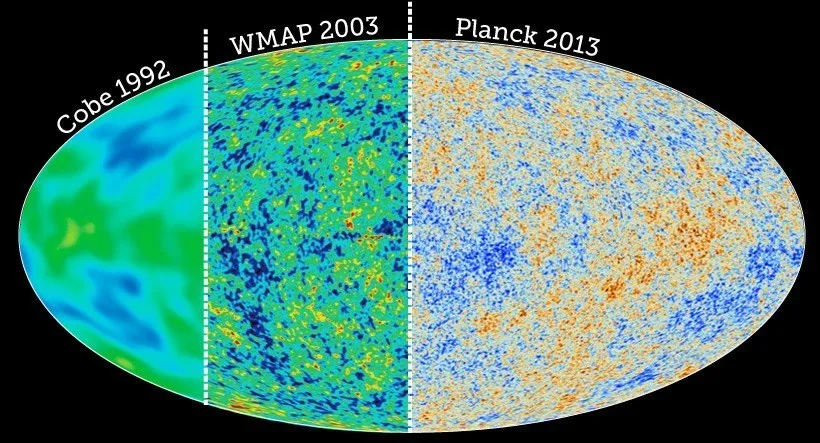
Since the mid-1960s when this relic of the early universe was discovered, it has been studied using instruments of increasing precision: the COBE, WMAP and Planck probes. Now a new stage opens with a combined experiment: Cosmic Microwave Background-Stage 4 (CMB-S4).
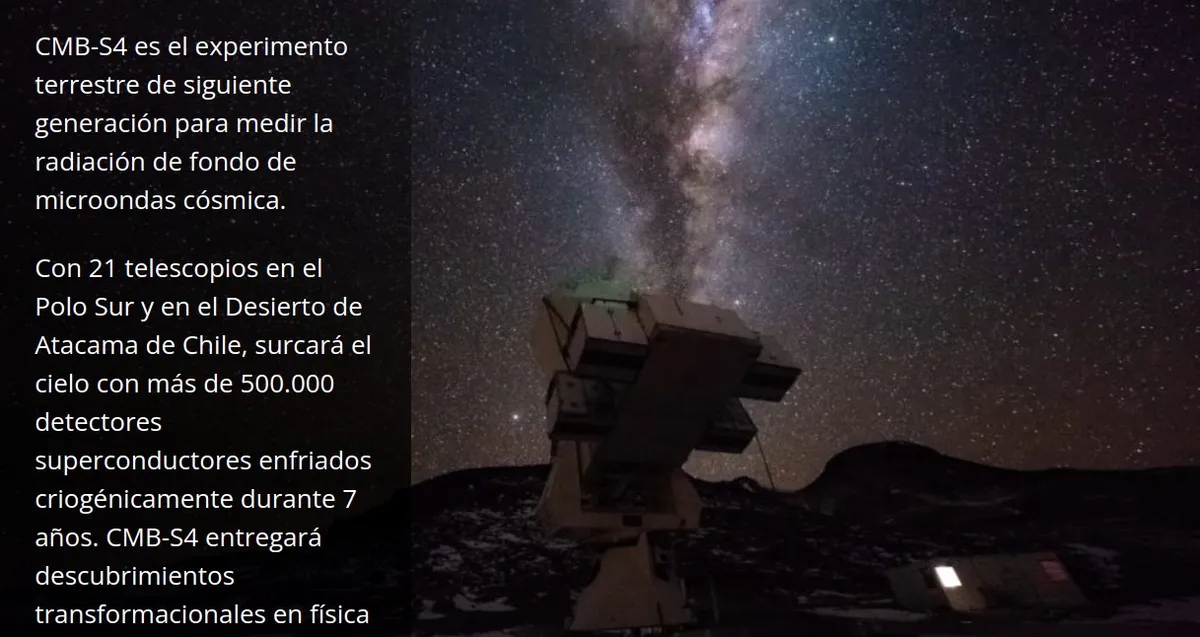
CMB-S4 is an ambitious project to use a set of telescopes in hot and arid Chile and in the frigid South Pole.
It is an international collaboration between 400 scientists from 121 institutions. One of its main goals is to find evidence of cosmic inflation hidden in the CMB.
The idea is to install a set of microwave telescopes in the Atacama Desert, in Chile, with the Simons Observatory, under construction; and at the South Pole Observatory, which already operates in Antarctica.
To meet the scientific objectives of CMB-S4, it will be necessary to look at the same sector of the sky for a long time and the South Pole is conveniently oriented for that. Plans are to host at least 9 small-aperture telescopes of 0.5 meters in diameter and one of 5 meters to conduct an ultra-deep survey of 3% of the sky.
Other objectives will require collecting data from a large area of the sky. For that, Chile is ideal. There, plans are to use two 6-meter telescopes to conduct a survey of 70% of the sky.
They will use hundreds of thousands of bolometers as detectors. "What makes these experiments sensitive is the number of detectors they have in the focal plane", said Kevin Huffenberger, a professor at Florida State University and spokesperson for CMB-S4.
On the CMB-S4 website it is explained -in Spanish- the technical configuration of the detectors: "The technology of the CMB-S4 detectors is based on a superconducting bolometer, a thermal detector that consists of an absorbing structure that is thermally isolated from its environment. In this configuration, photons absorbed by the structure heat the device and produce a signal. We use superconducting Transition Edge Sensors (TES) to measure these small changes in the bolometer's temperature. The CMB-S4 TES detectors will have an operating temperature of approximately 0.1 K, which gives them exceptional sensitivity".
With CMB-S4, baryon acoustic oscillations (BAO), primordial gravitational waves, dark matter and dark energy will be sought. CMB-S4 could also find a hypothetical ninth planet in the outer reaches of the solar system, if there is one out there. The thermal emission of known planets, dwarf planets and asteroids has been measured at these wavelengths, and since their orbits give them rapid and suitable motions, they can be easily distinguished from the extrasolar sky.
Why is it called "stage 4", "stage 4"?
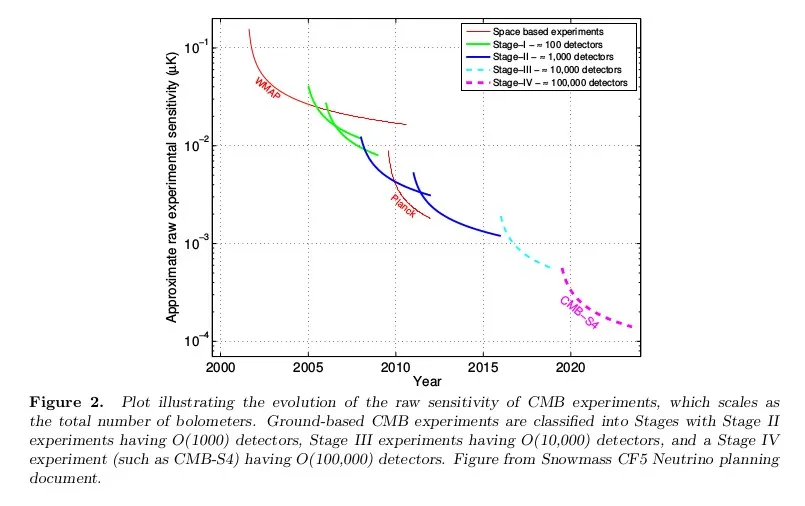
The instruments that have been used to investigate the background radiation can be classified as first stage or higher based on the number of detectors used. Scientists love to talk complicated, so they use a logarithmic scale and the Greek letter sigma to denote orders of magnitude.
In these graphs we see different stages and experiments-instruments used. Sensitivity is expressed in micro kelvin. The smaller the detectable temperature variations, the more sensitive the instrument.
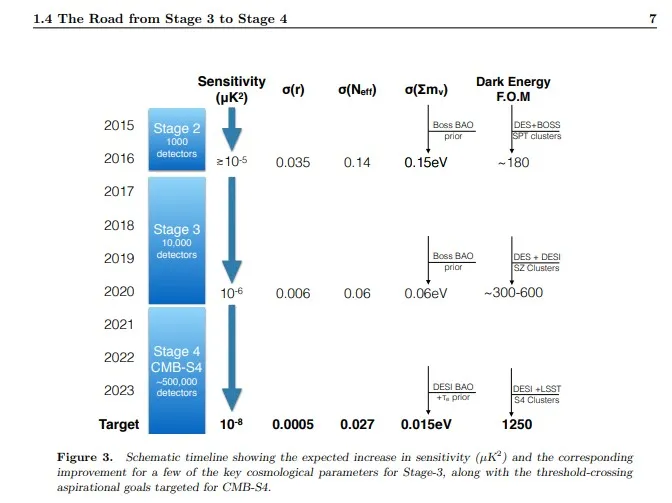
Orders of Magnitude and sensitivity
The order of magnitude of a number is the value to which the base is raised when a number is expressed in scientific notation.
In a recent note published on CulturaCientifica.com, mathematics professor Raúl Ibáñez proposes the following exercise. Let's think about the numbers one thousand million, also called one milliard (10^9) and one trillion (10^12).
Here we see a number line with zero and one trillion at its ends. Mark where the milliard (10^9) should go. It's about thinking in orders of magnitude: the milliard is THREE orders of magnitude smaller than the trillion.
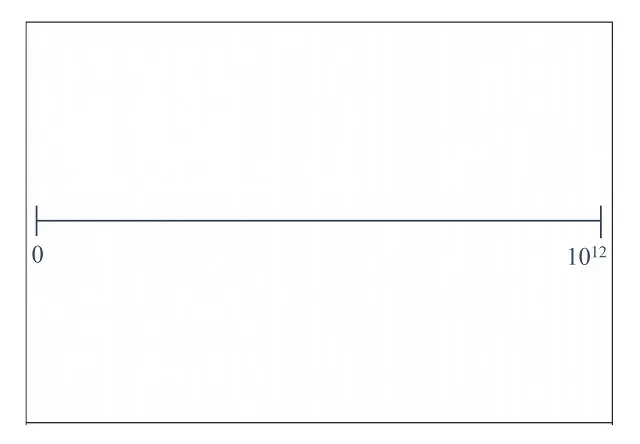
Let's see:
If we divide the segment into ten equal parts, then 10^12/10=10^11. That is, each segment will be 10^11, which is greater than 10^9. Now we divide each of those segments into another ten equal parts. Then, 10^11/10=10^10, which is still greater than the milliard. Only the tenth part of that is the value we are looking for.
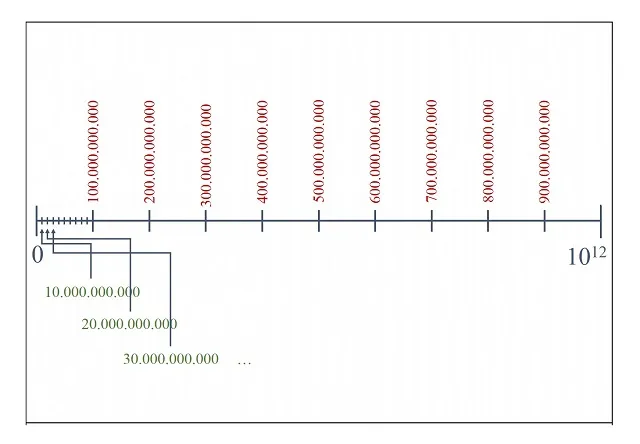
Appearances are deceiving. 10^9 may seem "close" to 10^12 because 9 is close to 12, but the exponential meaning is very different. Three orders of magnitude difference is an abyss. 10^9 is (999 times) closer to zero than to 10^12.
CMB-S4 aims to increase sensitivity by one order of magnitude, compared to stage 3 experiments, which were in turn an order of magnitude more precise than their predecessors.
It never ceases to amaze me to think that most of modern knowledge in astronomy was generated during the 20th century/late 19th century: stellar classification, galaxies, black holes, CMB, dark matter, dark energy, expansion, inflation, GRB, cosmic rays, FRB. If astronomy is one of the oldest sciences, the truth is that until the last century what was known was 1% of almost nothing. We are privileged to live in times of so much scientific revolution in astronomy, even if it doesn't seem like it. And we are far from the satiety of knowledge.
Analyzing the Cosmic Microwave Background is scratching the bottom of the Universe in search of the leftovers of the primitive Cosmos to feed our astronomical curiosity.☉
Sources and related links
- The next stage of cosmic microwave background research
https://www.symmetrymagazine.org/article/the-next-stage-of-cosmic-microwave-background-research - The Simons Observatory
https://simonsobservatory.org/ - CMB-S4
https://cmb-s4.org/es/cmb-s4/ - CMB-S4 Science Book, First Edition
https://arxiv.org/abs/1610.02743
About the images
Current experiments SPT and BICEP observing at the South Pole.
Image credit: Geoffrey Chen/NSF
A short walk through large numbers, by Raúl Ibáñez https://culturacientifica.com/2022/11/16/un-pequeno-paseo-por-los-grandes-numeros/