A guide to understanding the scientific work.
I once read a supposed anecdote attributed to Albert Einstein: they say a journalist asked him if he could explain his Theory of Relativity without using mathematics. To which the physicist would have replied: If you can explain to me how to fry an egg without me knowing what an egg, a frying pan, oil, and fire are...
In summary: to understand complex things, you first have to know others. So there are two options regarding the news that circulated this past week about a quantum simulation of a wormhole: we resign ourselves to understanding nothing, or we make an attempt to approach what was done, even if we don't understand it in detail. We will try to explain the egg, the oil, and the frying pan. Here, a guide for the adventure.
Einstein's papers
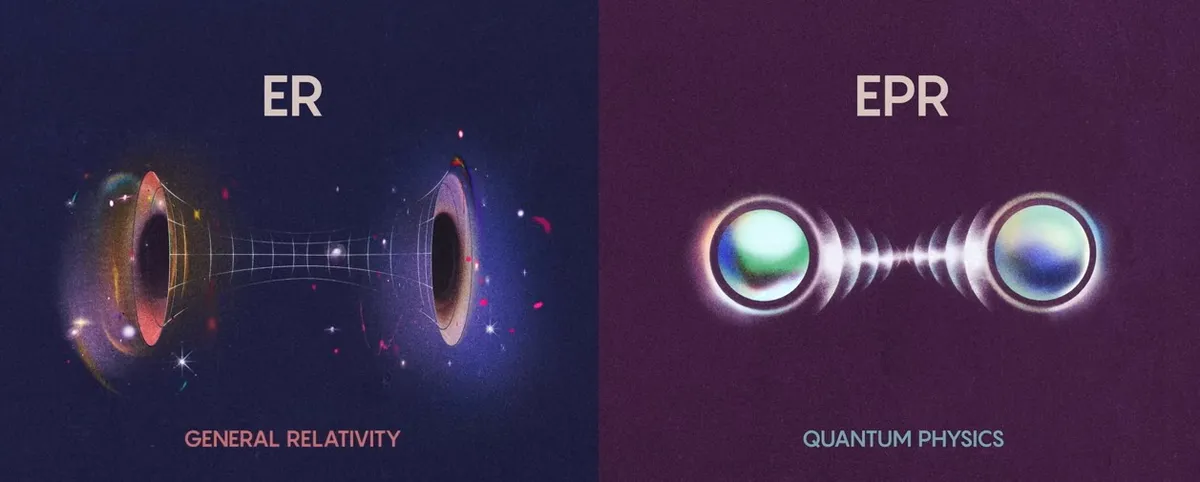
In 1935, two papers known as the ER and EPR works were published. The first, by Einstein and Rosen; the second, by Einstein, Podolsky and Rosen. In the first, the physicists considered the possibility that wormholes exist when trying to extend the Theory of Relativity. For that, they used what had been done before by Karl Schwarzschild when thinking that mass can attract itself gravitationally to the point of concentrating so much at a point that it distorts space-time, creating "bridges" in the space-time fabric.
In the other paper, they focused on quantum entanglement and "spooky action at a distance." According to quantum rules, particles can have multiple states simultaneously. Between two entangled particles, a state is shared, so that when the state of one particle changes, the state of the other particle also changes, regardless of the distance between them, instantly.
In the 1990s, quantum entanglement was proposed as a new possible form of computation. Entangling qubits, units of information that can have state 0 or state 1, would allow the combination of both states: 00, 01, 10, and 11. Three qubits make eight simultaneous possibilities and so on: the power of a quantum computer would grow exponentially. In recent years, some prototypes of quantum computers have materialized. One of them is Google's 54-qubit Sycamore machine.
THE HOLOGRAPHIC PRINCIPLE
The idea of space-time as a hologram dates from the 1980s. John Wheeler had coined the term "wormhole." Gerard 't Hooft thought of the universe as a hologram and the idea was elaborated by Leonard Susskind in a 1994 paper. A hologram is a three-dimensional image that emerges from a two-dimensional reality. Could the universe be a hologram? According to Susskind, a volume of curved space-time is equivalent to a system of quantum particles from a region of one less dimension.
By the Holographic Principle, the information inside a black hole could be encoded on its two-dimensional surface, instead of in its three-dimensional volume. Susskind and Hooft extended that notion to the entire universe: our 3D universe is a hologram that emerges from a 2D "source code."
The idea was taken up by the Argentine Juan Maldacena and his famous AdS/CFT correspondence. The universe appears to be a "de Sitter" space, named after astronomer Willem de Sitter. A "de Sitter" universe is always growing in a spherical shape pushed outward by its own positive energy. In contrast, an "anti de Sitter" (AdS) space is driven by negative energy, giving space a hyperbolic geometry: objects shrink as they move away from the center, becoming infinitesimal at the outer boundary.
Maldacena showed that space and gravity in an AdS universe correspond to the properties of a system known as Conformal Field Theory (CFT).
The Argentine physicist also noted something regarding black holes: when studying a particular entanglement between two sets of particles, where each particle in one set is entangled with one in the other set, he saw that this was equivalent to two black holes in an AdS space whose interiors are connected through a wormhole.
Later, he would glimpse a more general correspondence: ER=EPR. That is, that there would be a relationship between the two phenomena studied by Einstein and his colleagues, those two papers we cited at the beginning.
Together with Susskind they elaborated the idea that the bridges between black holes of ER are created by EPR correlations between microstates of the two black holes and that this duality could be more general: any EPR-correlated system would be connected by an ER bridge.
Daniel Jafferis enters this story. He is one of the co-authors of the work we are trying to explain. What he stubbornly set out to investigate mathematically since he learned of the ER-EPR correspondence is that wormholes can be traversed. Einstein-Rosen bridges are not very functional for science fiction: they collapse under their own gravity very quickly.
Jafferis, Ping Gao, and Aron Wall published a work in 2016 on quantum teleportation. It is the idea of using entangled particles in a wormhole.
The SYK model. It is a model created by Subir Sachdev and Jinwu Ye, to whom Alexei Kitaev was later added. The latter was the one who contributed the research that the SY model was holographic and since then it has been called the SYK model, after the initials of its authors.
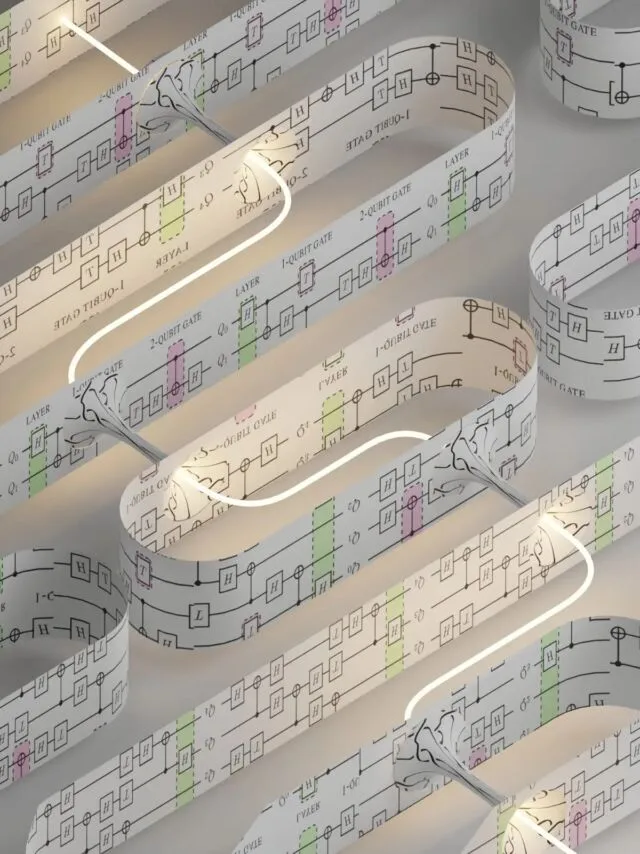
A PAUSE TO REVIEW
What we have here is a mathematical development, restricted by the rules of quantum and relativity, rules that are bent somewhat as necessary. With these games of equations, theoretical physicists have been trying since the beginning of the last century to find a way to unify gravity with quantum. The use of different numbers of dimensions has been a resource of String Theory and the Holographic Principle.
But all this is paper. Equations on screens. A mathematical abstraction. In the analogy I used at the beginning, according to Einstein, we have here the understanding of what the egg and the oil are. But we lack the frying pan. Quantum computers are our frying pan.
CONNECTING THE DOTS
In 2017, Juan Maldacena published a work in which he proposed that two related SYK models could encode what Jafferis was looking for, the traversable wormhole. In 2019 they developed a protocol to teleport information in qubits of an SYK system.
Maria Spiropulu invited Jafferis to her team of researchers who used quantum computers to do experiments in quantum gravity, with Google's Sycamore machine.
The SYK model involves sets of particles that interact in groups. The necessary quantity is such that doing the calculations is endless. They had to simplify the model to put it into practice on a computer that had to be programmed, our frying pan.
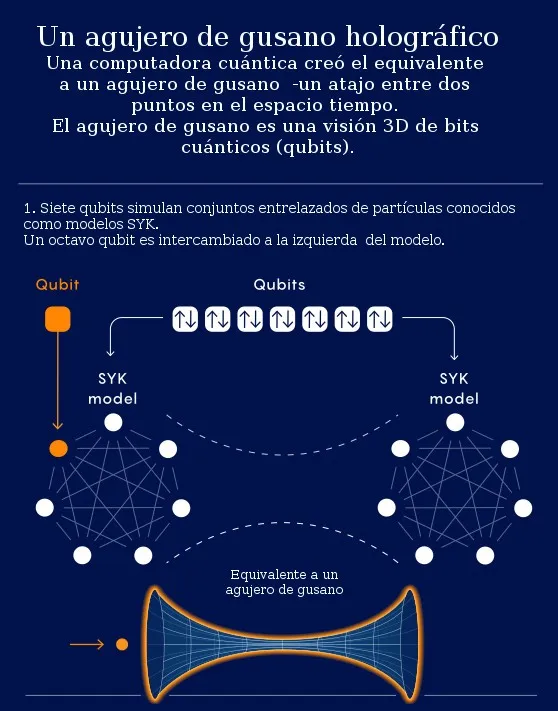
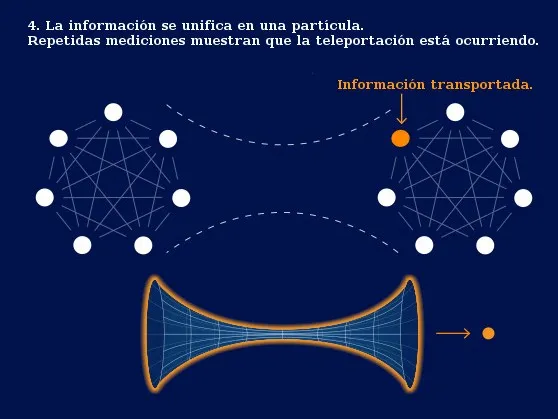
They use 7 qubits that encode 14 particles -seven in each of the SYK models- where each particle on one side is entangled with another on the other side. An eighth qubit, in some random combination of states 0 and 1, is exchanged for one of the particles.
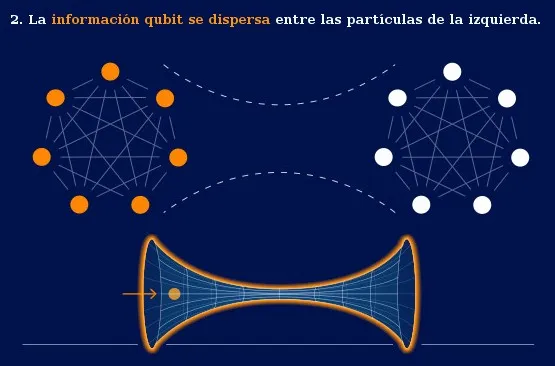
The information from the qubit disperses among the particles on one side. Then a magnetic pulse rotates the states of the qubits. That is like sending a negative shock wave through the wormhole.
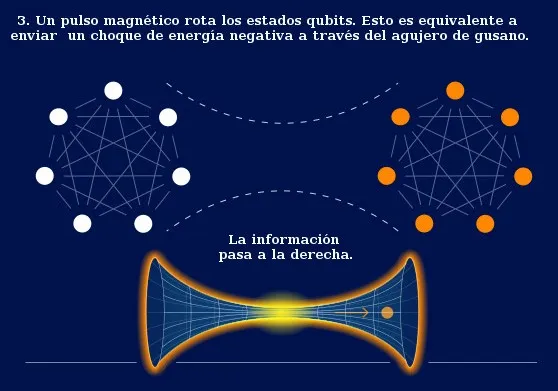
This makes the information travel to a single particle on the other side.
One way to understand it could be this: suppose we connect two computers, so that we can pass information from one to the other. But in each CPU we put some rigid conditions for information to be able to pass from one side to the other. Or, in the same machine we create two directories, with a series of rules to exchange data between one folder and another.
To know if it is possible to pass data from one side to the other, we will have to make a measurement in the folders/CPU. Depending on how those measurements turn out, we will conclude that information passed or did not pass.
But the model, the rules, have parameters. Many. Finding the right parameters for things to flow is a Jedi art. After much testing, the researchers finally found the signal, the measurement they were looking for, which indicates that information can be teleported from a qubit in one SYK model to another. That is the news.
AND WHAT DOES THIS HAVE TO DO WITH REALITY?
Can the AdS/CFT correspondence be applied? Cosmologists think, based on the information currently in their possession, that our universe is "de Sitter", not AdS. In recent decades, it is thought that if there is a correspondence with an AdS universe, there should also be one with a dS universe. Perhaps, but so far, theoretical physicists are sinking in this naval battle.
So no conclusions can be drawn from a 2D experiment in an AdS model regarding how it would be in reality in a 4D dS universe. But it is an approximation. Perhaps a pearl in a long, infinite chain of approximations needed to understand a little more how reality is. Sometimes, stranger than science fiction.
The quantum experiment will only be useful for publishing papers and doing cool experiments in quantum laboratories. Very excitingly nerdy. But it could be very useful for cinema: some of these ideas were already used in Star Trek: un nuevo comienzo (2009).
Does this mean you can travel faster than the speed of light? No, it does not mean that. "It is highly illogical," Mr. Spock would say.
I hope this basic guide to the news of the experiment has been useful to you. In the analogy at the beginning, we explained the egg, the oil, and the frying pan. We still need to know what the fire is. Perhaps in the coming decades a new Prometheus will arise. That is all. Live long and prosper.☉
The post is largely a translation -modified and adapted by me- of an article by Natalie Wolchover from Quanta Magazine, with data also from a note in Ars Technica.
Sources and related links
- Physicists Create a Holographic Wormhole Using a Quantum Computer
https://www.quantamagazine.org/physicists-create-a-wormhole-using-a-quantum-computer-20221130/ - No, physicists didn’t make a real wormhole. What they did was still pretty cool
https://arstechnica.com/science/2022/12/no-physicists-didnt-make-a-real-wormhole-what-they-did-was-still-pretty-cool/ - Traversable wormhole dynamics on a quantum processor
Daniel Jafferis et al
Nature volume 612, pages51–55 (2022)
https://www.nature.com/articles/s41586-022-05424-3 - They simulate a wormhole in a quantum computer
https://www.agenciasinc.es/Noticias/Simulan-un-agujero-de-gusano-en-un-ordenador-cuantico - The World as a Hologram
https://arxiv.org/abs/hep-th/9409089 - Traversable Wormholes via a Double Trace Deformation
Ping Gao, Daniel Louis Jafferis, Aron C. Wall
https://arxiv.org/abs/1608.05687 - A Traversable Wormhole Teleportation Protocol in the SYK Model
Ping Gao, Daniel Louis Jafferis
https://arxiv.org/abs/1911.07416 - Diving into traversable wormholes
Juan Maldacena, Douglas Stanford, Zhenbin Yang
https://arxiv.org/abs/1704.05333 - How Physicists Created a Holographic Wormhole in a Quantum Computer
https://www.youtube.com/watch?v=uOJCS1W1uzg&t=208s&ab_channel=QuantaMagazine - Einstein's anecdote
https://steemit.com/news/@jonathanxvi/einstein-s-anecdote
About the images
Graphic by Merrill Sherman/Quanta Magazine
Graphic by Andrew Mueller/INQNET/ARSTECHNICA