Why do astronomers say there are no green stars? Well, actually, all of them are (a little bit) the color of hope.
Green, how I want you green.
Under the gypsy moon, things are looking at her and she cannot look at them.
Federico García Lorca
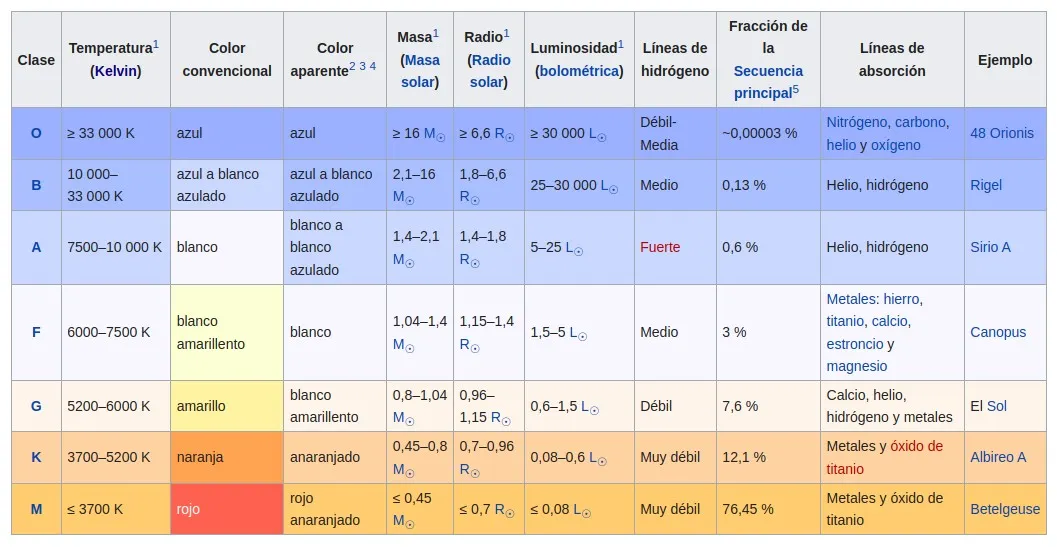
Astronomers use stellar classification systems. There is more than one. The Harvard one is among the best known: it establishes for each class of stars a range of temperature, color, mass, radius, luminosity.
There are O, B stars, which are blue; the A ones which are white-blue; the F ones are white; the G ones (like our Sun) which are white-yellow; the K, orange and the M, red.
Where are the green, sky-blue and pink ones?
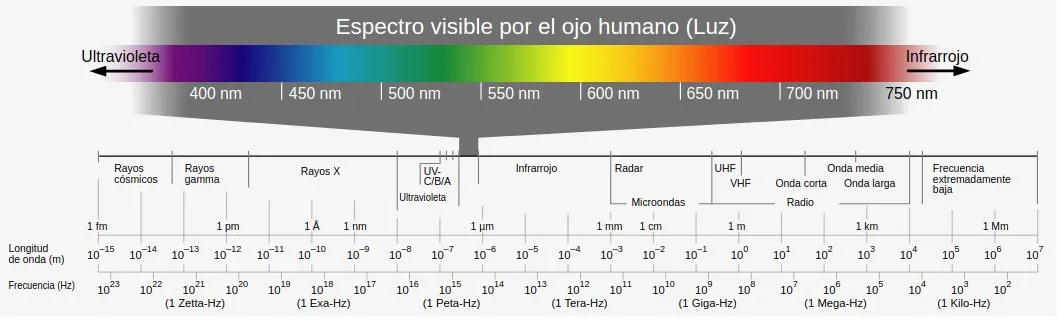
The color we perceive is nothing more than a range of energy in the electromagnetic spectrum. Only the part called "visible" we identify with colors, since the rest of the spectrum we do not perceive with our eyes. Our brain, through the cells in our eyes, encodes the different energies and wavelengths of visible light with colors. The visible or optical part of the spectrum is divided into parts with different energy-wavelengths, from the most energetic or blue to the least energetic or red.
Blackbody radiation
A blackbody is an object that absorbs all the light it receives. It does not reflect light, nor does light pass through the object, but rather all the light is absorbed. That light is energy that heats the object and due to that temperature it will emit radiation. That radiation will depend on the temperature it reaches. The idea of a "blackbody" is an abstraction: there are no perfect blackbodies, but stars approximate that.
The temperature of an object is a measure of the amount of movement (average velocity) of the particles that compose it: the faster they move, the higher the measured temperature. When charged particles are accelerated, they create electromagnetic radiation, that is, light.
An ideal or perfect blackbody follows these rules:
1-The hotter it is, the more light it radiates at all wavelengths. If you compare two blackbodies, regardless of the observed wavelength, the hotter one will radiate more light than the cooler one.
2-The blackbody spectrum is continuous, that is, it emits at all wavelengths, with a peak in a certain part of the spectrum. The peak moves to shorter wavelengths for hotter objects. The hotter it is, the bluer the wavelength at its emission peak will be.
These two characteristics are synthesized in the Stefan-Boltzmann and Wien laws.
Now we will use an online blackbody spectrum simulator with which you can entertain yourself for a while. But the most important thing:
If stars emit at all wavelengths (here we are talking mainly about the visible part which is what matters to us this time) and that implies that a region of the visible part is green, then ALL stars emit, a little bit, in the green.
STELLAR COLOR SIMULATOR
But, if that's the case, why are there no green stars?
Well, our brain mixes the primary colors blue, green, red to form the rest. And then this happens:
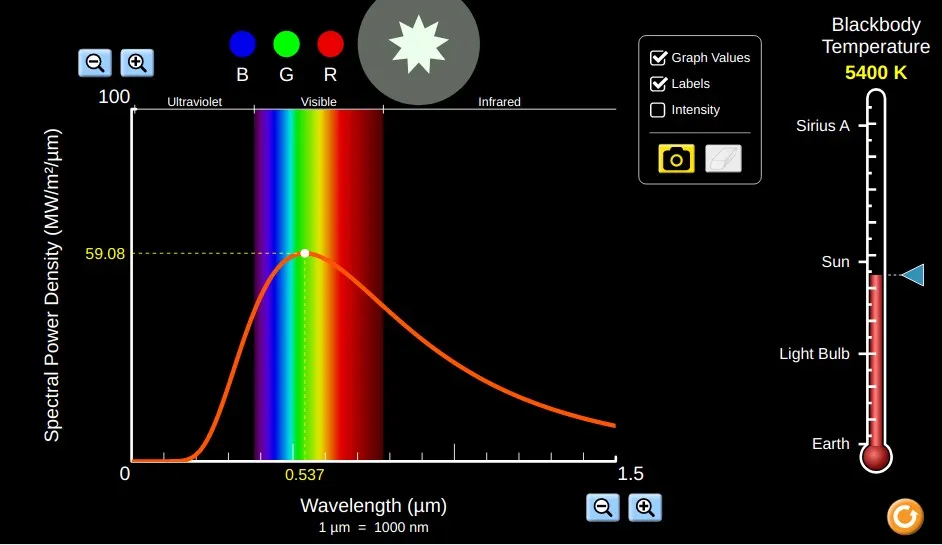
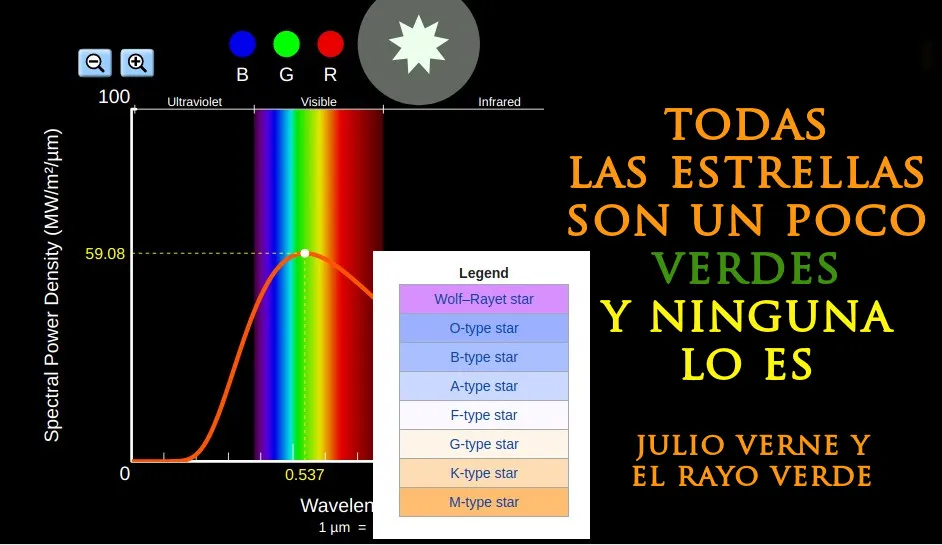
Here we see the simulator. At the top there is a drawn star. The color of that star is the color our simulated star will have.
Below we see the spectrum. In this case it is a spectrum like that of our Sun. Note that the emission peak is in the green, but the color we finally see is white, since the energies from each part of the emitted visible spectrum are added together.
If the star were more massive, the peak of the spectrum would shift to the bluer part (as we said before):
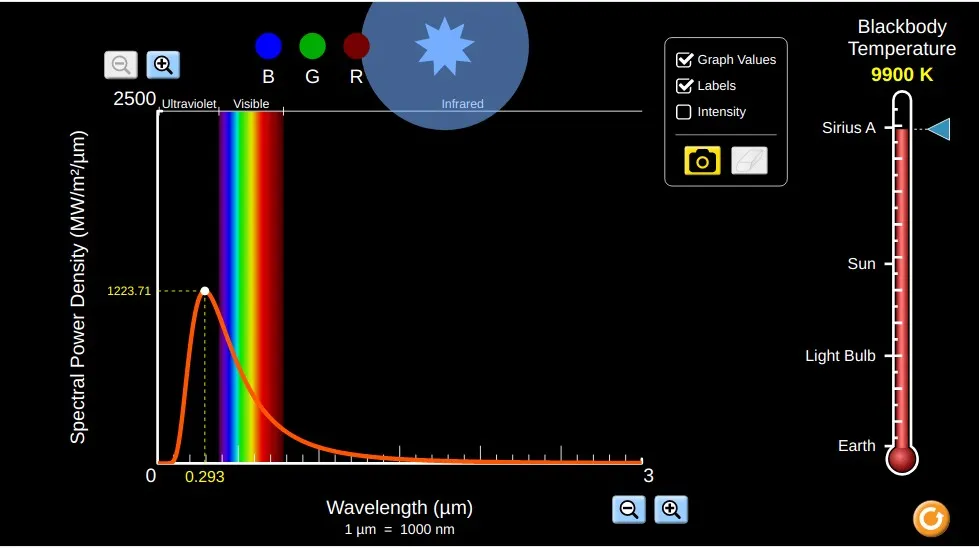
Sirius A is a main sequence star, white-blue, although a part of its emission corresponds to the "green" wavelength range: between 500 and 570 nm.
On the other hand, a star less massive than our Sun emits its peak more towards the red, resulting in its color being more reddish:
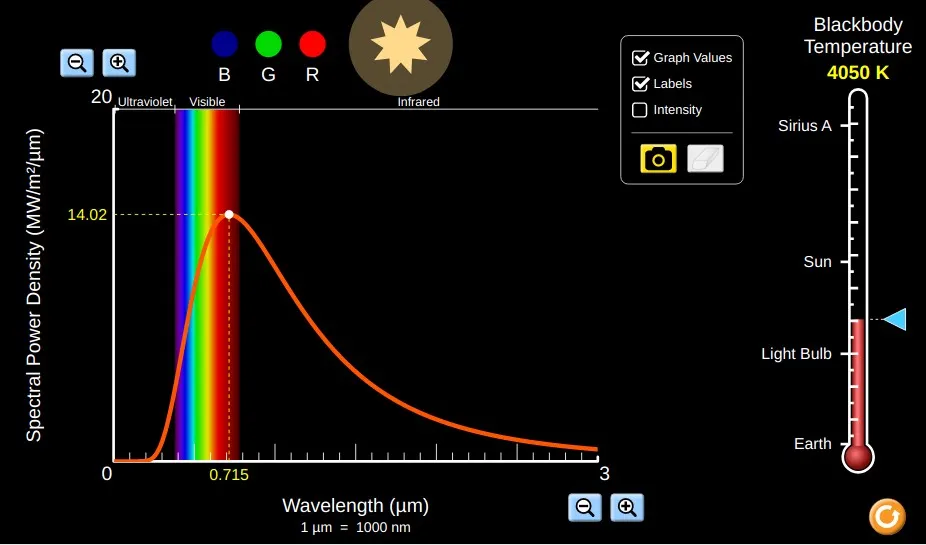
For us to see a star as green, it would be necessary for the emission peak to be in the 550 nm range, but also for the emission to be very narrow to avoid the other wavelengths. And that doesn't happen.
BUT...THE GREEN RAY
There are two effects to consider: what astronomers call "extinction" due to the dust between the astronomical object and Earth; as well as the effect of scattering and absorption produced by the atmosphere. The "green flash" effect can occur at sunrise or sunset. A greenish point or region is perceived on the Sun lasting a few seconds. This effect is produced by the atmosphere refracting the light, separating it like a prism.
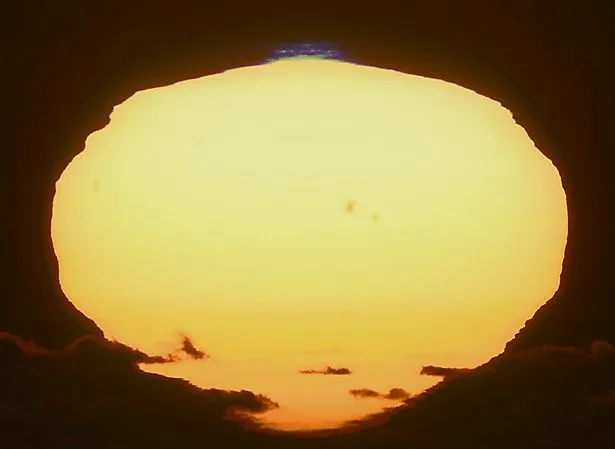
The concept of the green flash was popularized by the 1882 novel The Green Ray by Jules Verne. There is a film version, with the same name, directed by Eric Rohmer, from 1986.
In the novel, the phenomenon is described as follows:
"[...] a green that no artist could ever obtain on his palette, a green of which neither the varied tints of vegetation nor the shades of the clearest sea could ever produce an equal! If there is a green in Paradise, it cannot be other than this shade, which most surely is the true green of Hope!"
In the end we have said that ALL stars emit "in the green", meaning that a part of the emitted waves have intermediate energy, but that NONE is, finally, green.
Paraphrasing Lorca, we could say: The green stars look at us, but we cannot look at them.☉
Sources and related links
- The Star That Can't Exist
https://www.youtube.com/watch?v=vXOYbzQ4jDA&ab_channel=CoolWorlds - Blackbody Radiation
https://www.e-education.psu.edu/astro801/content/l3_p5.html - PhET Interactive Simulation of the Blackbody Spectrum
https://phet.colorado.edu/sims/html/blackbody-spectrum/latest/blackbody-spectrum_en.html - Green flash
https://es.wikipedia.org/wiki/Destello_verde
https://en.wikipedia.org/wiki/Green_flash - The Green Ray, Jules Verne
https://biblioteca.org.ar/libros/154353.pdf - Why aren't there any green stars?
http://www.astronomycafe.net/FAQs/q72x.html - Interpretation of ‘Verde que te quiero verde’ / Federico Garcia Lorca – B1 / B2
http://hetspaanseatelier.nl/interpretacion-de-verde-que-te-quiero-verde-federico-garcia-lorca/
About the images
APOD 2002 January 9
Blue Flash
Credit & Copyright: Mario Cogo https://apod.nasa.gov/apod/ap020109.html
By Horst Frank, Jailbird - This image has been extracted from the archive, CC BY-SA 3.0, https://commons.wikimedia.org/w/index.php?curid=1793461