A global phenomenon: doctoral fellows and working conditions in astronomy.
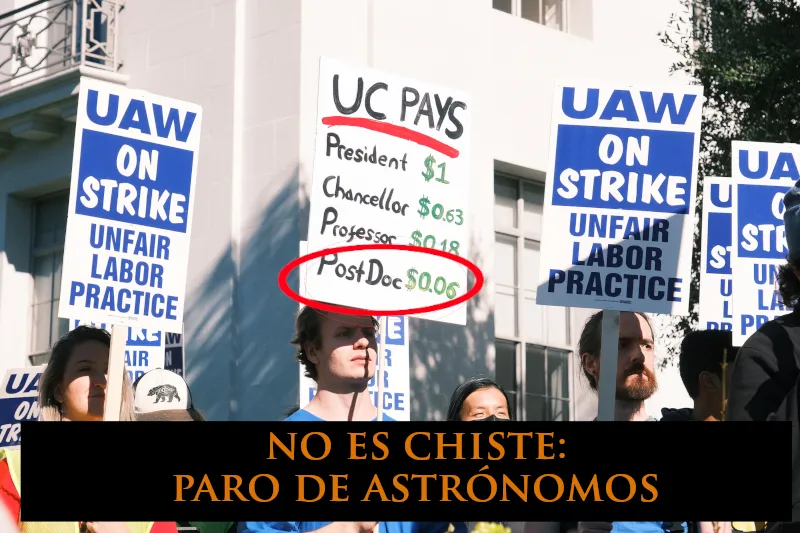
Workers can carry out different forms of industrial action for various kinds of demands, such as a strike (also called a work stoppage), a slowdown, street blockades (pickets), public assemblies, etc. In general, these actions can be a beginning of a solution to problems as long as they generate social impact, which in turn produces political pressure. Examples: when bank employees don't work due to industrial action, other people have limited possibilities to make withdrawals, deposits, and other procedures. When garbage collectors go on strike, trash accumulates, creates bad odors and diseases, which impacts the rest of society, which complains, which in turn, like dominoes, alters the "social meter" of the ruling class.
ASTRONOMERS' STRIKE: IS IT A JOKE?
Astronomy is, however, one of the sciences with the least consequences for daily life. Can an astronomers' strike have social impact? Who would be affected by astronomers not working? The same question is valid for other sciences, like paleontology.
On the blog I publish astronomy jokes invented by me. It occurred to me a while ago that the idea of an astronomers' strike would be comical, for example:
-There's an astronomers' strike
-Oh, no! Without the updated Hubble constant, how will I live?
I admit it, the joke is silly. The point is that an astronomers' strike doesn't move anyone's ammeter. To make up for it, here's another joke, much better:
Salary expansion
The League of Astronomers of the Universe is on strike demanding an update of their wages: they ask to be increased at a rate of $70/s/Julian day.
However, beyond the humor, astronomers are scientists and science researchers are workers, so it's not so far-fetched that they could carry out industrial actions. I invite readers to think how many times they've heard of an astronomers' strike. They exist, only they are not actions carried out solely by astronomers, but by academics.
DOCTORAL FELLOWS
Those who might be in worse conditions, that is, have greater justifications for carrying out industrial action are the "doctoral fellows", a title that creates confusion because it's not clear if they are workers or students. A fellowship is a subsidy granted to someone who studies. A "fellow" must therefore be a student, right?
Well, no. A doctoral fellow studies how to conduct scientific research while producing it. They work and study. But they work full-time and receive an incomplete salary. It's not like an internship where the student learns something while doing a practice, part-time. A doctorate is very difficult. It requires exclusive dedication. Without economic support, it's impossible. On the other hand, such support is justified by the production of work. What the fellow produces is not their property. Similarly, the worker who produces screws is not the owner of them. The fellow is a worker. But since they are not considered as such, they are paid a lower salary, without retirement, without medical coverage and other items.
We have talked about this situation in Argentina on some occasion. Today I want to show that this is a worldwide phenomenon. Which doesn't justify anything.
THE SITUATION IN CINEMA
The film Dark Matter (Chen Shi-zheng, 2007) is a fiction based on real events. What's important in this context is that it narrates the vicissitudes of a Chinese student in the USA who obtains a doctoral fellowship. But he has a strong disagreement with his professor-thesis advisor, and doesn't pass it. The fellowship ends and if he wants to continue, he no longer gets paid, so he must find (another) job. Meanwhile, he must then work and do the thesis, which implies he will dedicate less time, effort, and concentration to it. It's the ideal formula for failure. A doctoral thesis is VERY DIFFICULT (much more so if you dedicate yourself to selling creams!).
THE REAL SITUATION IN THE UNITED STATES AND ASTROBITES
Astrobites is an astronomy outreach initiative carried out by an independent group of doctoral fellows in astronomy. These are people who already have a bachelor's degree and are now doing their doctorate, which prepares them to be scientific researchers. Since 2016, this blog has had the support of the AAS, the American Astronomical Society. "American" here means "United States".
During 2022 they published several posts on their site about "union strikes". The word Union in English means "union/syndicate" and strikes is "stoppage/strike".
No, they are not "astronomers' strikes", but strikes by doctoral fellows, which include astronomers and also many other scientific professions.
THE LOCAL AND THE GLOBAL
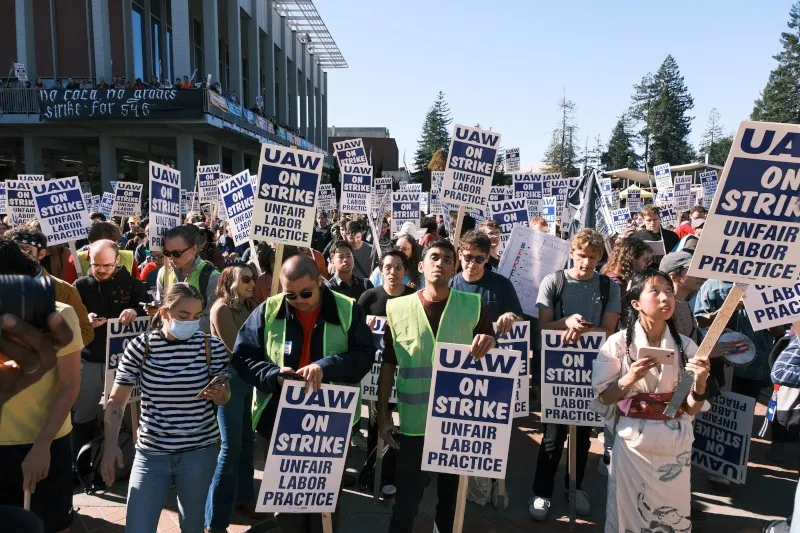
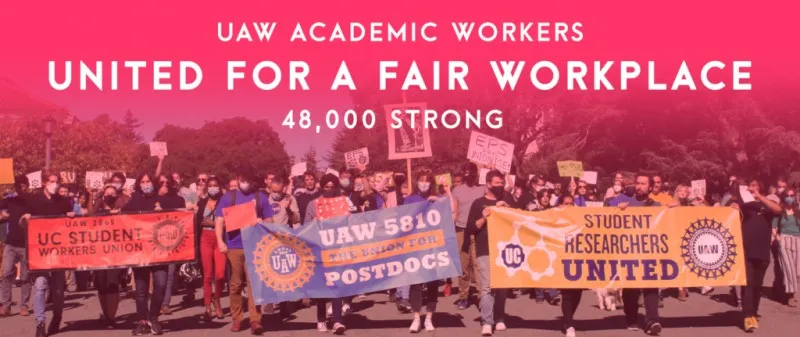
The demands of doctoral fellows from different US universities are:
Better salaries, health insurance, help for childcare, improvements in access for people with disabilities, and removing fees that international fellows must pay. One of the complaints is that at least 30% of their income is spent on rent, which they pay to the very universities that hire them. Several of the initiatives reported by Astrobites during 2022 include demands on gender and diversity issues, sexual harassment, and mistreatment.
In other parts of the world, very similar things happen, although the media impact and the initiatives of fellows, students, teachers, and graduates may be different.
On the other hand, in each country there are different laws and other regulations, both for the public and private sectors.
Astrobites has a sibling in Spanish: Astrobitos. To this day, no note on the matter has been published there, despite many posts on the subject being made on the English blog. That's why I decided to write this entry: it's something that must be known, in Spanish, because it happens.
OTHER PRECEDENTS
In 2013 there was a strike by scientists at the ALMA radio telescope in Chile. It lasted two weeks and they were demanding a salary increase and the working conditions involved in working at high altitude.
In 2020 a group of astronomers (mostly women) carried out a strike at the Calar Alto Observatory. Eldiario.es said at the time that: The technical astronomy group at Calar Alto represents 20% of the total number of workers and "brings together almost all of the existing precariousness", being "residual or non-existent" in the remaining 80% of the staff.
I wanted to mention this paragraph in particular because it is also, despite local differences, a global phenomenon: workers against workers. That is, those with worse conditions go on strike and the rest do not support, do not sign statements, look the other way or worse, justify the state of affairs.
THE INVISIBLE LIFE OF ASTRONOMERS
Several years ago I wrote two posts here about the "invisibilization of astronomers" in journalistic discourse, even in texts produced by the universities themselves. I refer to the phenomenon by which things are said like: "The Hubble Telescope discovered such and such," as if the discovery could be made by a device and not by a person.
In a recent post I made clear how important, revolutionary, the technological advance in astronomy has been with more and better instruments. Exponential leaps have been made in the knowledge of the cosmos. But discoveries are made by people, not machines. Automatic instruments can detect light, but what they are, how they interact with the environment, and other questions are answered by the analysis of the data performed by astronomers (men and women).
Similarly, if you search the internet for the phrase "Astronomers' strike" you will have a hard time finding recent articles, except for those I pointed out as precedents from a few years ago. I thought it appropriate to put it in writing, in Spanish, that these initiatives exist, for example in the United States. And that despite local differences, of each university, and of each country, the general situation is very similar in many other places.
To conclude, it is important to emphasize that if you analyze the proposals, for example from the initiatives carried out last year in the USA, the goal of those doctoral fellows is not to get rich, but to have an income commensurate with their work that allows them to live a dignified life, pay their rent, feed their children and be able to dedicate themselves full-time to their research. They are not seeking a "revolution," but to give a "turn more," a revolutio, to their salary situation and working conditions. Nothing out of this world.☉
Sources and related links
- US Graduate Workers Strike Back – a year in review of graduate student union activity
https://astrobites.org/2023/01/06/union-year-2022/ - Student Workers of Columbia - UAW Local 2710
https://www.studentworkersofcolumbia.com/ - Calar Alto, on strike: astrophysics PhDs working “in precarious conditions” at the largest observatory in continental Europe
https://www.eldiario.es/andalucia/almeria/calar-alto-huelga-doctoras-astrofisicas-trabajando-precario-mayor-observatorio-europa-continental_1_6107964.html - Chile: Strike paralyzes world's largest observatory
https://www.scidev.net/america-latina/news/chile-huelga-paraliza-observatorio-m-s-grande-del-mundo/ - ALMA workers suspend strike after reaching agreement: Operations will resume Monday
https://www.latercera.com/noticia/trabajadores-de-alma-suspenden-huelga-tras-llegar-a-acuerdo-operaciones-se-reanudaran-el-lunes/ - Strike of telescopes and brains at Calar Alto
https://www.eldiario.es/andalucia/apagon-telescopios-cerebros-calar-alto_1_4960835.html
About the images
Photos for Use from Strike https://www.fairucnow.org/photos-for-use-from-strike/