To make larger telescopes, we must understand the smallest things.
Telescopes revolutionized astronomy. So did computers and cameras. We increasingly need larger telescopes, not only to see farther, but to detect objects with a smaller angular diameter.
A telescope composed of diffraction gratings has been designed that could detect an Earth-like planet up to 30 light-years away. It is the DICER (Diffractive Interfero Coronagraph Exoplanet Resolver) telescope proposed by Heidi Newberg of the Rensselaer Polytechnic Institute.
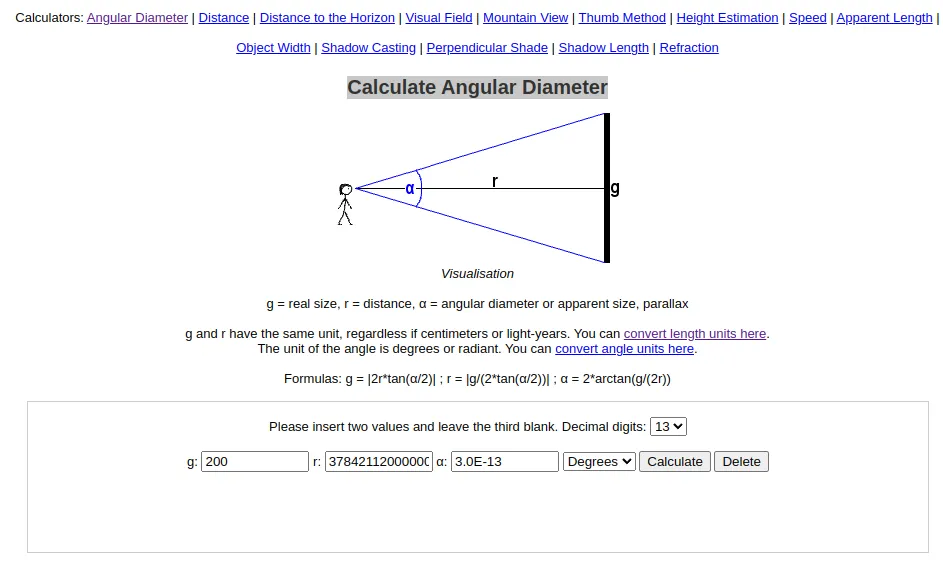
To go further, it would be very important to observe the nearest stars in search of exoplanets and then investigate them to detect artificial satellites or artificial lights on the surface. But if a satellite were 200 meters in diameter (which is too much) and were around an exoplanet just 4 light-years away, its angular diameter would be 0.0000000000003 degrees.
One possibility is to make optical interferometers. Just as interferometry is already performed with radio waves, the idea would be to have several telescopes in the visual range separated by a great distance, but linked in such a way as to share observations in a synchronized manner. A large baseline could be placing telescopes in orbit. But the possibility of physically connecting the devices makes it impractical.
Michelson interferometers are well known, like those used by LIGO to detect gravitational waves. They collect photons from their sky sources in two or more sub-apertures and are transported through optical links to an interference point. For a pair of sub-apertures separated by a baseline B, the measured interference is sensitive to a source with an angular size of 𝛿𝜃 ∼ 𝜆/𝐵, where 𝜆 is the photon wavelength. Therefore, this type of interferometer is difficult to make for long distances.
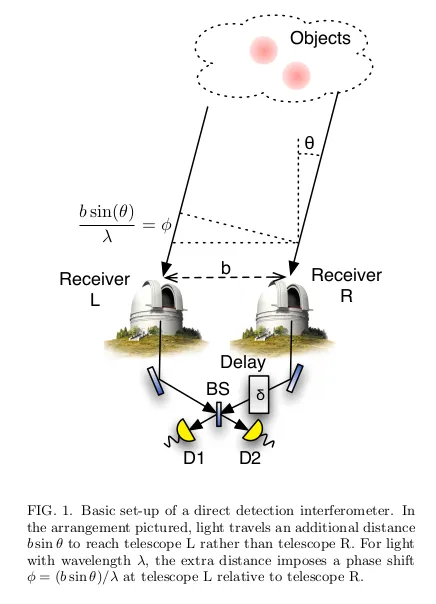
Using quantum optics to improve precision is a desired goal. In particular, the Gottesman-Jennewein-Croke (GJC) proposal attracted attention as a way to build a quantum telescope, that is, a very long baseline interferometer enabled by the use of quantum optics effects. This proposal, however, depends on quantum repeaters, a technology that still requires much development.
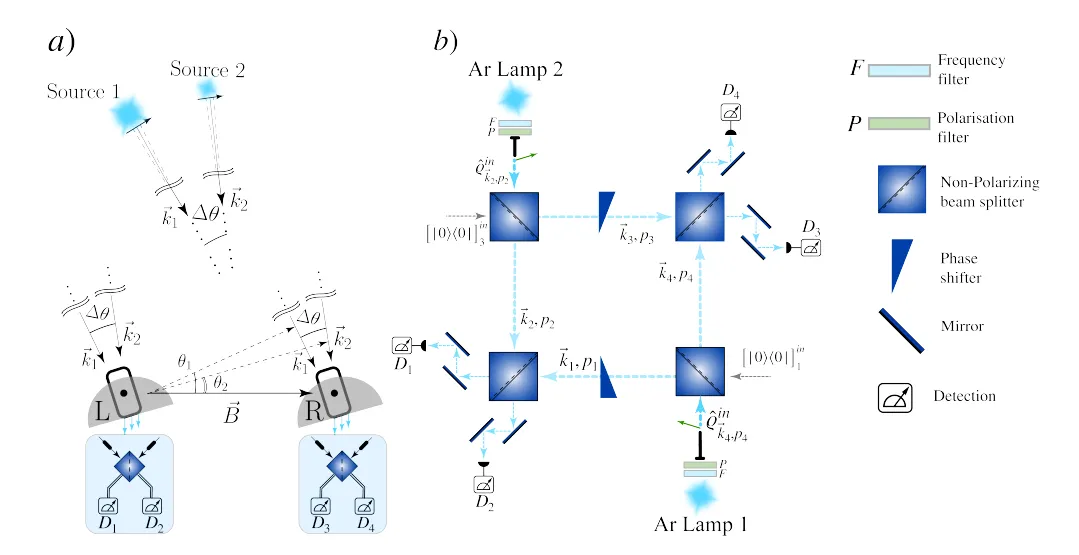
Another alternative was that of Stankus-Nomerotski-Slosar-Vintskevich (SNSV) which depends on the Hanbury Brown and Twiss (HBT) effect. This type of instrument, known as an intensity interferometer, was used in the Narrabri Stellar Intensity Interferometer.
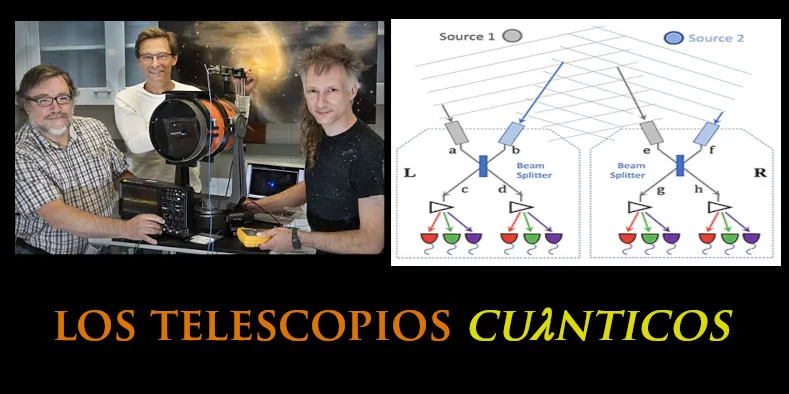
A recent work by several researchers from Brookhaven National Laboratory takes the design of those previous proposals. "The proposal was to use an entangled photon source and employ photon correlations at two stations and thus remove the problem of phase stability. Intensity interferometers are used to measure stellar diameters using a technique based on the HBT effect. In our scheme we use the same effect, only in its phase-dependent part, to measure the opening angle between two stars, which can thus be separated by a considerable angle. On one hand, the second star can be seen as a source of coherent photons for the first star and thus there is a link with the GJC proposal", explained Andrei Nomerotski, co-author of the work, to Universe Today.
In a note published some years ago on the Brookhaven Laboratory site it explains: In classical interferometry, photons from an astronomical source arrive at two telescopes with a delay (phase difference), which can be determined through the interference intensity. Using two photons in the form of entangled pairs that can be transmitted simultaneously to two stations and interfere with the stellar photons, would allow arbitrarily long baselines and finer resolutions.
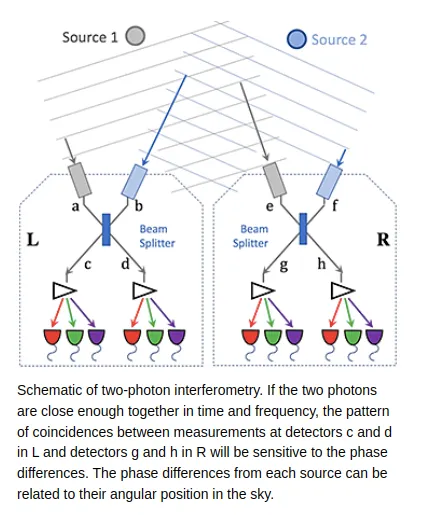
"It is an exploration project where for the first time we will test ideas of two-photon optical interferometry using quantum entanglement for astronomical observations", commented Nomerotski. "We will start with simple experiments in the laboratory and in a few years we hope to have a demonstration with real sky observations".
The astrophysicist added to Universe Today that "There are a variety of interesting conceptual ideas in this field, but many of them are theoretical and therefore, futuristic. We think our work is one of the few that addresses the experimental difficulties and we are making good progress".
Astronomy is characterized by studying giant objects at enormous distances. But, ultimately, it is about collecting light and concentrating it at a point. And light is composed of electromagnetic waves. Using the quantum properties of light, therefore, should not be surprising. In the end, the smallest will allow us to study the largest. The part for the whole. The astronomical synecdoche will transform the quantum instruments of the future into the telescopes par excellence.☉
Sources and related links
- Longer-Baseline Telescopes Using Quantum Repeaters
Daniel Gottesman, Thomas Jennewein, Sarah Croke
https://arxiv.org/abs/1107.2939 - Towards Quantum Telescopes: Demonstration of a Two-Photon Interferometer for Quantum-Assisted Astronomy
https://arxiv.org/abs/2301.07042 - Are We Entering the Era of Quantum Telescopes?
https://www.universetoday.com/159741/are-we-entering-the-era-of-quantum-telescopes/ - Imaging stars with quantum error correction
https://arxiv.org/abs/2204.06044 - Calculate Angular Diameter
https://rechneronline.de/sehwinkel/angular-diameter.php - Hanbury Brown and Twiss effect
https://en.wikipedia.org/wiki/Hanbury_Brown_and_Twiss_effect - Quantum Astrometry
https://www.bnl.gov/newsroom/news.php?a=116760
About the images
Photo: Brookhaven Lab physicists: Paul Stankus, Andrei Nomerotski (principal investigator), Sven Herrmann.