Artificial intelligence in astronomy and human classifications.
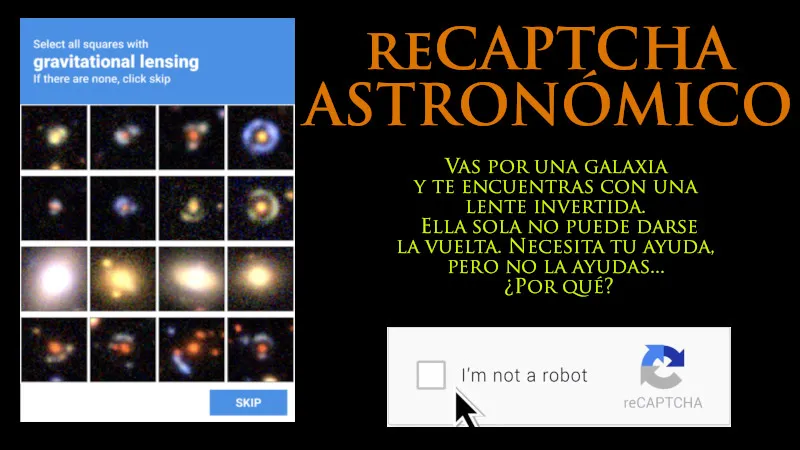
Artificial Intelligence (AI) is among us and it's here to stay. One of the biggest uses of AI is for classifying images. Astronomers, in the era of the data deluge, have a very large amount of information to process. However, to train a neural network, people are used to classify images, sometimes without even knowing it. An example is the Google ReCAPTCHA service. CAPTCHA is an English acronym that stands for "Completely Automated Public Turing test to tell Computers and Humans Apart". Surely you have at some point found that to access a website you were asked to confirm you are a person with this type of contraption where you must point out objects of the same kind.
Cosmologists who study gravitational lenses have had to use new methods to analyze the copious data obtained. However, computational methods generate many false positives. That is why people are asked to verify the computational result. But this introduces human biases: how good are we people at identifying gravitational lenses compared to a trained machine? This is what Karina Rojas, from the University of Portsmouth, and her colleagues studied.
THE EXPERIMENT
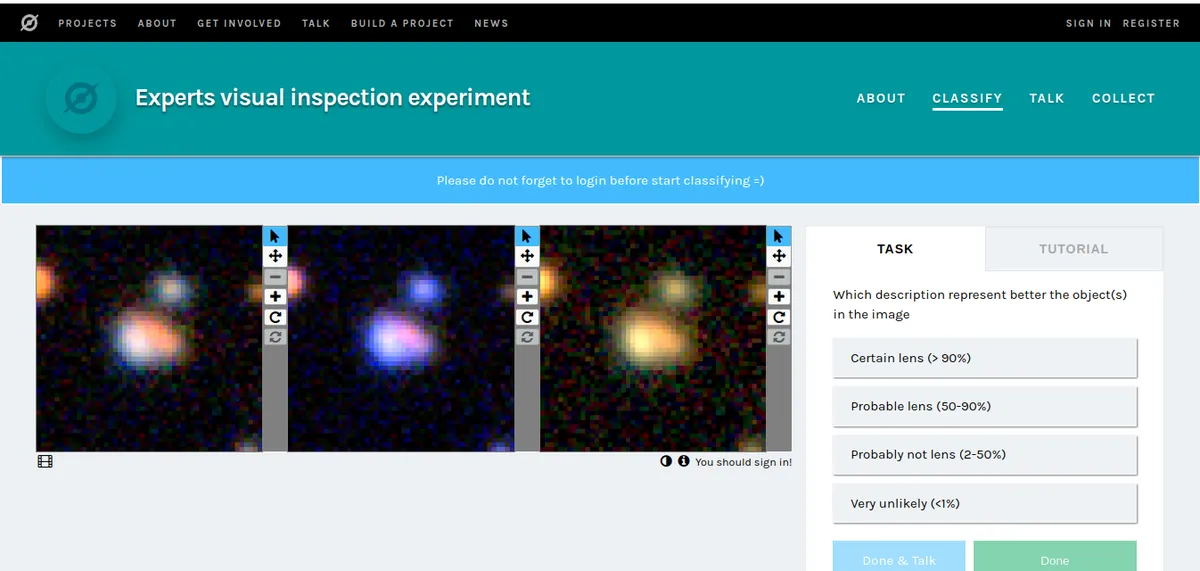
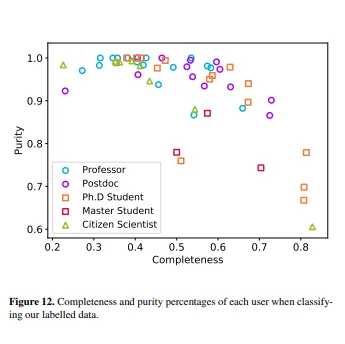
One of the objectives of the work was to determine whether prior knowledge of the objects of study was relevant when classifying. That is why they invited experts in the field. They used the citizen science site Zooniverse. Users had to choose the best description for the object shown:
Definite lens (>90%), Probable lens (50-90%), etc. No tutorial was included, as is usual in citizen science projects. The images shown come from the Dark Energy Survey that uses the 4m Blanco telescope at the Cerro Tololo Observatory in Chile.
The images of each potential lens were offered in triplicate at different wavelengths. The sample contained simulated lenses, repeated data, images without lenses. In total 1489 images. Each candidate had to classify 1000 images.
CONCLUSIONS
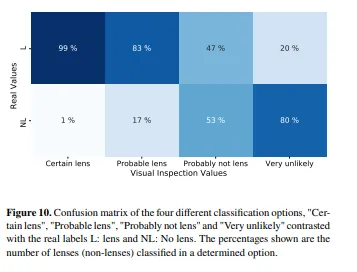
With a total of 66835 classifications, the results can be summarized as follows:
-Most lenses are positively identified when they have an Einstein Radius greater than 1.2" and the magnitude is less than 23.
-People managed to identify non-lenses in a large proportion.
-They found no correlation between the results of people and those of a neural network, which suggests that machines and people look for different characteristics.
-The result in groups is better than the individual one.
We live in a digital society in which people must prove we are not robots, like the Voight-Kampff test in Blade Runner, but in reverse. Undoubtedly, machines can be better than people at certain tasks, even though we are the ones who create them. No one would think to doubt the result of a calculator. Why should we doubt the result of an AI? Because it's not the same. AIs compare statistically based on what they know. Let's remember the case where a Google service confused people with animals.
For now, computers and people can each contribute our part and coexist peacefully, just as we do with calculators. Until AIs start dreaming of electric sheep.☉
Sources and related links
- The impact of human expert visual inspection on the discovery of strong gravitational lenses
Karina Rojas et al (2023)
https://arxiv.org/abs/2301.03670 - How Good are Humans at Visually Identifying Gravitational Lenses?
by Lucas Brown
https://astrobites.org/2023/02/16/how-good-are-humans-at-visually-identifying-gravitational-lenses/ - Google apologizes for confusing a black couple with gorillas
https://www.bbc.com/mundo/noticias/2015/07/150702_tecnologia_google_perdon_confundir_afroamericanos_gorilas_lv
About the images
L Brown-K.Rojas