Several methods to know the radius based on luminosity.
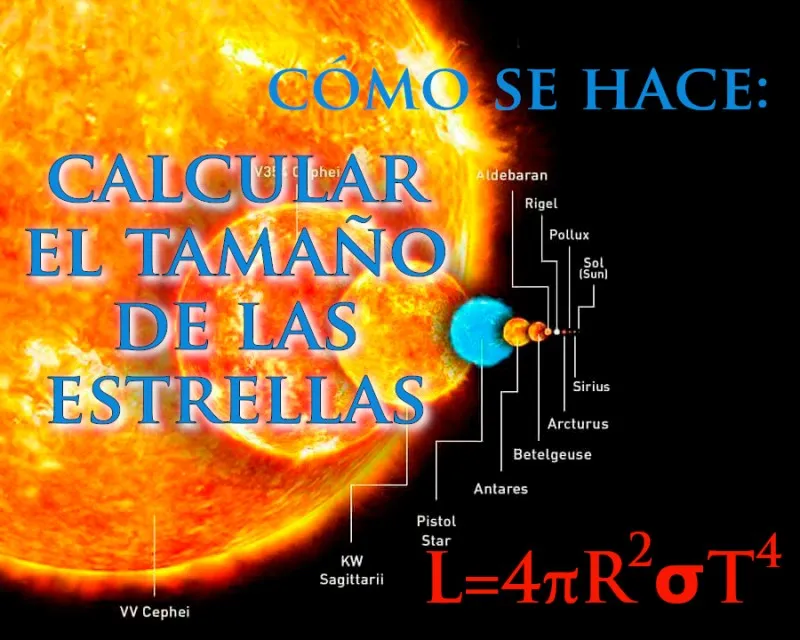
The luminosity of a star can be known with this formula (here we will call it F1):
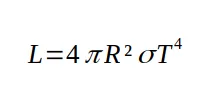
where R is the radius in meters, σ (sigma) is the Stefan-Boltzmann constant, T is the surface temperature in Kelvin.

Temperature is related to magnitude, the B-V color index:
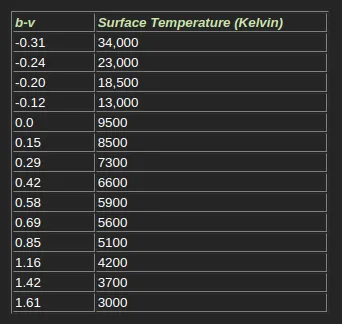
In many cases, luminosity is a known datum and is indicated in relation to the Sun's luminosity (L/Ls), in which case, the radius can also be calculated as a proportion with the solar radius (Rs), which we will call F2:

The Sun's temperature is 5800 K.
If we don't know the luminosity relative to the Sun's, we can use the absolute magnitude, considering that an increase of 1 magnitude equals 2.512 times brighter. Thus:
L/Ls=2.512 ^dm
where dm is the difference in absolute magnitude= ms-m, with ms being the Sun's absolute magnitude (4.83).
If the absolute magnitude is not known, it can be calculated if the visual or relative magnitude and the distance (in parsecs) are known:
M=m-5*log d+5, where d is the distance.
I WANT MY CALCULATION
Let's calculate the radius of Sirius (it's a double star, we'll use component A for this case):
According to Spanish Wikipedia, Sirius (A) has a temperature of 9900 K and a luminosity of 25.4 Ls.
With F2: R/Rs=(5800-9900)^2 * 25.4^1/2=1.72
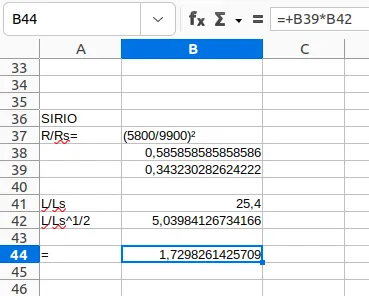
According to Spanish Wikipedia, the radius of Alpha Canis Majoris is 1.71 solar radii.
Done, we are geniuses. Congratulations! Good afternoon, nice to meet you, I retire to my chambers...
WAIT A LITTLE BIT, GOOD SIR
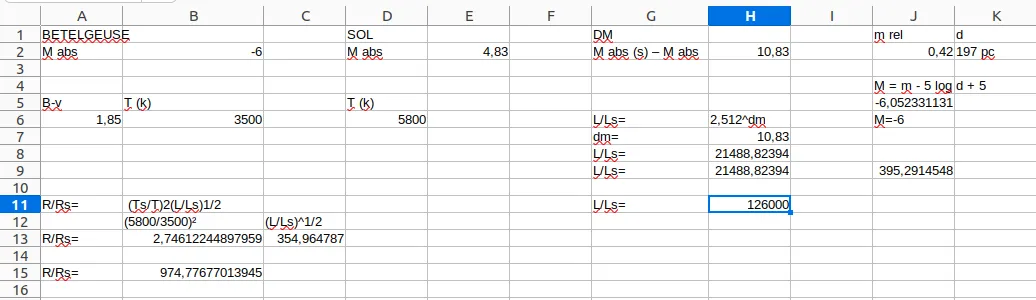
But it happens that if we try to do the same with Betelgeuse we will be disappointed: We will get 402 as an answer, when the closest result is double that. This happens if instead of using solar luminosity as input, we calculate it as indicated above from the absolute magnitude difference. If we do it that way, the luminosity relative to the Sun will be 2.512^10.83=21400, considering for Alpha Orionis M=-6.
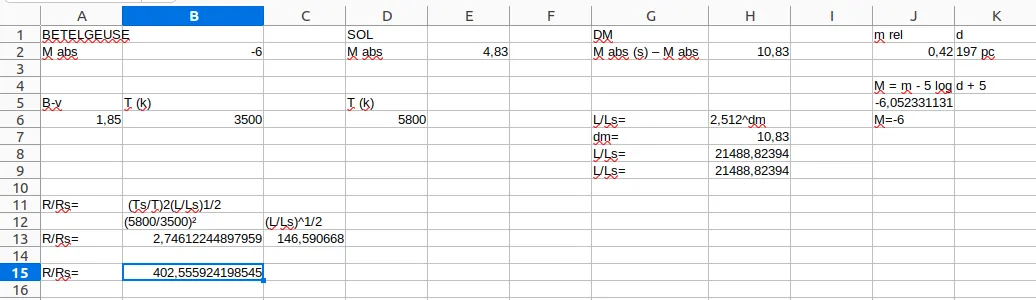
However, in sources like Wikipedia, its luminosity is indicated as 126,000 Lsol. I suppose this is due to the reddening (which astronomers call "extinction") caused by the dust surrounding the star, a belt 250 times larger than the star.
On the other hand, if we use the value 126,000 Lsol as input, it gives us a value of 974 solar radii, which is closer to the one found in books.
A MUCH SIMPLER METHOD, BUT VERY LIMITED
The library informs that the formula R = d tan (a/2) is a good approximation, where d is the distance in km and a is the angular size in arcseconds. The problem is the latter: the parallax of many stars is not known.
Another, similar way is:
We use the value of solar luminosity= 3.827 × 10^26 W. When looking up the luminosity value of the star in question, it will give a value relative to solar luminosity.
We use the previous formula, for R (derived from F1)=
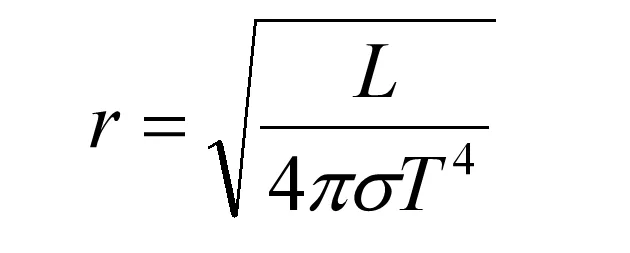
For example, for Betelgeuse, where it says L we put 126000*3.827*10^26
Below: 4*PI*5.7*10^-8*T^4
In the case of Alpha Orionis, T=3500.
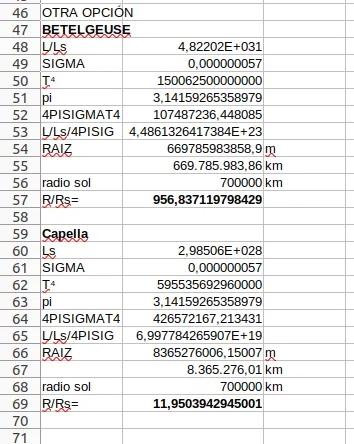
It gives us a value in meters. We divide by 1000 to get km. If we divide that value by 700,000 (which is the solar radius in km), we get the radius of the star relative to the Sun. In this case, 956.
For Capella, α Aur:
L=78☉
T=4940 K
R=11.95 R☉
Note: if a civilization existed that had no ears, I calculate that its star would have no radius...☉
With a touch of humor, the How it's done Series ends here.
Sources and related links
- How to Calculate Stellar Radii
https://sciencing.com/characteristics-star-5916715.html - Calculating the Radius of a Star
http://cas.sdss.org/dr4/en/proj/advanced/hr/radius1.asp - HOW BIG IS A STAR?
https://www.astronomy.ohio-state.edu/ryden.1/ast162_2/notes9.html - How to calculate a star's luminosity/radius
Reference: https://www.physicsforums.com/threads/how-to-calculate-a-stars-luminosity-radius.975438 - How to Determine a Star's Radius : Astronomy & Astrophysics
https://www.youtube.com/watch?v=FnFkb5Dw5-A - How To Determine a Star's Radius
https://forums.space.com/threads/how-to-determine-a-stars-radius.27399/
About the images
Image Futurism https://twitter.com/steube/status/1155980966357155840/photo/1