How we would see the Sun from the famous dwarf planet.
The apparent magnitude of the Sun, from Earth, is -26.7. That of the full Moon, -12.7. The magnitude scale is logarithmic. The brightness difference is 2.512^dm, where dm is the magnitude difference. Since the apparent magnitude difference of both objects is 14, the brightness difference is 2.512^14= ~400,000.
That is to say, the Sun is four hundred thousand times brighter than the full Moon, even though both have an apparent diameter of half a degree and the Moon is 400 times closer to the planet than the star.
The brightness of the moon, as we know, is nothing but sunlight. With the full phase, such illumination is enough to read a book.
What would happen if we were on Pluto?
We are now approaching winter in Buenos Aires. It's already cold. But on the dwarf planet, we would freeze with temperatures of -200ºC. With a good suit and oxygen tank, plus some imagination, could we read a book on Pluto?
The distant world is 39 times farther from the Sun than Earth.
Light attenuates with distance. The formula 4πr^2 is used. This means:
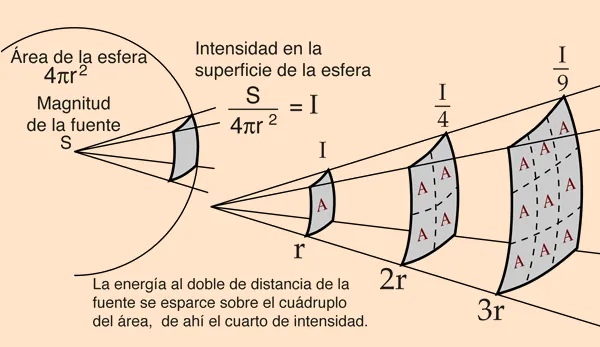
Let's imagine a sphere that covers the entire Sun and Earth. The light that leaves the star in all directions and on each square centimeter of the sphere passes a certain amount of light. If we now double the size of the sphere, the amount of light is the same, but by increasing the volume, the amount of light per square centimeter is less. If we double r, the light difference will be 4 times less.
We can imagine a much larger sphere, which includes the Sun and Pluto. If instead of doubling (multiplying by 2) the volume of the sphere (surface area) we multiply it by 39, then the amount of light decreases by 39^2= ~1500.
But at the beginning we said the Sun is 400,000 times brighter than the full Moon. Therefore, from the very distant Pluto, although the Sun appears much less luminous, it will still be brighter than the full Moon, about 250 times more.
Let's remember that orbits are not circular, but elliptical, so the distance used is average. Sometimes Pluto is closer to the Sun (perihelion) and other times farther (aphelion).
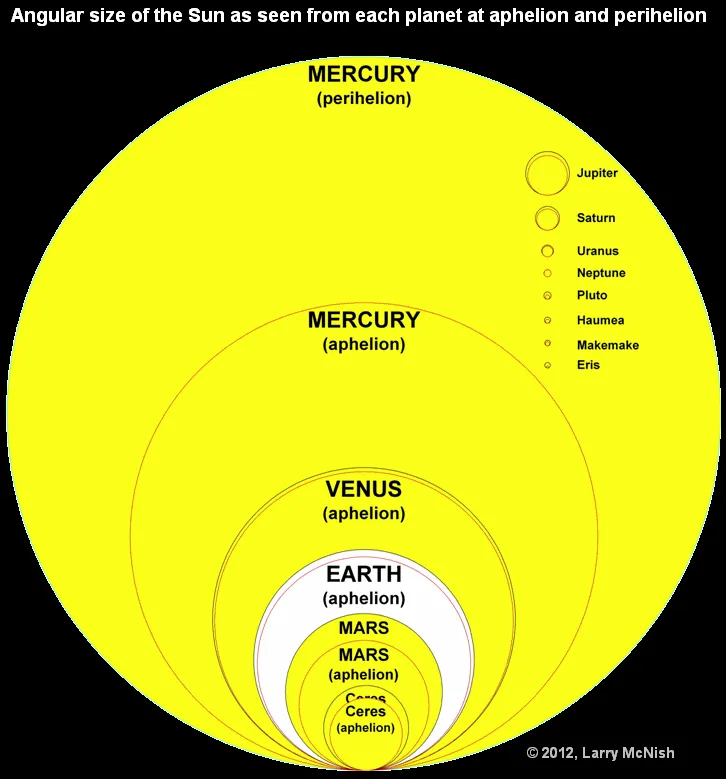
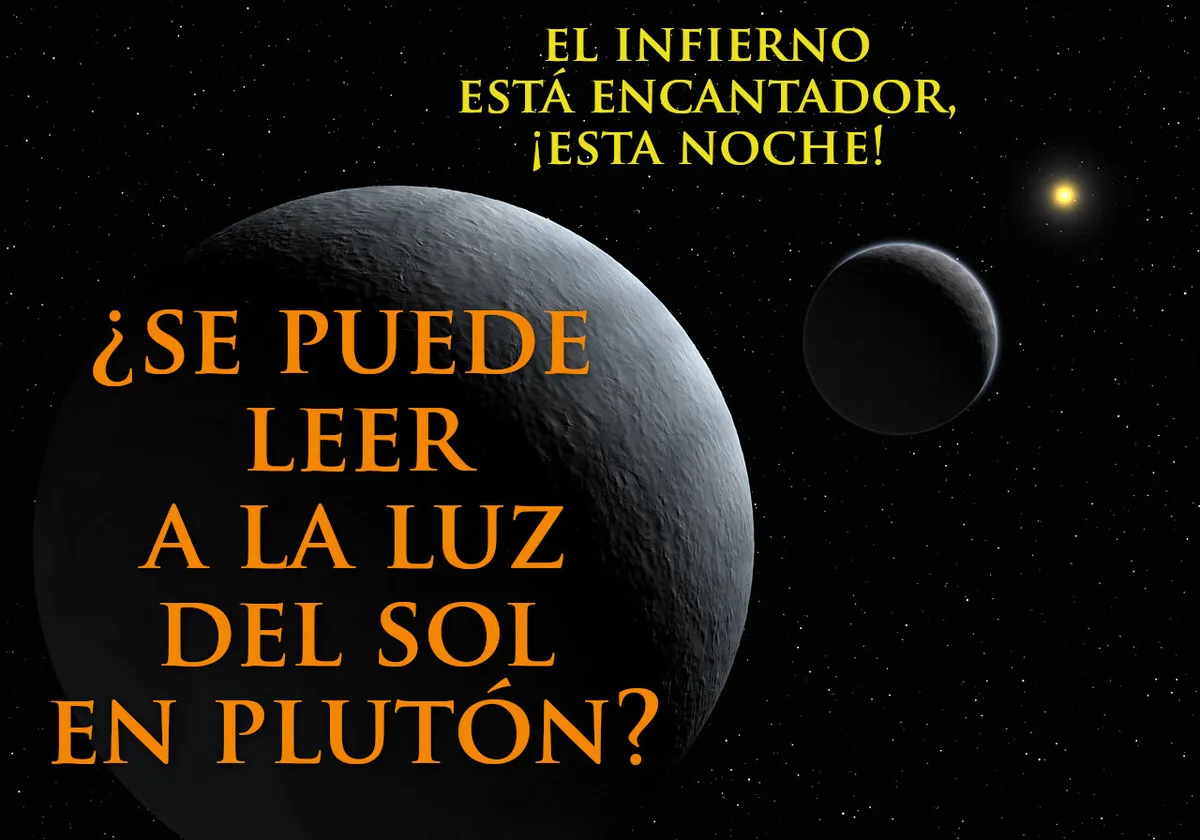
From the dwarf planet, the Sun looks like a point. If from here we see the Sun with an apparent size of half a degree (30 arcminutes) and Pluto is 39 times farther away, then from there, the star will be seen with a diameter of less than 1 arcminute, that is, a tiny dot, although at perihelion it could be seen as a small disk.
PLUTO TIME
NASA has a page where you can calculate, based on our location on the globe, at what time of day we would see here as much light as reaches Pluto at its noon. It's "Pluto Time."
The dwarf planet has a radius of 1151 km. Its day lasts 153 hours, and its year 248 Earth years. It has 5 moons: Charon, Nix, Hydra, Kerberos, and Styx. Although Charon is still considered a natural satellite, given that it is too large compared to Pluto, it is also a binary system.
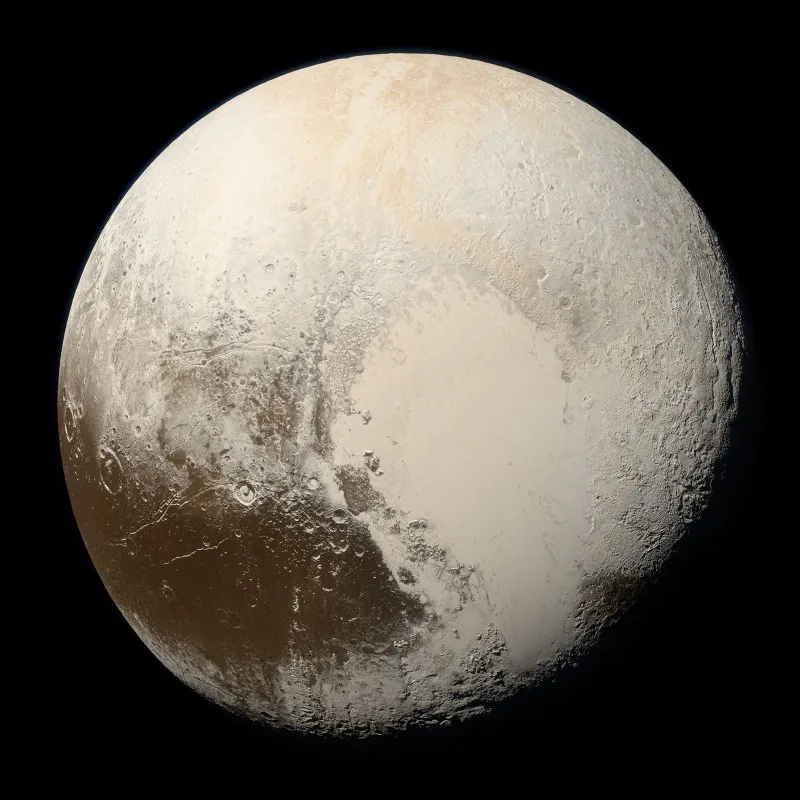
The names of the satellites correspond to those of gods of the underworld in classical mythology. Your hell is charming, tonight!☉
Sources and related links
- Find Your Pluto Time
https://solarsystem.nasa.gov/planets/dwarf-planets/pluto/plutotime/ - BAFact math: How bright is the Sun from Pluto?
https://slate.com/technology/2012/03/bafact-math-how-bright-is-the-sun-from-pluto.html - BAFact math: how big does the Sun look from Pluto?
https://slate.com/technology/2012/03/bafact-math-how-big-does-the-sun-look-from-pluto.html - General Law of the Inverse Square
http://hyperphysics.phy-astr.gsu.edu/hbasees/Forces/isq.html - Pluto-Charon system
https://www.eso.org/public/images/eso0602a/ - RASC Calgary Centre - The Sun and Transits as Seen From the Planets
https://calgary.rasc.ca/sun_and_transits.htm
About the images
Images: NASA/Johns Hopkins University Applied Physics Laboratory/Southwest Research Institute/Alex Parker
Initial illustration: ESO