A revolutionary fact, if there ever was one.
It is very common for astronomy textbooks and websites to indicate the average distance of the planets from the Sun. The smallest distance (perihelion) and the largest distance (aphelion) are taken, added together, and divided by 2. To establish a planet's distance from ours, 1 (astronomical unit) is subtracted from the planet's average distance from the Sun.
In a previous post, about a mathematical problem that interested Einstein, we explained that calculating an average is like thinking about a balance scale. We'll see with a couple of simple examples that you can't always "divide by two".
1-Average of 10 students
Ten students take an exam. Half got a grade of 4; the other half, 10. The lowest grade will be the lower value; the other, the upper value.
Let's think of it as a balance scale with two pans. In one pan we have the lower value, in the other, the upper value. Each pan contains the number of students. Since 5 students got each grade, the two pans have the same quantity. Therefore, we can add the values and divide by two, since the scale is balanced. The average, 7, is equidistant from the two values (4 and 10).
It's like holding a broomstick using just one finger. We'll place it at the midpoint (equidistant from the ends), as long as the stick has a homogeneous mass. It's the point of balance, equilibrium, or center of mass, like the barycenter.
2-Weighted average
But if there were 100 students and only 1 got a 4 and the remaining 99 got a 10, we cannot do the calculation the same way.
In the pan with value 4 there is 1 student; in the pan with value 10, there are 99. The average will not be a value equidistant between 4 and 10, but will be a value much closer to 10. Again, it's like holding a broomstick, but now with the broom part. Therefore, one end will be heavier (more massive) and to achieve balance we will have to place our finger closer to that area.
If you calculate it, you'll see the average is much closer to 10. We cannot add the values and divide by 2.
This last point is very common when dealing with speeds. If you cover the same distance at different speeds, what you will have in each pan will be the lower and higher speed values, but associated with them, the amount of time (in hours, for example).
Similarly, it happens with the orbits of planets. You have to weight the amount of time a planet is closer or farther from another.
ORBITS AND KEPLER'S LAWS
It's easy to see that, according to Kepler's Laws, planets have elliptical orbits. And that they increase their orbital speed when they approach the Sun and decrease it when they move away. Therefore, planets spend more time in the slow region than in the fast region.
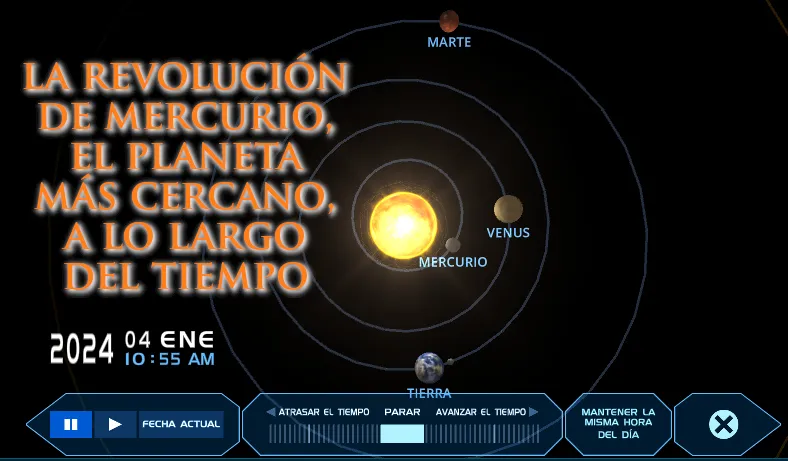
As a consequence, at those times when Venus, our immediate neighbor, is in opposition (on the opposite side of the Sun from Earth), Mercury will go around the Sun very quickly and for a large part of that time will be closer to Earth than Venus.
A few years ago, some astronomers published a paper on this, in case you're interested in the mathematical detail. It's the work by Stockman et al (2019) linked below.
To make it easier to understand, visualization is better. For that purpose, I used a free, online Solar System simulator called Solar System Scope. I ran a simulation advancing time to get a snapshot of the respective positions of the inner planets over the months.
The size of the planets is not to scale. What I show below is an animated GIF file with captures from the simulator. There is no distance measurement, so you'll have to do it "by eye," but I think it's easier to notice this way, even if it's not as precise.
Let's remember that Venus takes 225 days to orbit the Sun, about 7 months; while Mercury does it in 88 days and Mars almost twice as long as Earth, about 687 days.
Venus, however, is the planet that comes closest to us. Useless but curious facts, which show that in astronomy you can always give ideas one more twist.☉
Sources and related links
- Solar System Scope
https://www.solarsystemscope.com/ - The closest planet to Earth? Probably not the one you’re thinking of
https://www.sciencefocus.com/space/what-is-the-closest-planet-to-earth - Venus is not Earth’s closest neighbor
Tom Stockman, Gabriel Monroe, and Samuel Cordner
https://pubs.aip.org/physicstoday/Online/30593/Venus-is-not-Earth-s-closest-neighbor
About the images
Captures from Solar System Scope