#FFF8E7, (255, 248, 231) or cosmic latte, whichever you prefer.

At the dawn of the century, a pair of astronomers wanted to answer the question: what is the color of the universe?
The problem is similar to the question about the color of that dress, some years ago. Color is the way our brain interprets a range of energy. And since our eyes cannot observe at any wavelength, there is "light" or radiation that we cannot see and therefore cannot assign a color to.
Ultimately, the color of the universe will depend on the lens through which you look. As Jarabes de Palo would say, "It depends, on what does it depend?/ On how you look at it, everything depends".
Karl Glazebrook & Ivan Baldry were not daunted by the challenge and tried to answer the question anyway. And they published their work in The Astrophysical Journal in 2002. Twenty years ago there was less internet access and perhaps many people didn't hear about it. It's worth recycling that publication in line with World Coffee Day, celebrated on October 1.
To achieve the goal, the astronomers used the 2dF Galaxy Redshift Survey with over 200 thousand galaxies. With that they built what they called "The cosmic spectrum", which represents the sum of all the energy in the local volume of the universe, emitted at different optical wavelengths. In a graph, the spectrum looks like this:
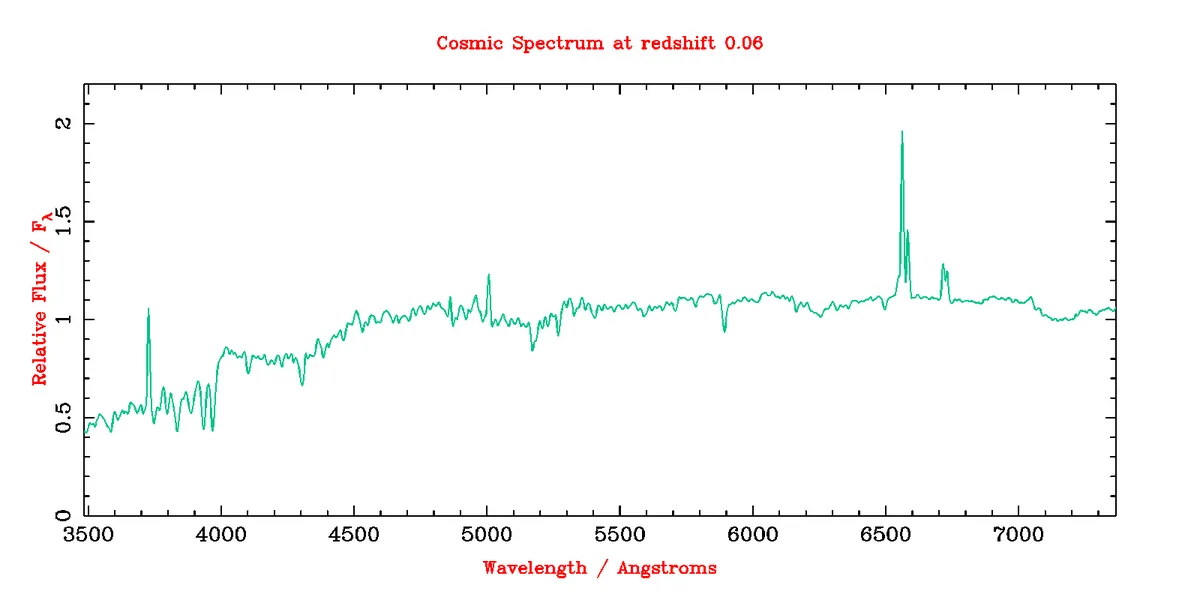
On the X axis we see the wavelength in angstroms. Let's remember: humans can see what is called the optical range or visible light, between 380 to 750 nm. One nanometer equals 10 angstroms.
This graph, in color, would look like this:

This could be the end of the answer. It is not ONE color, but a spectrum. But astronomers wondered, what is the average color? For that they used CIE diagrams. What is that?
CIE is the acronym for Comission Internationale de l´Éclairage (International Commission on Illumination). They designed a two-dimensional system to represent how the cells in our eyes capture light. There are three types of cells that are sensitive to different energy ranges within the visible spectrum and that our brain interprets as red, blue, and green. But color can be represented as two variables: brightness and chromaticity. Thus, by computing those two values (called x and y) a color can be represented. The CIE developed the XYZ or standard color system. In the original work those three RGB color data points were 0.269, 0.388, 0.342.
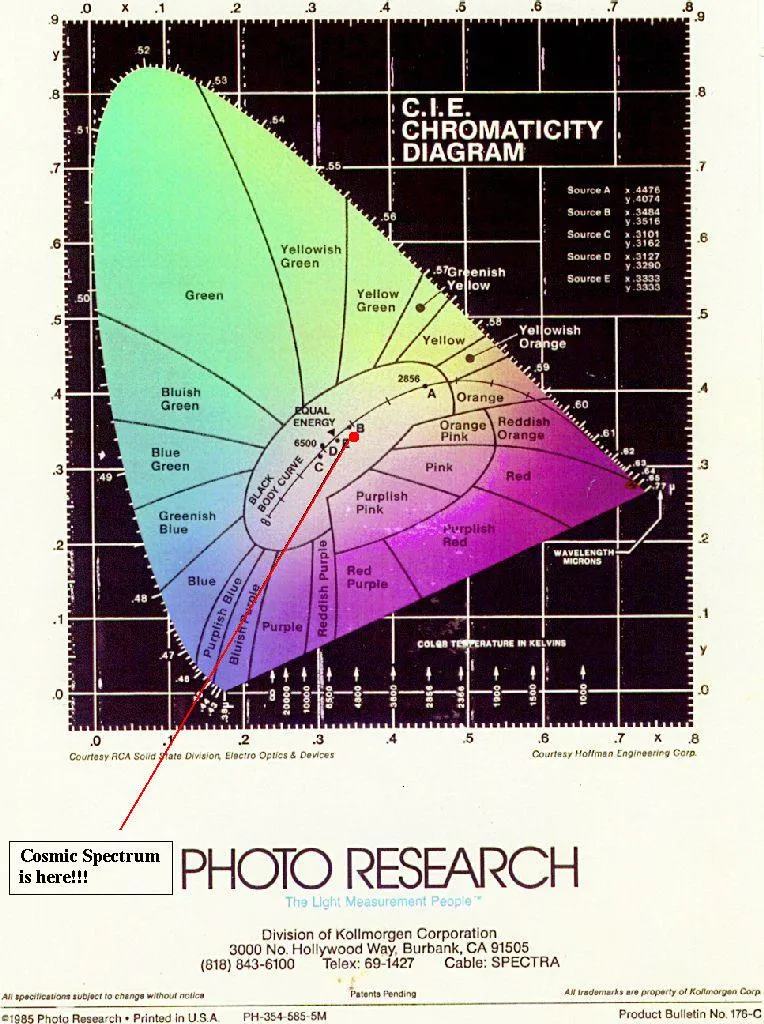
The original publication stated that this average color was turquoise. A couple of months later, they issued a statement explaining that due to an error in the software used, the average color was (255, 248, 231), closer to white/cream.
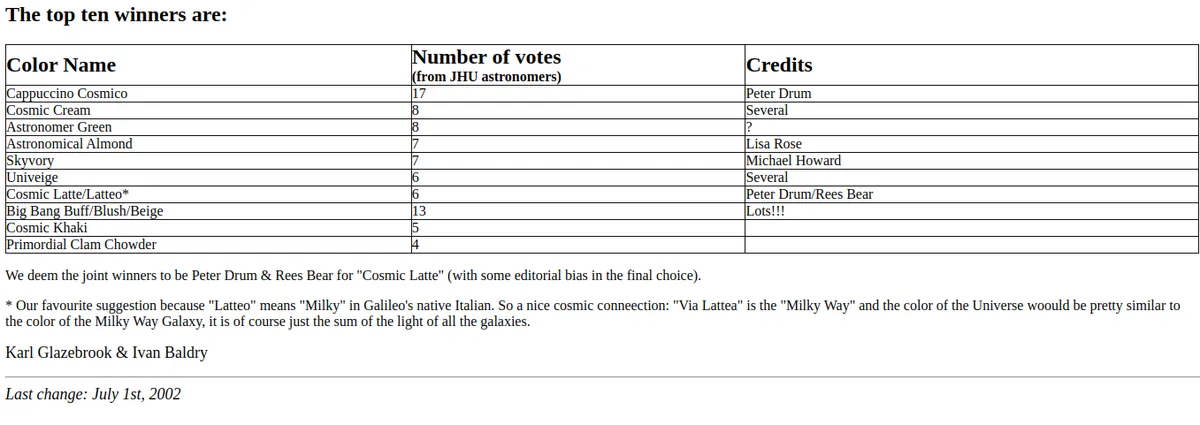
A small survey was conducted among astronomers at Johns Hopkins University and the name for the color chosen by the authors was "Cosmic Latte", although the most voted for was "Cosmic Cappuccino".
The result can be shown like this:

It may look cream. But if the background is black, it's hard to tell the color from white.

THE SCIENTIFIC BACKGROUND
In that published work, the reference to an RGB color is a footnote, a "colorful" comment, an interesting or curious addition, but not the goal of the research.
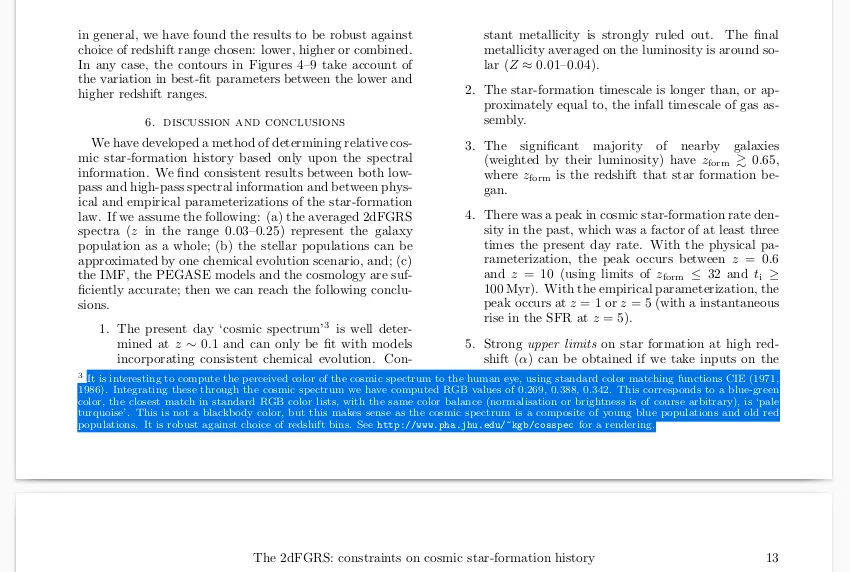
The astronomers' goal was not to make some nice images about the color of the universe. That is something interesting, curious, nerdy, ideal for outreach, but not the center of the scientific research. The goal was to understand stellar evolution throughout the history of the universe. You already know what "black body" means. It is an ideal object proposed in physics that absorbs all wavelengths of light it receives. Since light is energy, the object heats up and emits thermal radiation and shines. The brightness depends only on temperature.
In the work, the astronomers state that most stars in the current universe formed 5 billion years ago. When they form, stars are very hot and blue. Over time they cool down and redden. Therefore, there is a stellar "color history" in the universe. By the way, galaxies are seen from Earth with a redshift due to the expansion of the universe. In the previous calculation that was corrected.
In a graph published on an outreach page, the astronomers show how the color of the universe will evolve, from the Big Bang until 7 billion years in the future.

In HTML colors, the color of the universe is #fff8e7. Use a web color picker and you'll see how it looks on your monitor.
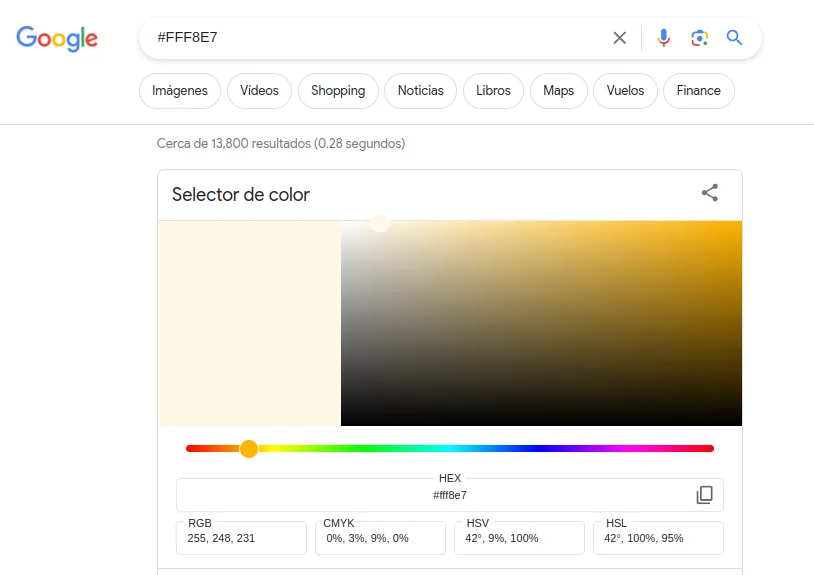
I'd call it "khaki", but I admit that "Cosmic Latte" (which means "Cosmic Coffee with Milk") sounds better. Excellent to pair with the crescent moon. Waiter, a cortado!☉
Sources and related links
- The Cosmic Spectrum and the Color of the Universe
https://www.astro.ljmu.ac.uk/~ikb/Cosmic-Spectrum.html - The 2dF Galaxy Redshift Survey: constraints on cosmic star-formation history from the cosmic spectrum
I. K. Baldry, K. Glazebrook et al
https://arxiv.org/abs/astro-ph/0110676
Ivan K. Baldry et al 2002 ApJ 569 582
DOI 10.1086/339477
Café con leche cósmico https://es.wikipedia.org/wiki/Caf%C3%A9_con_leche_c%C3%B3smico
It was finally discovered why the viral dress was seen in different colors https://www.infobae.com/tendencias/2017/04/14/por-fin-se-descubrio-por-que-el-vestido-viral-se-veia-de-diferentes-colores/
Universe: Beige, not Turquoise https://www.wired.com/2002/03/universe-beige-not-turquoise/
About the images
Coffee photo: By David Adam Kess - Own work, CC BY-SA 4.0, https://commons.wikimedia.org/w/index.php?curid=44394094
Graphics by I. K. Baldry, K. Glazebrook et al (2002).