It's been a quarter of a century since Google, the ISS and the concept of dark energy have existed.
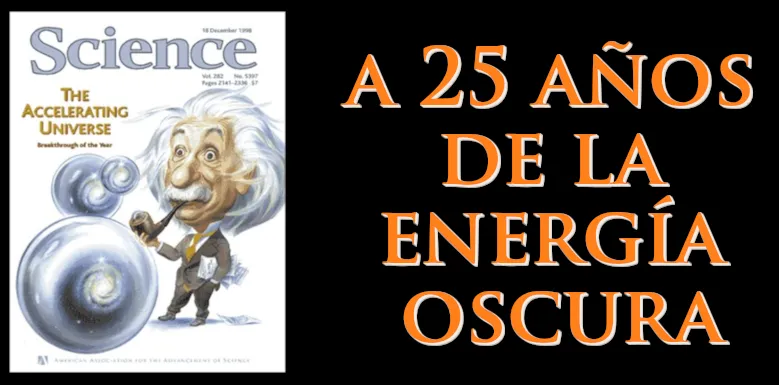
In 2024 we will start year 26, since 1998. That was a nerdy year. Google was founded, construction of the International Space Station began, and the term "dark energy" was invented.
The history of dark energy is interesting because it is one of those cases where astronomers found something different from what they expected. In short: During the 1920s, Edwin Hubble and Humason calculated the distance to relatively nearby galaxies by detecting Cepheid variables in them, used as "standard candles". Hubble's successor, Allan Sandage, continued the work and published a famous paper in which he said that cosmology should establish two numbers: the rate of expansion of space (denoted h0) and the deceleration rate (q0). The latter implied that, in the long run, the expansion should have a lower speed.
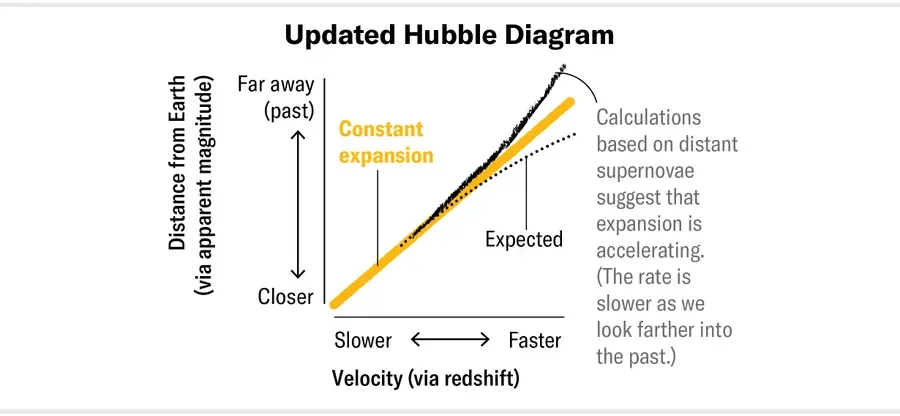
To extend Hubble's Law and its well-known diagram to larger scales, it was necessary to calculate the distance to much more distant galaxies. Cepheids would not be the right tool. Then they thought of using Type Ia supernovae as a resource. Two independent groups reached the same conclusions in 1998. When the most distant galaxies are added to the diagram, the result is not linear.
What astronomers expected was that very distant galaxies would be brighter, in proportion to the expansion rate. If that expansion frequency was constant, one could calculate what the brightness would be according to the distance. What both groups found is that very distant galaxies are less bright than expected. One way to explain the result is that the expansion speed has increased.
LAMBDA AND OMEGA
The story goes that a couple of years after the publication of the General Theory of Relativity, Einstein was made aware that his model of the universe allowed space to contract or expand. The former seemed the most feasible due to gravitational attraction. Since there was no indication that this was the case - Hubble's observations would come a few years later - the German physicist decided to modify his theory and incorporate a variable called "Cosmological Constant" indicated by the Greek letter lambda (Λ). He defined it as a repulsive force with the aim of balancing gravity. Upon learning of Hubble's work and elaborating the idea of the expansion of space, Einstein considered that the incorporation of lambda into his theoretical scheme had been his greatest mistake and removed it.
By 1998, with the finding of the two supernova distance measurement projects, the concept of a "repulsive force", Einstein's cosmological constant, was recovered. That is why the Standard Cosmological Model that is currently in force and debated by cosmologists is called Lambda CDM, where CDM is the acronym for "Cold Dark Matter".
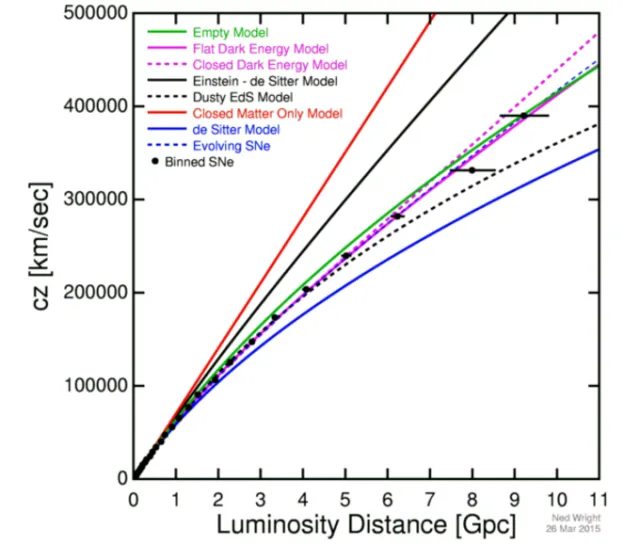
The data were convincing, it had to be something real: two independent groups, using different supernovae, reached the same conclusion. On the other hand, the idea of a "dark energy" solved some cosmological mysteries: galaxies had been detected that seemed to be older than the universe. Accelerated expansion was a solution. At the same time, the value of omega (Ω) had been calculated. For the astronomers of the time, the density of the universe was very low. Omega expresses the critical density rate or, to put it in Spanish: how much matter is needed for the universe to be flat or curved.
Since 1980, cosmologists have used inflationary theory, which implies an accelerated expansion in the first instants that, as a consequence, had flattened the universe. Thus, the universe had to be flat, with Ω=1, exactly what is needed for the total mass not to generate a gravity that contracts the universe. Until 1998, observations indicated that the composition of the universe was nowhere near 1, considering baryons (protons and neutrons) and dark matter. With dark energy, the scheme was completed and an omega very close to 1 was obtained, which is what observations seem to indicate.
DARK ENERGY: VERY BAD FOR ASTRONOMY
In 2007, theorist Simon White published an essay titled "Why dark energy is bad for astronomy". In short, he points to an old duel between observational astronomers and theoretical physicists. In an excerpt from his paper, White says:
Astrophysicists must motivate their activities in their own cultural context, not that of high-energy physics. This is especially important when interacting with students and young scientists. It is undeniable that dark energy is a fascinating enigma, but it is an enigma of high-energy physics. Creativity in understanding dark energy will not come from the planned astronomical surveys. They will provide more precise measurements of quantities that are already sufficiently known for astrophysics. Although achieving such precision is a major challenge, it offers few opportunities for scientific creativity, unless one is primarily interested in large dataset processing or data analysis statistics. Bright and ambitious students will decide to become astrophysicists only if they see the opportunity to make high-impact contributions as individuals. Within dark energy studies, these opportunities will come primarily from studies of astronomical objects. In the race to gain a financial advantage by labeling projects with the Dark Energy label, it is essential to avoid giving the impression that astronomical science is "secondary", of lesser importance or interest than improved measurements of cosmic expansion and structure growth histories. Translation done with the free version of the translator DeepL.com
WHAT ACCELERATES AND WHAT DOES NOT
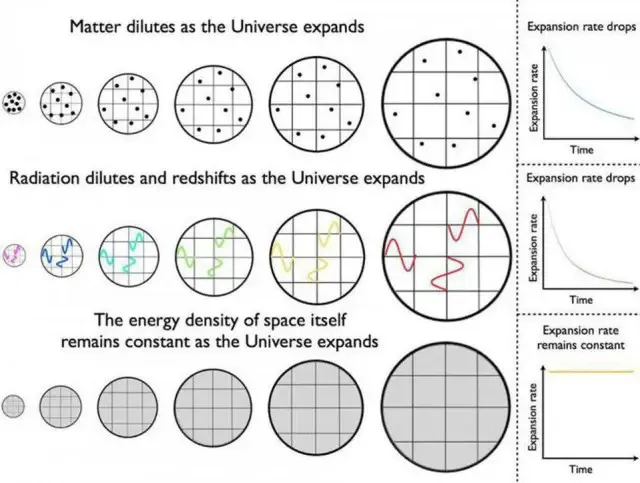
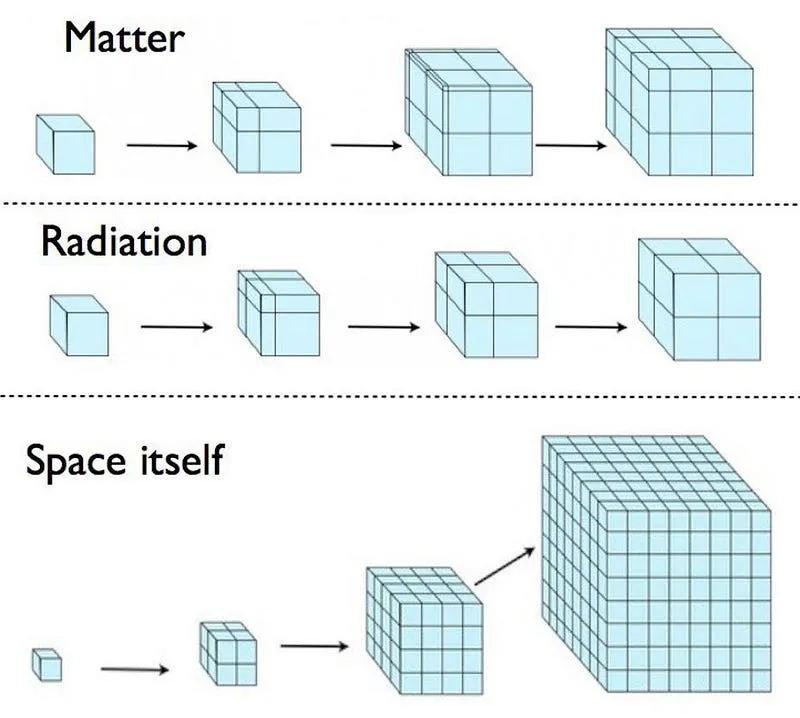
The expansion rate (h0) depends on the total energy density. If the universe had only matter and radiation, as it expands, the volume would increase, but not the energy, so the density would decrease and therefore, the expansion should decelerate. However, with dark energy something different happens: its density is constant, even though space changes size. In the origins of the universe, the dark energy component was small. Matter and radiation dominated, space expanded and as the density decreased, the expansion rate decreased. But the dark energy content increased until it became dominant. This implies that the expansion rate can no longer drop to zero, but tends to a non-zero value. The universe will not contract, but will continue expanding endlessly. Now, the expansion rate continues to decrease, but at a slower pace. Meanwhile, galaxies are moving away faster and faster in the distant universe.
THE ORIGIN OF THE TERM
Astronomer Michael Turner is credited with coining the term "dark energy" in a paper with Dragan Huterer. The concept of "dark matter" was already very established, so the use of the word "dark" as a synonym for "mysterious" turned out to be similar.
THE FUTURE OF THE CONCEPT
Twenty-five years ago, the journal Science published an issue with the discoveries of the year, in 1998. The great finding, according to the journal, was dark energy. The idea is part of the universe model of contemporary cosmology, but its understanding has not expanded enough in these five lustrums. Knowledge about dark energy did not accelerate. For some, this implies a "crisis" that deserves a change of model.
They say that "Time passes, truth flees". Which implies that doing cosmology is an almost impossible task. Despite which, some evidence can be gathered to form theories and try to prove them. However in science, as Murphy's Laws indicate, problems are not created, nor destroyed, they only transform.☉
Sources and related links
- The Most Shocking Discovery in Astrophysics Is 25 Years Old
https://www.scientificamerican.com/article/the-most-shocking-discovery-in-astrophysics-is-25-years-old/ - Observational Evidence from Supernovae for an Accelerating Universe and a Cosmological Constant
Adam G. Riess et al
https://arxiv.org/abs/astro-ph/9805201 - Measurements of Omega and Lambda from 42 High-Redshift Supernovae
S. Perlmutter et al
https://arxiv.org/abs/astro-ph/9812133 - Prospects for probing the dark energy via supernova distance measurements
Dragan Huterer, Michael S. Turner (Chicago/Fermilab)
https://arxiv.org/abs/astro-ph/9808133 - Constraining dark energy with SNe Ia and large-scale structure
Saul Perlmutter (LBNL), Michael S. Turner (Chicago/FNAL), Martin White (UIUC)
https://arxiv.org/abs/astro-ph/9901052 - Michael Turner
https://astro.uchicago.edu/people/michael-s-turner.php - The Cosmic Triangle: Revealing the State of the Universe
SCIENCE 28 May 1999 Vol 284, Issue 5419 pp. 1481-1488
https://www.science.org/doi/10.1126/science.284.5419.1481
https://arxiv.org/abs/astro-ph/9906463 - Dark energy fills the cosmos
https://www2.lbl.gov/Science-Articles/Archive/dark-energy.html - Breakthroughs 1998
https://www.science.org/doi/full/10.1126/science.282.5397.2193 - Fundamentalist physics: why Dark Energy is bad for Astronomy
Simon D.M. White
https://arxiv.org/abs/0704.2291 - Cosmology: A search for two numbers
Allan R. Sandage
Physics Today 23 (2), 34–41 (1970);
https://doi.org/10.1063/1.3021960 - Ask Ethan: What drives the expansion of the Universe?
https://bigthink.com/starts-with-a-bang/what-drives-expansion-universe/ - How Is The Universe Accelerating If The Expansion Rate Is Dropping?
https://bigthink.com/starts-with-a-bang/how-is-the-universe-accelerating-if-the-expansion-rate-is-dropping/ - Ask Ethan: Is the Universe’s expansion accelerating or not?
https://bigthink.com/starts-with-a-bang/universe-expansion-not-accelerating/
About the images
Graphics by: Jen Christiansen - Ned Wright/Betoule et al. (2014) - E. SIEGEL