The good and bad of the Netflix production. [Spoiler alert].
Science fiction novels and series do not always have much verisimilitude and scientific detail. The lack of great credibility does not prevent telling an attractive story. I recall the novel "Calculating God" (Robert Sawyer, 2000) in which a scientist establishes contact. How he communicates is hard to swallow, but what matters is what it poses: the scientist is an atheist, the ETs are looking for evidence of a creator.
In "The Light of Other Days" (Arthur Clarke and Stephen Baxter) a technologist invents a device that works like a wormhole, except that instead of using it to travel, it is used to see the past anywhere in space-time, albeit for brief seconds. The use of the concept is creative, even though it is not very plausible, but it poses an interesting number of consequences: all criminals are identified and captured, so crimes cease; mythical accounts are put to the test; the loss of privacy...
Authors need to take some liberties to be able to tell their stories and readers -even those of us who love science- must appeal to the provisional suspension of disbelief. If we look for the hair on the egg, it would be impossible to make these proposals, which as seen in the brief review above, can be very interesting.
On the other hand, works of fiction can be told from different points of view:
-When the protagonists know the same as the viewers
-When the characters know less than the audience
-When the protagonists know more than the public
In the first case, if the story is plausible for the characters, it will be for us, readers-viewers. The second case is deceptive, when the characters find out what we already know, they will react, perhaps in an unexpected way. The third case is that of "Ocean's Twelve" (Steven Soderbergh) in which a group of thieves must steal something before another thief. The director deceives the spectators, making us believe things happen that do not happen. This resource is very good because it guarantees surprise, but there is a risk that what finally happened is poorly explained or implausible.
Something like this also happened in the series Lost in which the credulous TV viewers thought everything would be properly explained at the end, with the disappointing known result.
I had that "déjà vu" when watching the first episode of "The Three-Body Problem" (3BP), on Netflix, without having read the literary work. But there is more to say about the first season.
GOOD
Unlike other current audiovisual productions, this series is truly science fiction, with all the letters.
It poses that humanity made contact and that the aliens, originating from Alpha Centauri, are coming here to conquer us, but it will take them 400 years to arrive. Meanwhile, these "San-Ti" as they are called, know everything that happens at all times anywhere on Earth, produce individual and massive hallucinations and other things, in a mysterious way.
The proposal is very interesting to evaluate how we would react to such a situation.
The narration advances, while presenting these mysteries and makes you want to know what will happen. The central characters (the scientists) are presented in a way that generates empathy, which at the same time hooks us into the story.
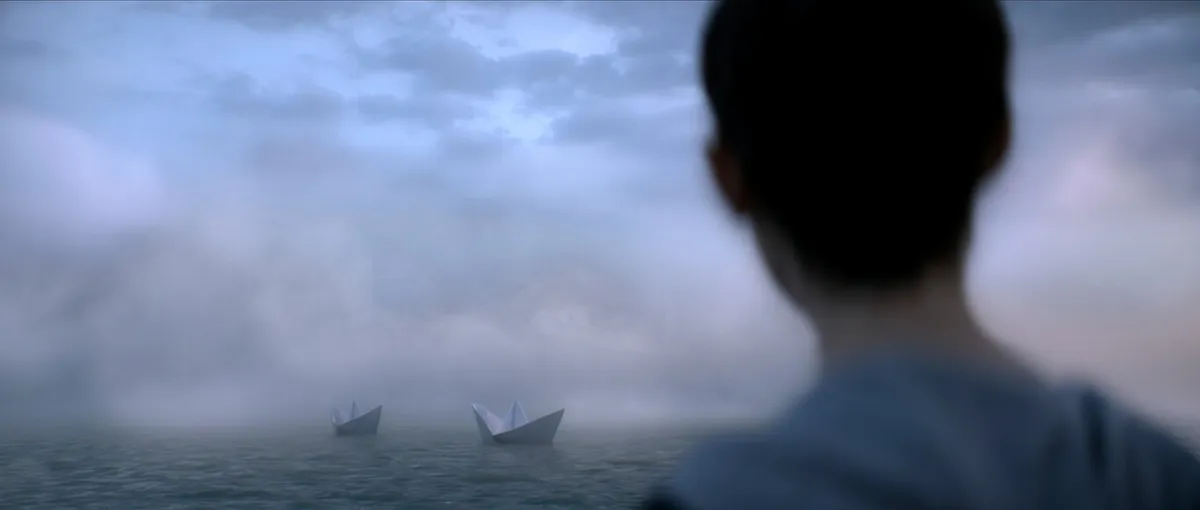
Towards the last of the 8 episodes, a metaphorical resource is used that had not been used until then, similar to the scene of the unicorn (director's cut) trotting while Deckard plays the piano, in Blade Runner. I am referring to the images of the paper boats, which gives it a poetic touch. [It seems that in the books the idea has another meaning].
BAD
The initial proposals seemed so crazy to me that they would be very difficult to explain. I expected another "Lost". I cannot say, yet, if that is the case. It is to be assumed that there will be at least another season, who knows when. The explanations for many of the oddities of the beginning arrived around the middle of the episodes with the mention of sophons, supposed pico-technology that allows creating 11-dimensional supercomputers, the size of a proton (in 3D). The director uses these sophons as a magic wand, as a deus ex machina.
On the other hand, it is curious that the attitude of some towards the ETs is quasi-religious reverence, a kind of sect that justifies anything (even deaths) under the argument "they know". It is a waste not to delve deeper into the social consequences.
How people manage to speak with the San-Ti is another issue difficult to explain and that we let pass because we understand that otherwise there would be no story. [Except for Douglas Adams, inventor of the Babel Fish].
It is striking that the aliens do not use their supercomputers to mathematically solve the three-body problem, which we know has a convergent solution, although very slow.
TO COME
What is not slow is how the story is narrated. According to those who read Liu Cixin, these 8 episodes include actions from the following books.
Due to the journey of the ETs, and the fact that they already talk about hibernation and use it, the story is going to be long. At the end of this string of chapters, the Wallfacer strategy is established by which 3 people are chosen with authorization to develop plans against the San-Ti, without telling anyone (because the ETs can know everything, but cannot read minds). What plans will they have and how will they fare? That should be part of the next season. According to summaries I read of the work, the total plot lasts millions of years and includes the end and possible rebirth of the universe.
CONCLUSION
The Dark Forest hypothesis, name of the second book, is addressed in a scene in which the Chinese scientist tells Saul the story of Einstein and the saxophone, subtly. Basically, she wants to convey the idea that -for that story- it was convenient for Einstein to go unnoticed. That concept has been elaborated with respect to possible extraterrestrial civilizations as a possible answer to the Fermi Paradox. Paradoxically, Liu Cixin's books and the Netflix series will not go unnoticed.☉
Sources and related links
- Deus ex machina
https://es.wikipedia.org/wiki/Deus_ex_machina - The Three-Body Problem (novel)
https://en.wikipedia.org/wiki/The_Three-Body_Problem_(novel)
About the images
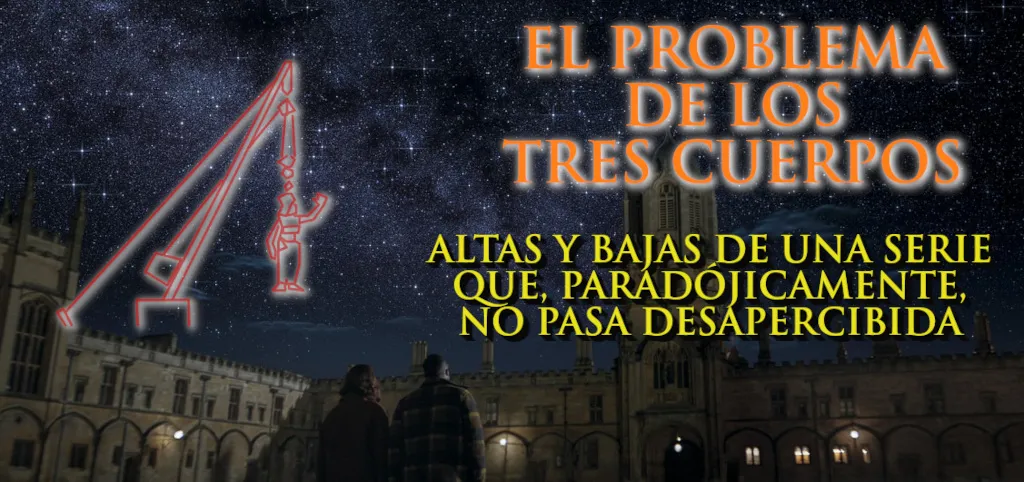
Credit: Netflix