Results from data collected with the DESI instrument.
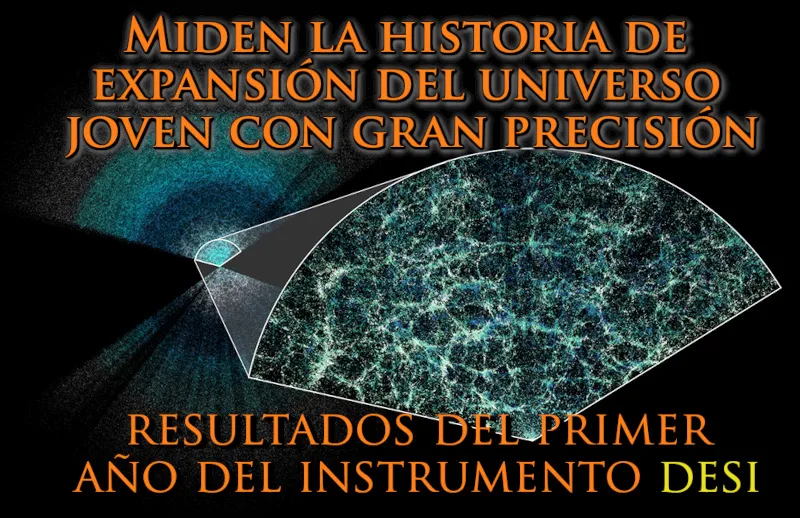
DESI stands for Dark Energy Spectroscopic Instrument. The main goal of researchers using DESI is to measure the expansion history of the Universe, with exquisite precision, over the last 11 billion years. This will achieve constraints on a large number of possible dark energy models. To achieve this, DESI will measure the position and recession velocity of approximately 40 million galaxies.
The instrument was mounted on the Mayall Telescope at Kitt Peak National Observatory, Arizona. It is a reflecting telescope with a 4m primary mirror, supported by an equatorial mount.
The telescope has 10 spectrographs. Each of the 10 spectrographs that make up the DESI instrument accepts an optical fiber cable connected to 500 fibers. The light collected by the fibers passes through the spectrograph via an aperture, with a shutter in front. When the shutter is open, the light is split using color filters passing to three cameras, each sensitive to a different wavelength range, and with different resolution.
After a year of operations, the result of a first analysis was announced: "We are incredibly proud of the data, which have produced world-leading cosmological results and are the first to come out of the new generation of dark energy experiments", said Michael Levi, director and scientist at the Lawrence Berkeley National Laboratory of the Department of Energy, which manages the project.
And he added: “So far, we’re seeing basic agreement with our best model of the universe, but we’re also seeing some potentially interesting differences that could indicate dark energy is evolving with time. Those may or may not go away with more data, so we’re excited to start analyzing our three-year dataset soon”.
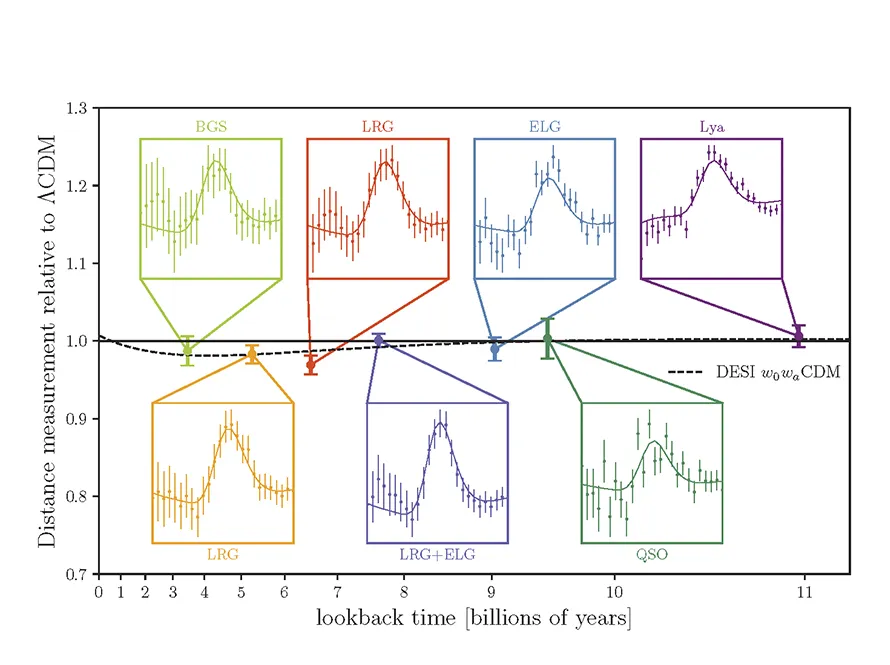
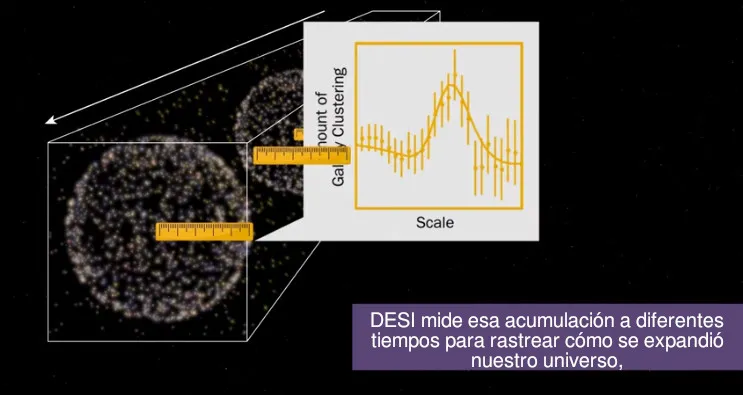
DESI's Hubble diagram plots a characteristic pattern (baryon acoustic oscillations or BAO "bubbles") at different ages of the universe. The amount of dark energy determines how fast the universe grows and, therefore, the size of the bubbles. The solid line shows the size Lambda CDM predicts the bubbles will be, while the dashed line shows the prediction of a different model where dark energy evolves over time. DESI will collect more data to determine which model is a better description of the universe. (Credit: Arnaud de Mattia/DESI collaboration)
Looking at DESI's map, it's easy to see the underlying structure of the universe: strings of clustered galaxies, separated by voids with fewer objects. Our early universe, far beyond DESI's view, was quite different: a hot, dense soup of subatomic particles moving too fast to form stable matter like the atoms we know today. Among those particles were the nuclei of hydrogen and helium, collectively called baryons.
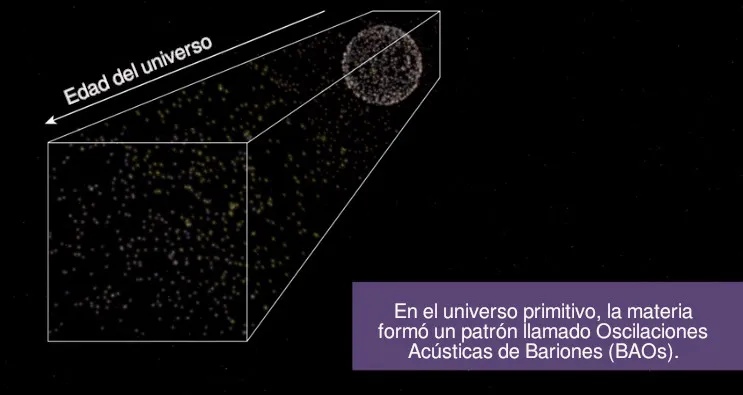
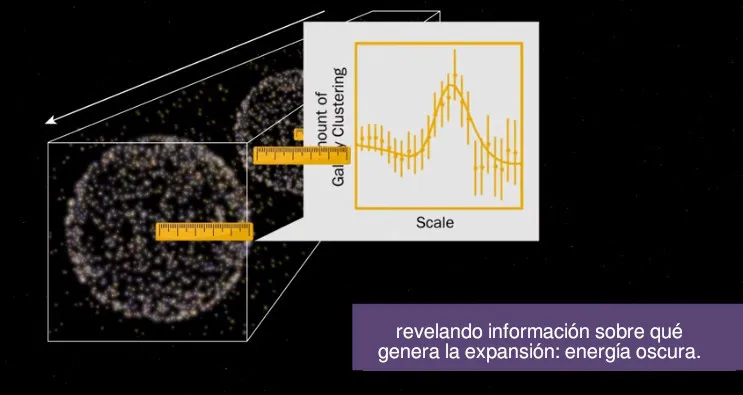
Small fluctuations in this early ionized plasma caused pressure waves, moving the baryons in a wave pattern similar to what you would see if you threw a handful of stones into a pond. As the universe expanded and cooled, neutral atoms formed and the pressure waves stopped, freezing the waves in three dimensions and increasing the clustering of future galaxies in the dense areas. Billions of years later, we can still see this faint wave pattern or three-dimensional bubbles in the characteristic separation of galaxies, a feature called baryon acoustic oscillations.
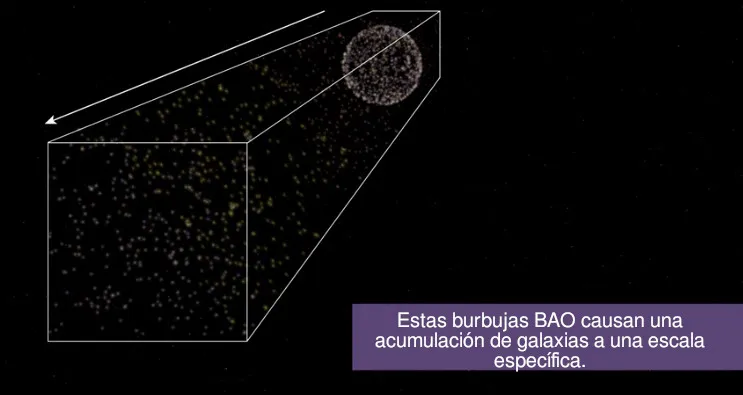
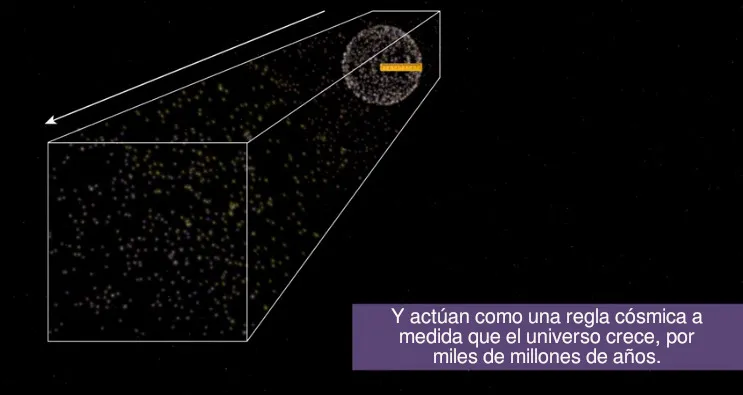
Researchers use BAO measurements as a cosmic ruler. By measuring the apparent size of these bubbles, they can determine distances to the matter responsible for this extremely faint pattern in the sky. Mapping BAO bubbles both near and far allows researchers to slice the data into parts, measure how fast the universe expanded at each moment in its past, and model how dark energy affects that expansion.
Using galaxies to measure expansion history and better understand dark energy is one technique, but it can only go so far. At a certain point, light from typical galaxies is too faint, so researchers turn to quasars, bright and extremely distant galactic nuclei with black holes at their centers. Light from quasars is absorbed as it passes through intergalactic clouds of gas, allowing researchers to map pockets of dense matter and use them the same way they use galaxies, a technique known as the "Lyman-alpha forest".
"We use quasars as a backlight to basically see the shadow of the gas that lies between the quasars and us", says Andreu Font-Ribera, a scientist at the Institute for High Energy Physics of Spain who co-leads DESI's Lyman-alpha forest analysis. “It allows us to look farther back, when the universe was very young. It’s a really hard measurement to do, and it’s great to see it succeed.”
Researchers used 450,000 quasars, the largest set ever collected for these Lyman-alpha forest measurements, to extend their BAO measurements back 11 billion years. By the end of the survey, DESI plans to map 3 million quasars and 37 million galaxies.
"We are in the golden age of cosmology, with large-scale surveys underway and about to be started, and new techniques being developed to make the most of these datasets," says Arnaud de Mattia, a researcher at the French Alternative Energies and Atomic Energy Commission and co-leader of the DESI group that interprets the cosmological data. "We're all really motivated to see whether new data will confirm the features we saw in our first-year sample and build a better understanding of the dynamics of our universe."
Sources and related links
- First results from DESI make the most precise measurement of our expanding universe
https://www.symmetrymagazine.org/article/first-results-from-desi-make-the-most-precise-measurement-of-our-expanding-universe - DESI
https://www.desi.lbl.gov/es/science-spanish/ - First Results from DESI Make the Most Precise Measurement of Our Expanding Universe
https://newscenter.lbl.gov/2024/04/04/desi-first-results-make-most-precise-measurement-of-expanding-universe/ - DESI VR Flight Stereoscopic
https://www.youtube.com/watch?v=jRYUt9nE9b0
About the images
Claire Lamman/DESI collaboration
Arnaud de Mattia/DESI collaboration