On ultra-faint satellite galaxies and gradients in astronomy.

Readers of the blog will have noticed that I make jokes appealing to the double meaning of words. A much-used resource is combining words with antagonistic meanings. The name of the music band "Peligrosos gorriones" is a good example.
If we try to invent jokes that way, one possibility is to think of "micro galaxies", given that the term galaxies refers to one of the largest structures in the cosmos. But just as in the biological diversity of our world, the universe also presents gradients that generate ambiguity in human classifications.
The Argentine astronomer, living abroad, Julio Navarro, was in the news last week for having received an Honoris Causa degree from the Casa de Trejo (University of Córdoba), the house of studies where he graduated. A couple of years ago his name was catapulted to media stardom for being mentioned as a Nobel Prize candidate. I have said here that this was very unlikely, until the existence of dark matter is empirically verified in a direct way. But that does not detract from his research, some of which has been widely accepted among his peers (citations).
Among his most recent works, two stand out on micro galaxies and ultra-faint dwarf galaxies. The difference between the former and the latter is really subtle. The former would be galaxies that were dominated by dark matter and therefore have a nucleus of stars very tightly bound gravitationally, to the point that they resist the gravitational tugs that tear galaxies apart when they interact with others. Finding galaxies like this is a way to verify the prevailing cosmological model, called Lambda CDM, which assumes the existence of dark matter.
Ultra-faint dwarf galaxies are usually satellite galaxies. An international team of astrophysicists (which included Navarro), using the UNIONS survey (Ultraviolet Near Infrared Optical Northern Survey) discovered a very compact satellite galaxy of the Milky Way, which received the designation Ursa Major III/UNIONS 1, (UMa3/U1).
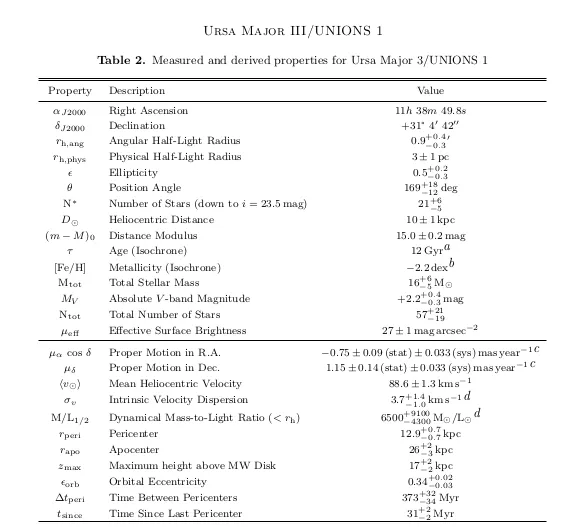
After identifying this group of stars, they used data obtained with the Keck telescope and from the Gaia probe that confirmed it is a coherent, co-moving system. UMa3/U1 has a visual magnitude of 2.2, making it the faintest known satellite, with an effective radius of 10 light-years. Calculations indicate its content is 50-60 stars, with an approximate mass of 16 solar masses. It is like a galaxy that had 16 stars of the mass of our sun.
However, returning to the concept of gradients and the ambiguities of classifications, it is not entirely clear whether it is a dwarf galaxy or a globular cluster. UMa3/U1 is located 52,000 light-years from the galactic center.
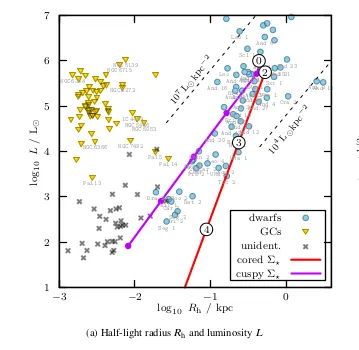
The intermediate region between dwarf galaxies (sky blue circles) and globular clusters (yellow triangles) contains unidentified objects (gray crosses). Credit: Raphaël Errani et al (2023).
MICROQUASARS
In an analogous way, microquasars also exist. A quasar is an object that looks like a star, because it is point-like, but is very, very distant and is thought to be the active nuclei of galaxies, powered by supermassive black holes. But micro-quasars have been detected, which are thought to be X-ray binaries (XRB) that are binary systems composed of a compact object – which can be a stellar-mass black hole or a neutron star – accreting matter from a companion star.
That is, while quasars are the very distant galactic centers, active due to supermassive black holes, of millions of solar masses; microquasars are binary objects that can include a stellar-mass black hole.
Microquasars have also been studied by Argentines: Dr. I Félix Mirabel (CEA Saclay, France & IAFE-CONICET, Argentina) and Dr. Gustavo Romero (IAR-CONICET & UNLP), with the GARRA group of the Instituto Argentino de Radioastronomía, have dedicated themselves to the topic, making important contributions to world astronomy.
Just as water (H2O) can form a timid trickle of liquid from a poorly closed tap, but can also compose tsunamis, waterfalls and oceans, the universe offers its phenomena in gradients: atoms unite and fuse to produce objects from the most distant and diffuse, to the closest and brightest, the most and the least massive. Super-Earths and dwarf planets, dwarf stars and giants. Cosmic diversity is countless and astonishing.
One might wonder, if we say there are as many stars in the galaxy as grains of sand on a beach, then, it must not be very nice to spend the summer in UMa3/U1.
And their cats must be very angry for not having a decent litter box!☉
Sources and related links
- The discovery of the faintest known Milky Way satellite using UNIONS
Simon E. T. Smith et al
https://arxiv.org/abs/2311.10147 - Micro galaxies as a falsifiable prediction of LCDM cosmology
Raphaël Errani, Rodrigo Ibata, Julio F. Navarro, Jorge Peñarrubia, Matthew G. Walker
https://arxiv.org/abs/2311.14798 - Julio Navarro: “Doing science is asking better questions”
https://www.unc.edu.ar/comunicaci%C3%B3n/julio-navarro-%E2%80%9Chacer-ciencia-es-hacer-mejores-preguntas%E2%80%9D - Astronomers discover the Milky Way's faintest satellite
https://phys.org/news/2023-11-astronomers-milky-faintest-satellite.html - A double-sided radio jet from the compact Galactic Centre annihilator 1E1740.7-2942
https://ui.adsabs.harvard.edu/abs/1992Natur.358..215M/abstract - "Microquasars" in Our Own Galaxy
https://www.nrao.edu/pr/2000/vla20/background/superlum/ - IAR: Microquásares
https://www.iar.unlp.edu.ar/actividades/temas-de-investigacion/microquasares/ - Grupo GARRA
https://garra.iar.unlp.edu.ar/
About the images
Table: Simon E. T. Smith et al (2023)
Graph: Raphaël Errani et al (2023).