Pluto's revenge?
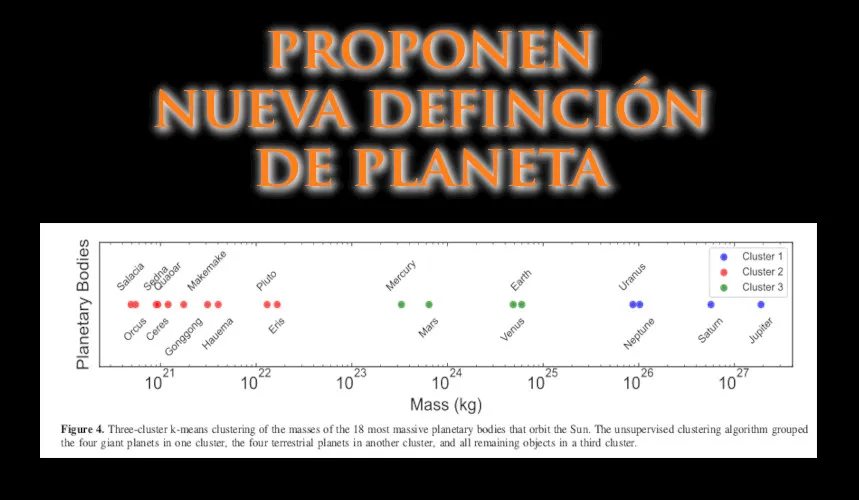
In a paper presented in The Planetary Science Journal, Jean-Luc Margot and others propose two definitions of planet.
Let's remember that the concept was redefined in 2006 and has three requirements. According to IAU resolution B5, a planet is a celestial body that (a) is in orbit around the Sun, (b) has sufficient mass for its gravity to overcome rigid body forces, so that it assumes a hydrostatic equilibrium (nearly spherical shape), and (c) has cleared the neighborhood around its orbit.
The definition was a consequence of an ambiguity: it was considered that planets and asteroids orbit the Sun, but the former are large and spherical, while the latter are small and irregular. But small and spherical objects began to be discovered, to which they were sometimes called "planetoids" because they had some characteristic of a planet and others of an asteroid.
Although the new definition served for that, it is problematic because, according to the author of this work, it is not quantitative and excludes exoplanets.
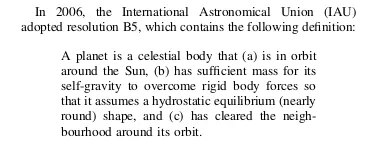
He is right: the "roundness" of an object, as well as its "clean orbit" are ambiguous concepts, unless they are quantified. Of course, any value that is established will be somewhat arbitrary, with which, the subjectivity is still there, but only to a certain extent. Taking density into account, a minimum mass required for an object to achieve the two requirements can be established: b and c.
On the other hand, any definition of planet should be coherent or compatible with that of exoplanet, or else be one single thing.
In 2018, the IAU's Commission F2 on exoplanets proposed the following definition of that concept:
Objects with true masses below the limiting mass for thermonuclear fusion of deuterium (currently calculated to be 13 Jupiter masses for objects of solar metallicity) that orbit stars, brown dwarfs or stellar remnants and that have a mass ratio with the central object below the L4/L5 instability are "planets", no matter how they formed. The minimum required mass and size should be the same as for the Solar System.
Margot and others, propose:
1-A planet is a celestial body that
(a) orbits one or more stars, brown dwarfs or stellar remnants;
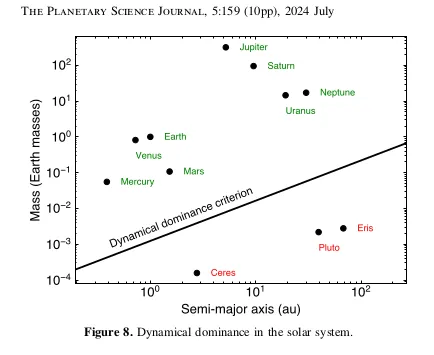
(b) has sufficient mass to dynamically dominate the neighborhood around its orbit, e.g., m> 0.0001 2m_central^5/8 a^9/8, where m is the mass of the planet expressed in Earth masses, m_central is the mass of the central body in solar masses and a is the semi-major axis expressed in astronomical units;
(c) has sufficient mass for self-gravity to overcome rigid body forces, so that it will be approximately in hydrostatic equilibrium and assumes a nearly triaxial shape, e.g., m>10^21 kg;
(d) has a true mass below the limiting mass for thermonuclear fusion of deuterium (currently calculated to be 13 Jupiter masses for objects with solar metallicity); and
(e) has a mass ratio with the central object below the L4/L5 instability, e.g., m/m_central ~1.25.
The second proposal is:
2-A planet is a celestial body that
(a) orbits one or more stars, brown dwarfs or stellar remnants;
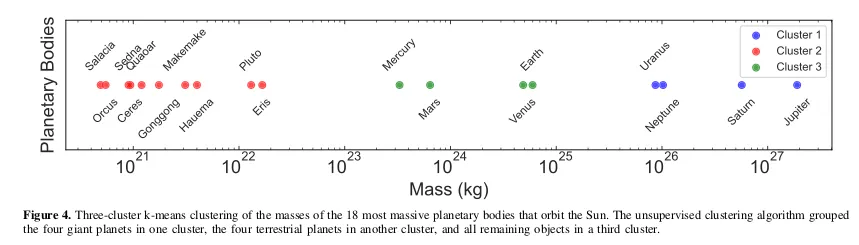
(b) is more massive than 10^23 kg; and
(c) is less massive than 13 Jupiter masses (2.5 x 10^28 kg).
Pluto has a mass on the order of 10^22 kg. Therefore, according to the second proposal Pluto would still not be considered a planet. Let's remember that Mercury has an approximate mass of 3 x 10^23 kg, that is, an order of magnitude (factor 10) of difference.
In both cases:
A satellite is a celestial body that orbits a planet.
The IAU Exoplanet Nomenclature Working Group has established that free-floating bodies ("rogue planets", "planetas errantes") are not planets. In this case it is proposed that they must satisfy criteria (b) and (c).
The IAU will meet this year in its XXXII General Assembly in Cape Town, South Africa, in August. It is unlikely that a new definition will be adopted so quickly. It is logical that astronomers deliberate a lot before redefining the word planet.☉
Sources and related links
- Astronomers Propose New Criteria to Classify Planets, but Pluto Still Doesn’t Make the Cut
https://www.smithsonianmag.com/smart-news/astronomers-propose-new-criteria-to-classify-planets-but-pluto-still-doesnt-make-the-cut-180984733/ - What exactly is a planet? Scientists propose improved definition
https://science.ubc.ca/news/july-07-2024/what-exactly-planet-scientists-propose-improved-definition - Astronomers want to change how we define a planet — again
https://www.livescience.com/space/planets/astronomers-want-to-change-how-we-define-a-planet-again - Quantitative Criteria for Defining Planets
Jean-Luc Margot et al 2024 Planet. Sci. J. 5 159
DOI 10.3847/PSJ/ad55f3
https://iopscience.iop.org/article/10.3847/PSJ/ad55f3 - IAU Assembly
https://www.iau.org/science/meetings/future/general_assemblies/2396/
About the images
Margot et al (2024).