About the "dark side" of the Moon.
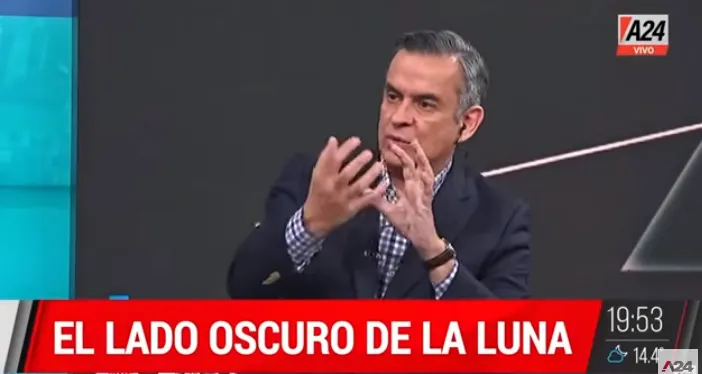
The former congressman, former vice-presidential candidate, university professor and international politics journalist Luis Rosales said this Friday, May 3, on channel A24, that the Moon has a "dark side", that it is not seen, that sunlight does not reach it, that it does not rotate... His studio colleagues, journalists Javier Díaz and Mariano Yezze, did not correct him. Below, in the links, link to the program's video on YouTube.
It's a blunder as big as a house. This should be known since high school. But there are still adults, graduates, even university graduates, who repeat this nonsense. Let's explain before it gets dark.
THE MOON'S ROTATION
Let's suppose the Moon did not rotate, but only revolved around the Earth. To be clear, let's define in some way what is and what is not rotating: If I rotated, my eyes would see first in one direction, then in another, and so on. On the other hand, if I always looked in the same direction, I am not rotating. Easy, right?
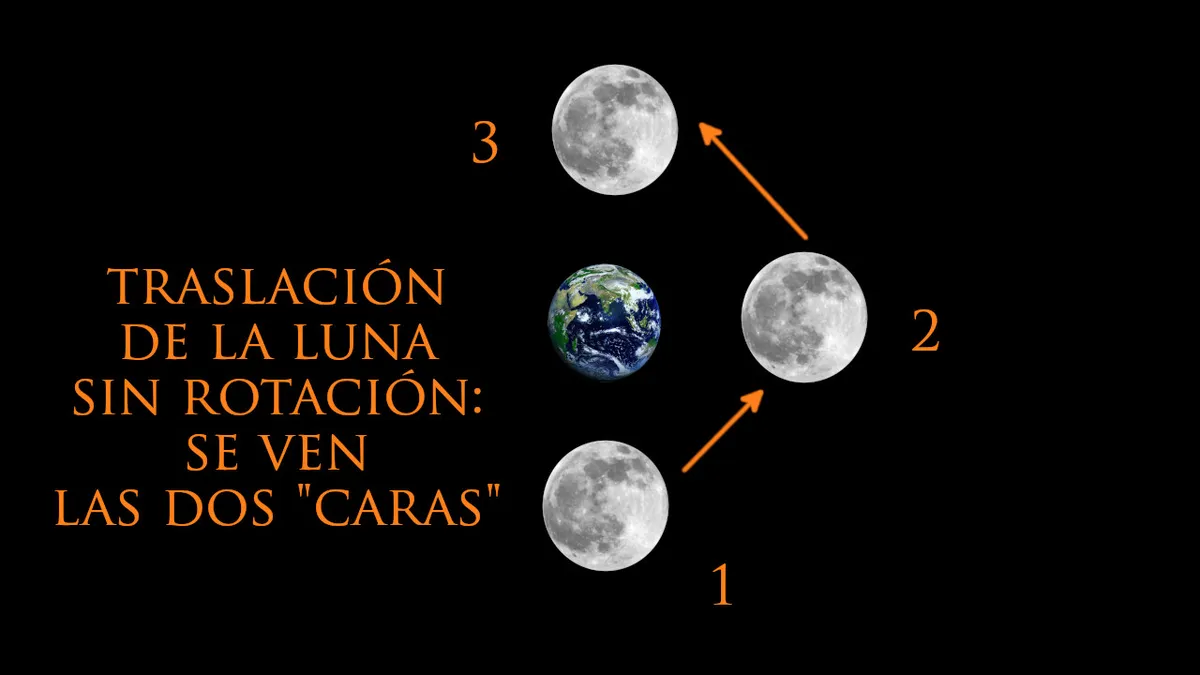
Well, let's look at the following image created for this purpose only. Obviously it is not to scale.
In position 1 we see the Moon. We, spectators from outside the system, see one face. But the inhabitants of Earth, in position 1, see the other face, right?
In position 2, the inhabitants would already be seeing something more than one face. And certainly, in position 3, they would see the same face as us, and therefore, they will have seen both faces, despite the fact that the Moon in this sequence does not rotate, it only revolves.
It is clear that this does not happen because we see only one "face". Therefore, it is false that this occurs. What is true is that the Moon ROTATES. And that is why we see only one face.
THE "FACES" OF THE MOON
Before continuing, some clarification is worthwhile. The Moon is almost a sphere. It deforms due to tidal forces, but for the purposes of this writing, it is a sphere. Spheres do not have "faces" as if they were cubes or pyramids, since they have no sides. But we could imagine that we cut a ball, a sphere, into two halves and paint the surface of each part a color. Then we could say that sphere has two "faces". Under that assumption, human beings, at any given moment, see one face, which is almost always the same. If we are a little more detailed, given a third movement the Moon has, called "libration", over the course of a year about 60% of the lunar surface can be seen.
ROTATION SPEED
What happens with the Moon is that its rotation and its revolution take the same amount of time. This does not mean the speed is the same, but on the contrary: the rotation speed is much slower than the revolution. Let's imagine that as the Moon rotates and revolves it "draws" a circle. Obviously, the circle of rotation is much smaller than that of revolution. But it takes the same amount of time (29.5 days) to go around both circles. Therefore, the speed of rotation must be much less than the speed of revolution.
Sometimes, however, we say that the rotation and revolution speeds are the same, because we are not talking about common speed, measured in km/h (for example), but in degrees/time.
Thus, the Moon takes 29.5 days to complete the 360º turn of rotation and the same amount of time to revolve around the Earth. In this case, we are not using length, but degrees, since all circles have the same amount.
Due to this slow rotation, as it is accompanied by revolution, there is one side we do not see from Earth. It is a side "hidden" from our view. But that does not happen with the Sun. The Moon, along with Earth, revolve around the Sun and therefore sunlight falls on the "hidden side". The "day" on the Moon lasts 15 days and the night, just as long.
THE DRUNKEN POLE GAME
In an old TV program, participants had to perform a test: carry a glass with water and other things, on a tray, from one place to another. The difficulty lay in that, before, they had to place their hands and head on a pole 1 meter high, and spin 20 times. Immediately after, they had to transport the tray. By spinning around the pole, the participants get dizzy (as if they were drunk) and that's where the difficulty lies.
Well then: if we think about such a movement, it is rotating and revolving simultaneously. The pole always sees our face, never our back. We go around the pole, therefore we revolve and our head points in different directions, therefore, we rotate.
The movement is NOT just revolution. If it were only revolution without rotation, we should always look in the same direction, as in the previous illustration of the Moon without rotation.
This simple example shows how it is possible to rotate and not show your back: by revolving at the same speed, not in length/time, but in degrees/time.
Below are two images showing the illustration of a person revolving around the Earth, rotating and not rotating.
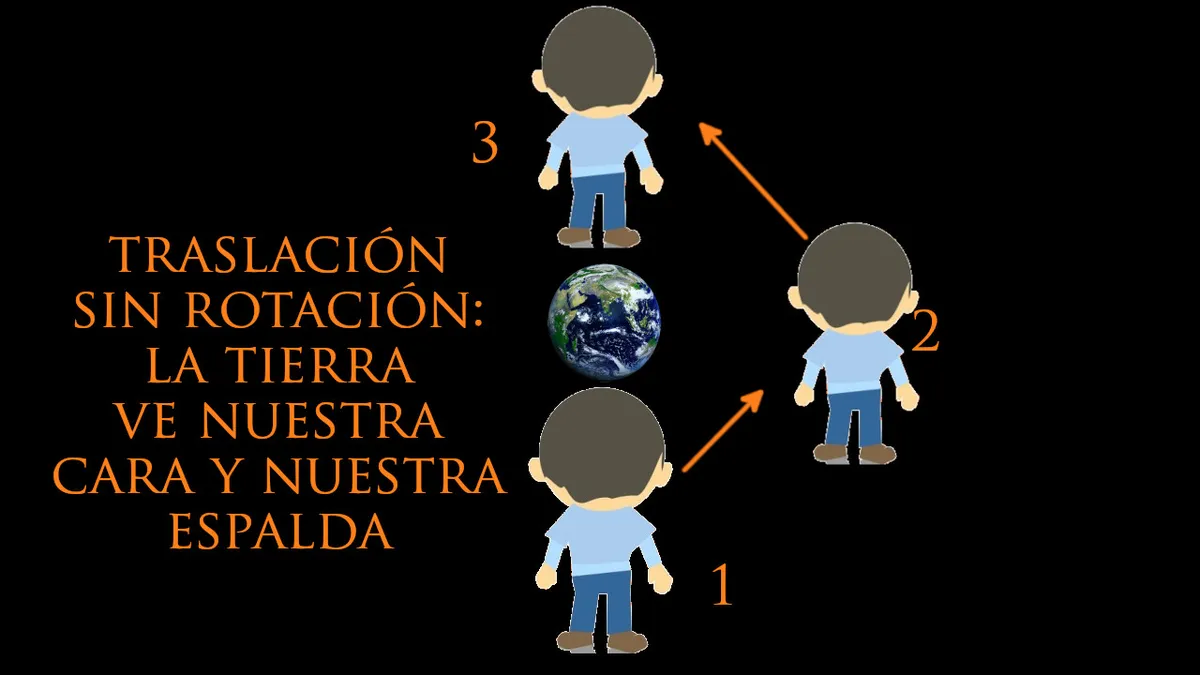
When the person rotates, in addition to revolving, their gaze changes direction. When they do not rotate, it does not. [I indicate their gaze as a reference because it's easier, but it doesn't have to be the gaze].
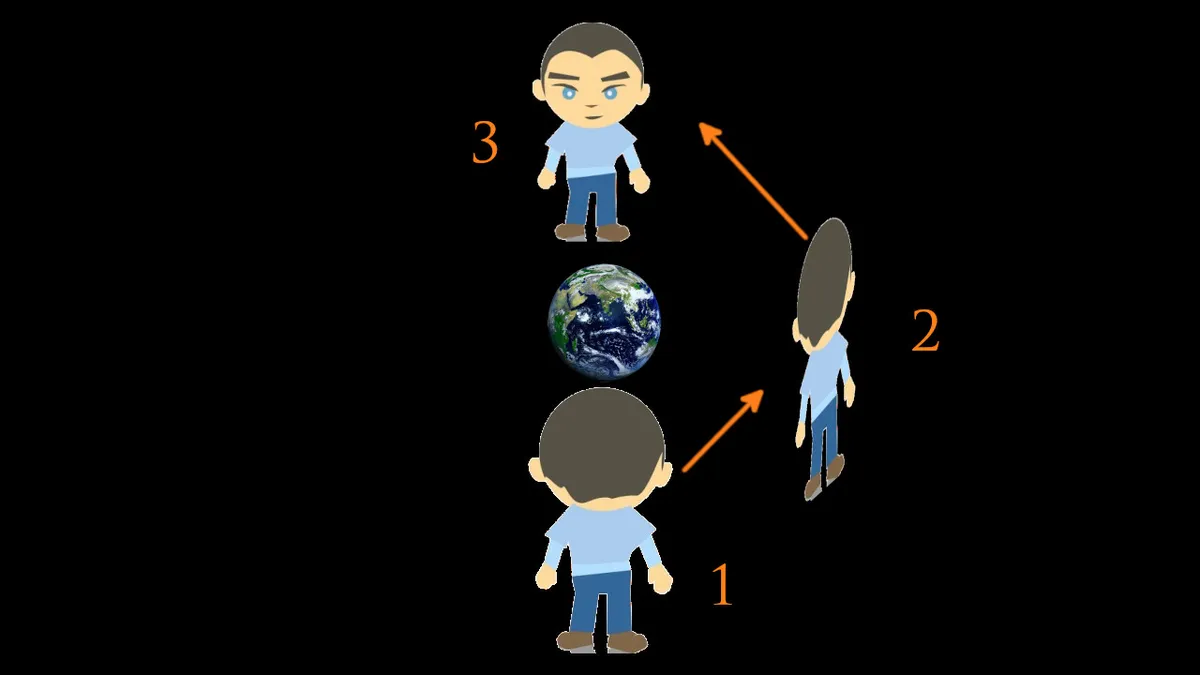
This is important, because if it seems "strange" to us that the Moon does NOT show one face and yet it ROTATES, then we will realize that we can easily replicate the Moon's movement by going around an object in such a way that the object-person never sees our back. By doing so, as in the drunken pole game, we will be performing the movement of revolution and rotation, simultaneously, and at the same relative speed (in degrees/time).
Conclusion: The Moon has a "hidden" side, but not a "dark" side. What does have a dark side is TV.☉
Sources and related links
#ParaQueSepas l COMPLETE PROGRAM 05/03/2024 https://www.youtube.com/watch?v=ruGV52XpkT4