Two blind analyses in astronomy on a current topic.
There's a hunger still unsatisfied
Our weary eyes still stray to the horizon
Though down this road we've been so many times
Pink Floyd - High Hopes
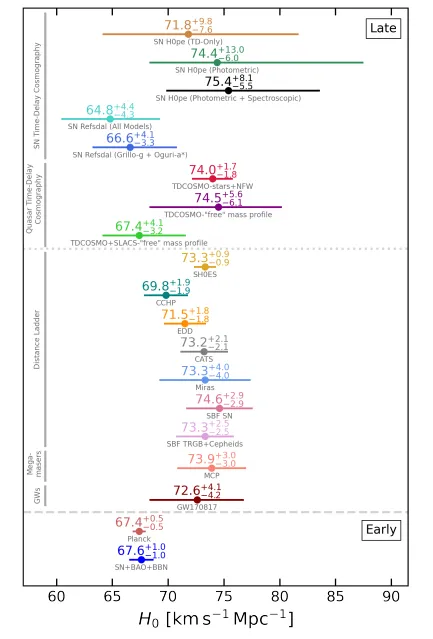
The term "Hubble Tension" refers to the difference in results when calculating the universe's expansion rate using two methods: the CMB (Cosmic Microwave Background) and the "cosmic distance ladder". The expansion rate is called the Hubble Constant or H0.
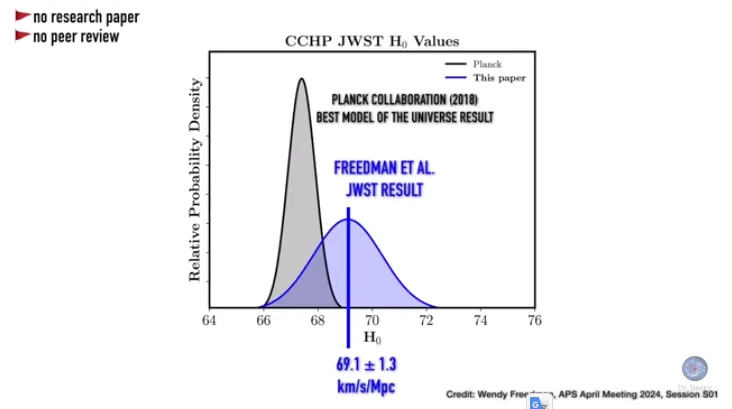
The difference in the H0 calculation results is ~10%: between 67 and 73 km/s/Mpc.
Why is that a problem?
Well, if you and I are going to measure the length of a straight line, even if we use different methods we should get the same results, since the line has only one length. However, there could be differences if the methods have different precision. But if both methods are sufficiently precise, the difference should be minimal. If, on the contrary, the difference is appreciable (this is calculated with the standard deviation), then there is a problem: either the methods are not good enough, or something is missing from our knowledge, or something is known incorrectly.
NEWS ON THE HUBBLE TENSION
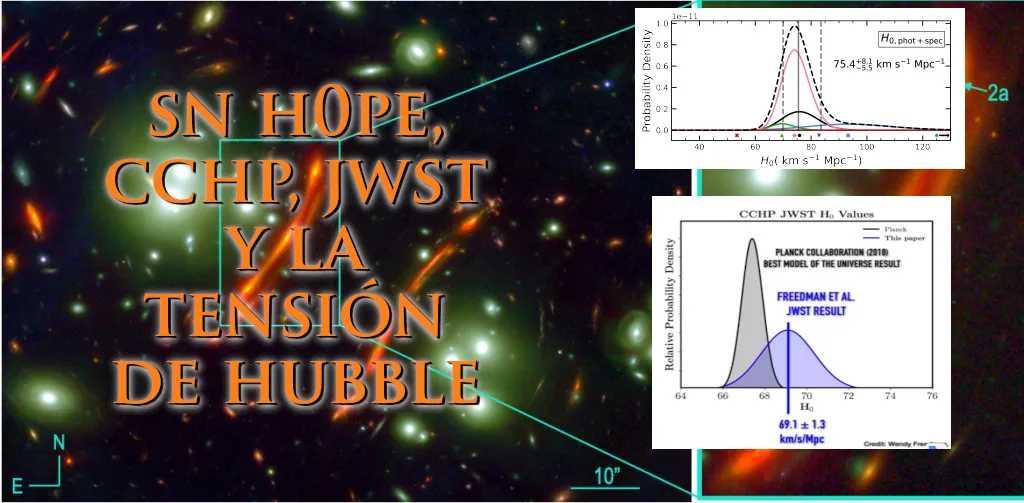
On one hand, at the last APS (American Physical Society) meeting in April, a presentation was given by Wendy L Freedman. A measurement program using the James Webb Space Telescope (JWST) calculates the distance to galaxies with three methods that allow calibrating the Type Ia supernova method: Cepheids, TRGB (Tip of the Red Giant Branch) and JAGB (J-region of the Asymptotic Giant Branch). For this they performed a blind analysis and their results are an intermediate value: 69 km/s/Mpc.
This is not new, as Wendy Freedman and others have been working for years on what is called the Carnegie-Chicago Hubble Program (CCHP), on which many published works have already been done. There is a video about that program indicated below in the links.
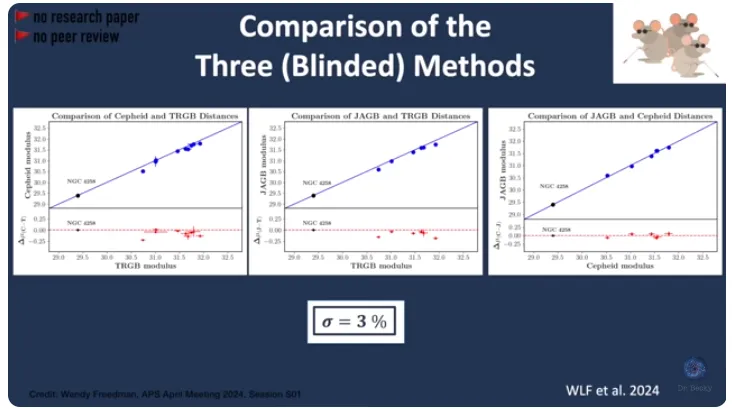
The general idea is this: to calculate H0 it is necessary to know the redshift of galaxies and their distance. To calculate the distance, different methods can be used: Cepheid variables, TRGB, JAGB, Type Ia Supernovae. When galaxies are very distant, only SNIa can be used. But if they are not so distant, like the Magellanic Clouds, all four methods can be used and thus better estimate the distance and calibrate the SNIa method. By calibrating that method, like a domino effect, it has consequences on the distance calculations of very distant galaxies where only SNIa is used. Perhaps in future posts we will talk specifically about TRGB and JAGB stars to explain why they can be used as calibration methods.
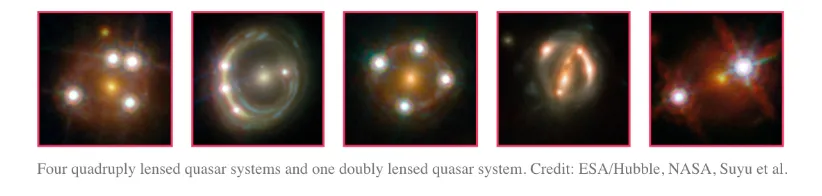
Another novelty is the development of a technique called TDCOSMO, short for Time-Delay Cosmography. In a publication by Tommaso Treu (2016) there is an introduction to this technique, first suggested by J. Refsdal in 1964. However, at that time there weren't many elements to use the technique and it remained a theoretical curiosity. This method uses strong gravitational lenses. During the following decades, the method was surrounded by controversy over its precision. But there were improvements that allow using this technique to obtain more precise data.
If a distant quasar or supernova is affected by a strong gravitational lens, the propagating wavefront splits when it passes near the foreground mass, forming multiple images, as shown in the following figures.
The wavefronts emitted along each light path of the lens are delayed in time relative to each other due to geometric differences between the light paths and the gravitational potential well of the lens.
Therefore, the time delay depends on the geometry of spacetime, that is, on the Hubble constant, and on the mass distribution of the lens object and all objects along the line of sight.
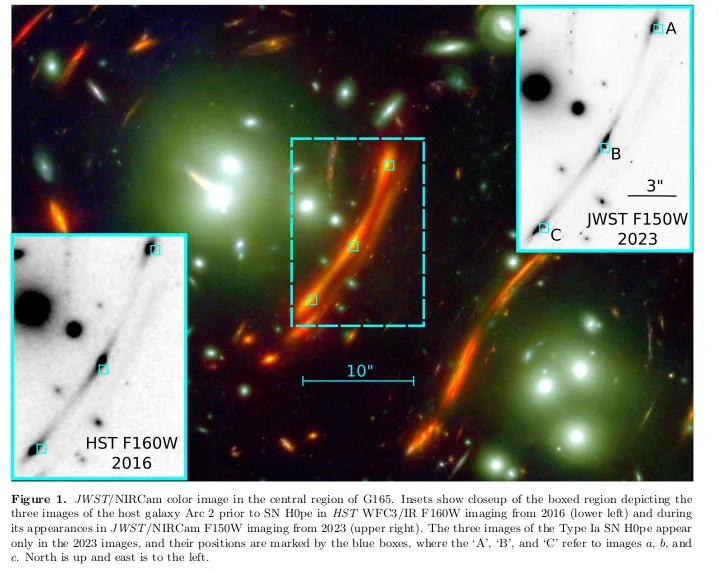
Recently, a paper by Massimo Pascale and others (2024) was published in which they attempted to calculate H0 with a SNIa detected by JWST. Among the images is the galaxy cluster with the poetic name PLCK G165.7+67.0, in which there is a SNIa in three images. That supernova was named "SN H0pe", because astronomers are very nerdy. "Hope" in English means "esperanza".
The result (they also used a blind analysis) gave 75.4 km/s/Mpc. But they will reanalyze the matter when the supernova has faded and are obtaining more supernova images to reduce the error bars. Thus, the method appears as a new "hope" in solving the Hubble tension.
About blind analyses
This is the name given to data analyses in which the researchers doing the analytical work are unaware of the data and focus on the analysis methods. Finally, they will know the results and the data, preventing possible biases, since there is none so blind as those who will not see.
CONCLUSION
Will these new methods solve the famous tension? Well... there is a risk of forcing the data and methods to obtain a reassuring result. Science is about trying to know how things are and not how we want them to be. The goal is not to be happy with a fantasy. And knowing reality is hard work. As Galileo said: "The aim of science is not to open the door to eternal knowledge, but to set a limit to eternal error."☉
Sources and related links
- A New H0pe for the Hubble Constant?
https://astrobites.org/2024/04/16/sn_h0pe/ - TDCOSMO
https://obswww.unige.ch/~lemon/tdcosmo-master/index.html - Has JWST SOLVED the crisis in cosmology?!
https://www.youtube.com/watch?v=yKmPJmaeP8A - J-region Asymptotic Giant Branch (JAGB)
Asymptotic giant branch
https://en.wikipedia.org/wiki/Asymptotic_giant_branch - TRGB Tip of the red-giant branch
https://en.wikipedia.org/wiki/Tip_of_the_red-giant_branch - Rama asintótica gigante
https://es.wikipedia.org/wiki/Rama_asint%C3%B3tica_gigante - First JWST Observations of JAGB Stars in the SN Ia Host Galaxies: NGC 7250, NGC 4536, NGC 3972
https://arxiv.org/abs/2312.02282 - The Carnegie-Chicago Hubble Program. VIII. An Independent Determination of the Hubble Constant Based on the Tip of the Red Giant Branch
https://arxiv.org/abs/1907.05922 - Video: The Carnegie Chicago Hubble Program
https://online.kitp.ucsb.edu/online/enervac-c19/freedman/ - APS: Abstract: S01.00002 : New JWST Results: Is the Current Tension in Ho Signaling New Physics*
https://meetings.aps.org/Meeting/APR24/Session/S01.2
On the Possibility of Determining Hubble's Parameter and the Masses of Galaxies from the Gravitational Lens Effect ⋆
Sjur Refsdal; Monthly Notices of the Royal Astronomical Society, Vol. 128, p.307 https://academic.oup.com/mnras/article/128/4/307/2601707
Time delay cosmography
Treu, Tommaso; Marshall, Philip J. The Astronomy and Astrophysics Review; Heidelberg Tomo 24, (Jul 2016)
1-41. DOI:10.1007/s00159-016-0096-8 https://www.proquest.com/openview/2618ba6159a6c78b716506d3fd2ad967/1?pq-origsite=gscholar&cbl=30894
SN H0pe: The First Measurement of H0 from a Multiply-Imaged Type Ia Supernova, Discovered by JWST
Massimo Pascale et al (2024)
https://arxiv.org/abs/2403.18902
JWST Photometric Time-Delay and Magnification Measurements for the Triply-Imaged Type Ia "Supernova H0pe" at z = 1.78 https://arxiv.org/abs/2403.18954
About the images
Credits: Freedman, WL et al. Massimo Pascale et al (2024).