Chronicle of an announced discovery.
There are journalistic announcements about a possible discovery of extra-terrestrial life. They are based on scientific publications made with data obtained with the James Webb Telescope (JWST). Isn't that old news?
The exoplanet was discovered in data from the Kepler mission in 2015. Since then, different scientific papers have been published that had an impact because it was found that:
-K2-18b, the first planet found around the star K2-18, is in the habitable zone.
-Water vapor was found.
-It would be a hycean planet, meaning it would possess a hydrogen atmosphere and an ocean.
-The probable existence of dimethyl sulfide (DMS) was detected.
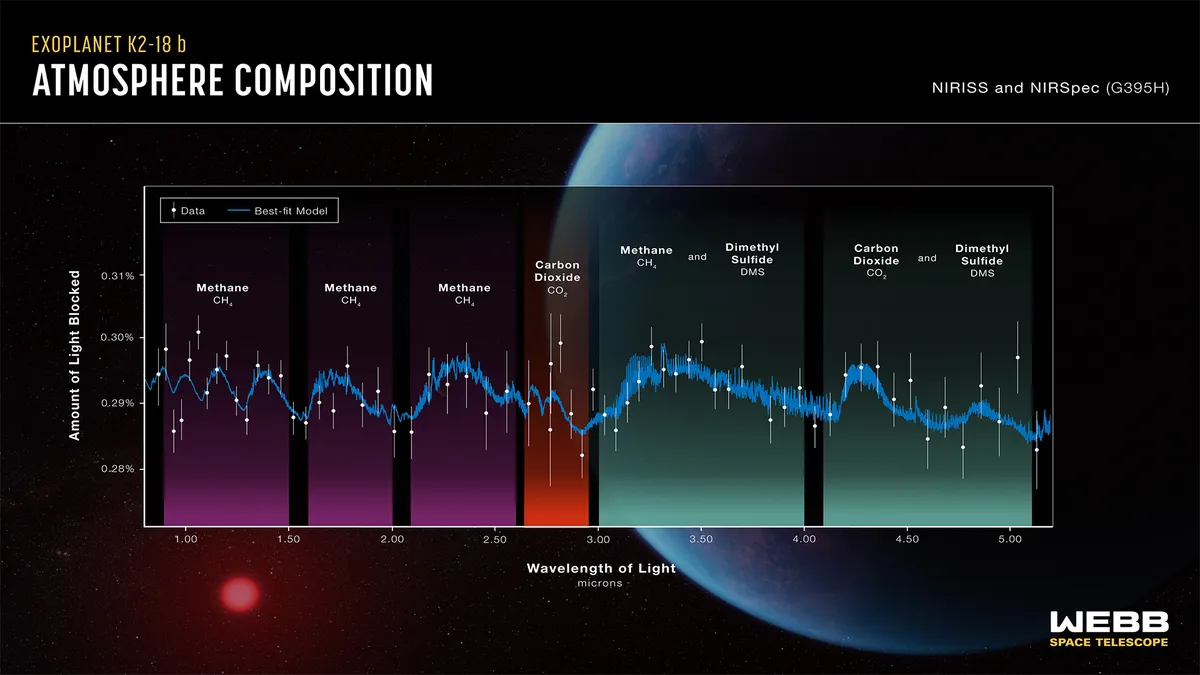
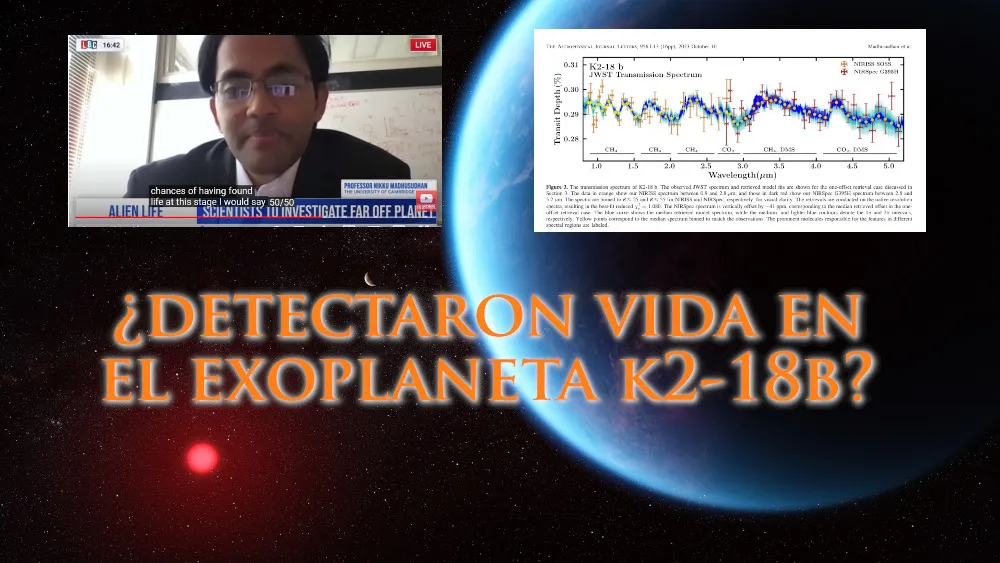
This last point was communicated in September 2023 and had significance because DMS is considered a biomarker. However, the data were not sufficient to draw a conclusion. The lead researcher, Nikku Madhusudhan, has obtained new data, using another instrument on board JWST, and in the coming months will publish new conclusions on the matter.
On a Youtube channel they interviewed him a few days ago and he states that he believes he found the first exoplanet with life, with a 50% probability...
Because of this, yes, it is somewhat old news, but still current. It is worth addressing the issue here. What is known so far?
The star K2-18 is a red dwarf, with a size of 40% of Earth's radius, at 120 light-years away. It has at least one planet, K2-18b, and a second exoplanet is suspected. The name comes from the K2 mission of the Kepler probe.
The planet has a radius 2.3 times that of Earth, with a mass 8 times greater than Earth's. According to data from NASA EXOPLANET ARCHIVE, the planet's density ranges between 2.67 and 4.11 g/cm3. The intermediate value is 3 g/cm3, which is almost half the density of our world (5.51 g/cm³). That is why it is considered a mini-Neptune. It has an orbital period of 32 days and its semi-major axis (distance to the star) is 0.1429 AU. In comparison, Earth is at 1 AU from the Sun.
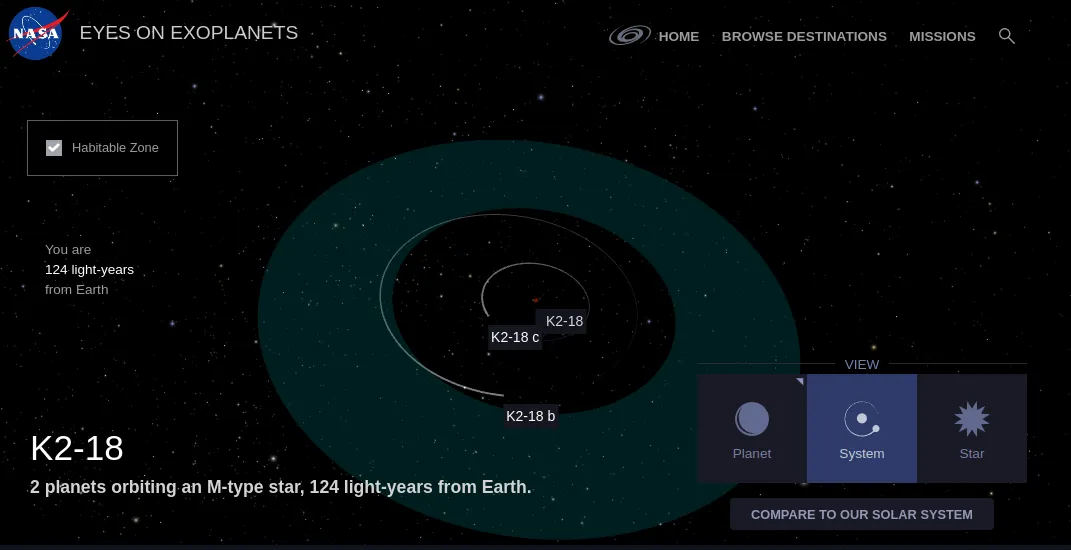
What is important here is dimethyl sulfide (DMS), which on our planet is produced by phytoplankton, which is why it is considered a biomarker, that is, an indicator of biological activity. If we add that the world is within the habitable zone and is a water world, with water vapor, it is plausible that this molecule is a product of biological activity.
What is the problem then? The detections made, first with the Hubble Telescope and now with JWST, do not have the necessary confidence to determine its real existence. It could be a false positive. What the instruments (spectrographs) detect is an emission spectrum, which has emission peaks. The detection of methane has 5 sigma (σ) confidence, while DMS has 2.4σ.
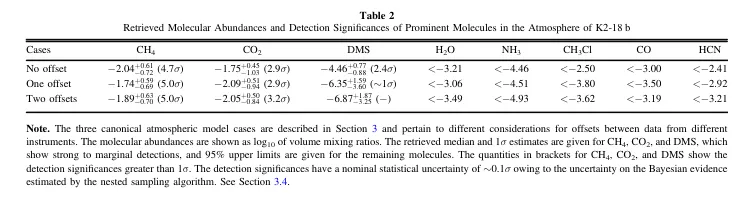
With the new observations, the presence of DMS could be ruled out or its detection strengthened. But even in this latter case, is finding this molecule enough to conclude that there MUST be biological life?
On our planet, no other way of producing this molecule than biotic is known, but outside our world it is possible that it forms in abiotic processes.
Nikku Madhusudhan has requested observing time with three JWST instruments in proposal 2722 (details in the links). The data from the MIRI instrument will be especially valuable as they are at longer wavelengths, which are more appropriate for disambiguating that emission from others.
In the event that the existence of the molecule is confirmed, K2-18b will be a great candidate for possessing life, but the possibility that the molecule is produced there by some non-biological process will have to be evaluated.
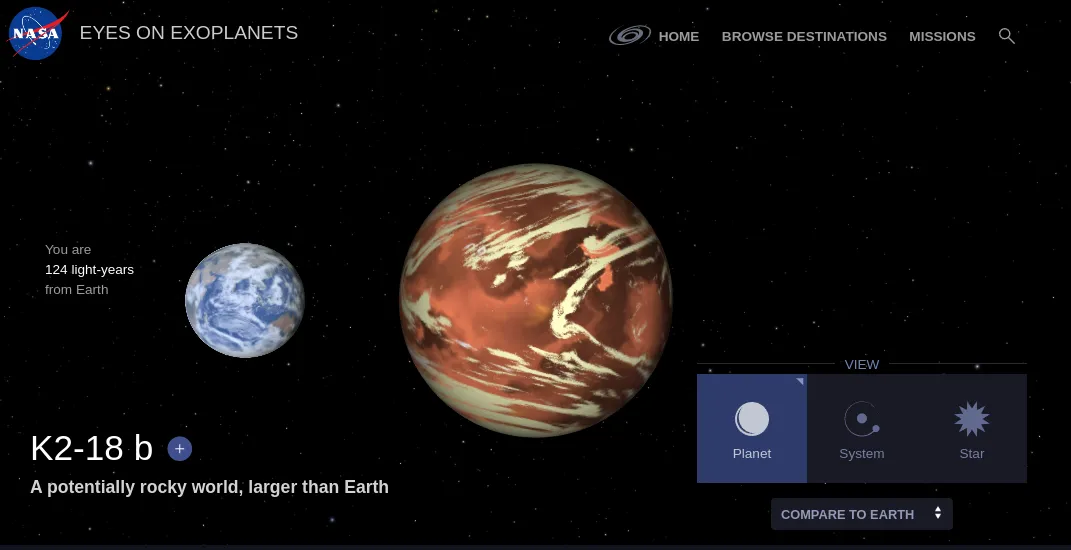
On the other hand, a recent investigation led by Nicholas F. Wogan (APJL, 2024) indicates that the JWST data are compatible with a mini-Neptune without a habitable surface. With new data, some scenario will be more reliable than others, but it will hardly be possible to shout Eureka! quickly. It is necessary to maintain a level of skepticism, no matter how much one wants to find life out there. It is not about adjusting reality to our desires (which is what astrologers do), but about knowing what objective reality is like.
Meanwhile, K2-18b will be a good promise of a water world with phytoplankton, a word that comes from Greek and means "wandering plant," like that nomad character played by Kevin Costner in Waterworld (Kevin Reynolds, 1995). Perhaps, in the end, the research deserves an Oscar more than a Nobel.☉
Sources and related links
- The Cambridge scientist who thinks he’s just discovered alien life
https://www.youtube.com/watch?v=Bj0PXPeKJRE - Did JWST find a MARKER OF LIFE in an exoplanet atmosphere?
https://www.youtube.com/watch?v=F360SGAlI8Y - Did Scientists Find Life on K2-18b Or What? Here's The Most Likely Explanation
https://www.youtube.com/watch?v=90tJaNFlPos - Carbon-bearing Molecules in a Possible Hycean Atmosphere
Nikku Madhusudhan et al 2023 ApJL 956 L13
https://iopscience.iop.org/article/10.3847/2041-8213/acf577
https://arxiv.org/abs/2309.05566 - K2-18b May Not Be Habitable After All
https://aasnova.org/2024/03/11/k2-18b-may-not-be-habitable-after-all/
What the James Webb telescope has really detected on exoplanet K2-18b (and it's not life)
Webb Discovers Methane, Carbon Dioxide in Atmosphere of K2-18 b https://www.nasa.gov/universe/exoplanets/webb-discovers-methane-carbon-dioxide-in-atmosphere-of-k2-18-b/
NASA Exoplanetarchive https://exoplanetarchive.ipac.caltech.edu/overview/K2-18%20b#system_parameters
NASA EXOPLANET K2-18B https://science.nasa.gov/exoplanet-catalog/k2-18-b/
GO 2722 https://www.stsci.edu/jwst/science-execution/program-information?id=2722
About the images
Illustration: NASA, CSA, ESA, J. Olmsted (STScI), Science: N. Madhusudhan (Cambridge University)