Small, hot, and old stars.
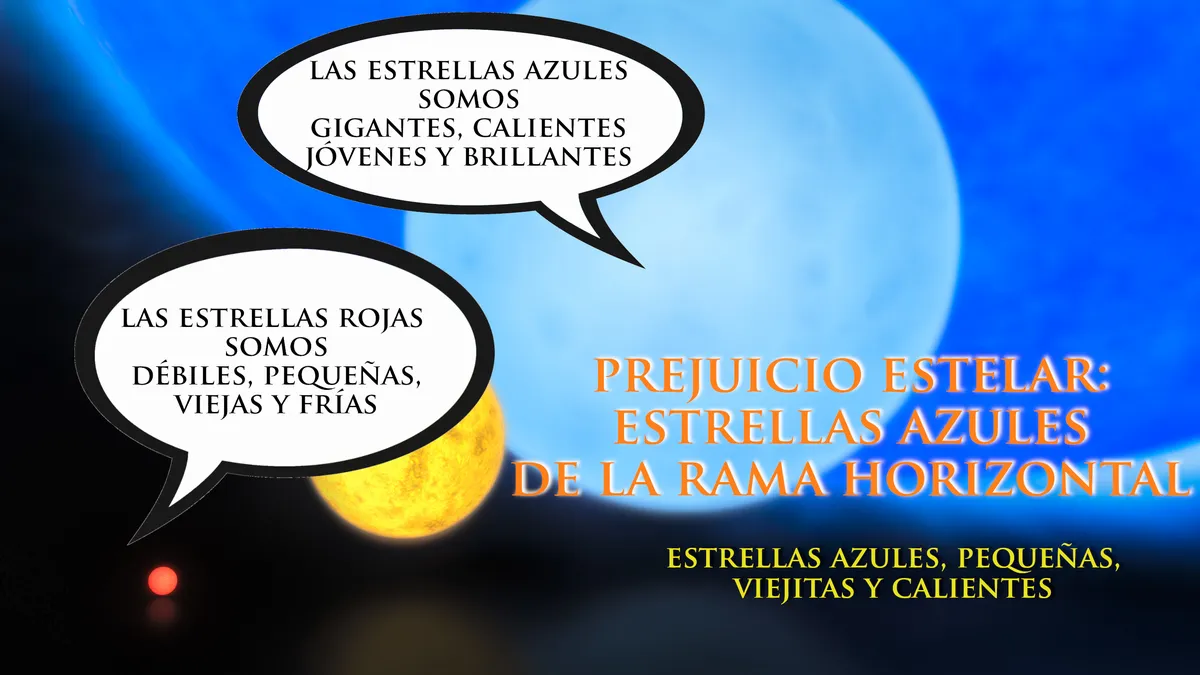
It is common to think and say that blue stars are giants, young, hot, and very bright; while red ones are faint, small, cool, and old.
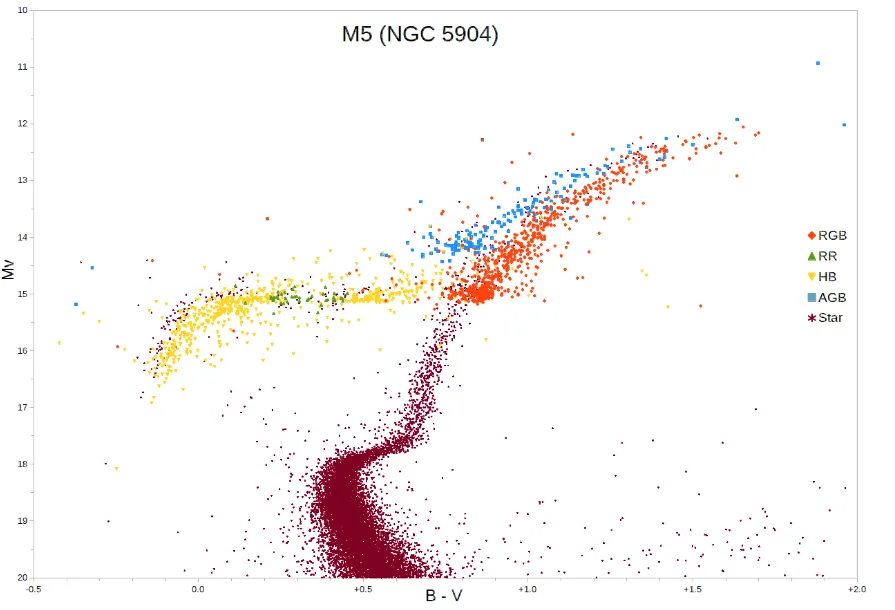
But when the stars of a globular cluster are shown on an HR diagram, a horizontal branch with a blue tail appears: the BHB (Blue Horizontal Branch) stars, blue stars of the horizontal branch, mix with the RR Lyrae variables and break the "stereotype".
First, because they belong to globular clusters, they cannot be recently formed. They are indeed hot, but with masses below 1 solar mass, their luminosity is low.

The horizontal branch (HB) is a stage of stellar evolution that follows the red giant branch in stars with a mass similar to our Sun. They are celestial bodies powered by helium fusion in the core and hydrogen fusion in an outer shell. In HR diagrams they appear almost horizontally, meaning their luminosity varies little, while some are hotter (blue) and others less so (red). They are low-metallicity stars (few heavy elements).
After burning hydrogen in the core, stars leave the main sequence and begin fusion in a shell around the helium core and become giants on the red giant branch. In stars with masses up to 2.5 solar masses, the helium core becomes a region of degenerate matter. In stars over 0.5 solar masses, the core finally reaches the temperature necessary for helium fusion into carbon through the triple-alpha process. Then they have a helium flash.
Horizontal branch stars have cores of similar masses, which implies that their luminosities are also similar. The size and temperature depend on the mass of the hydrogen envelope remaining around the helium core. Stars with larger envelopes are cooler. This temperature variation is more notable in low-metallicity celestial bodies, as in globular clusters, whose horizontal branch is more pronounced.
In a color-magnitude diagram, many RR Lyrae variables will be found among the horizontal branch stars. Like the blue horizontal branch stars, they are found in the halo of the Milky Way and are used as "standard candles" to calculate distance, although there are many more blue horizontal branch stars than RR Lyrae variables.
It can be difficult to distinguish these BHB celestial bodies from A-type dwarfs and blue stragglers.
CONCLUSION
Astronomers classify stars, just as we people also do with movies. Thus, we say there are science-fiction films and westerns, for example. Until someone makes Cowboys & Aliens and the labels have to be renewed.
Globular clusters never cease to amaze me. They are...beautiful structures of the galactic halo. About 150 have been discovered. From southern latitudes, Omega Centauri and 47 Tucanae stand out in observations.
I also continue to be amazed by the extraordinary usefulness that Cartesian axes and HR diagrams have had.
We should learn something from this. Just as we label stars as blue and red, giants and dwarfs; but then we are surprised by horizontal branch stars, we should consider the same with people. There are people like this, people like that, and people of the horizontal branch.☉
Sources and related links
- Horizontal branch
https://en.wikipedia.org/wiki/Horizontal_branch - BHB
http://astro.vaporia.com/start/bluehb.html - Identification of Blue Horizontal-branch Stars from LAMOST DR5
Jie Ju et al 2024 ApJS 270 11
https://iopscience.iop.org/article/10.3847/1538-4365/ad0df9
https://arxiv.org/abs/2311.16430
About the images
By ESO/M. Kornmesser - http://www.eso.org/public/images/eso1030c/, CC BY 4.0, https://commons.wikimedia.org/w/index.php?curid=10983760
By Lithopsian - Own work, CC BY-SA 4.0, https://commons.wikimedia.org/w/index.php?curid=48375156