An international research team, co-led by Romina Petrucci and Emiliano Jofré from the Astronomical Observatory of Córdoba (OAC)/ CONICET, has discovered a new exoplanet named TOI-3568 b.
This very unusual gas giant planet is part of what is known as the "Neptunian desert," a zone where planets with masses similar to Neptune and orbital periods of less than 5 days are very scarce. The discovery marks an important milestone in exoplanet research, as it challenges existing theories about the formation and evolution of planets under extreme conditions.
TOI-3568 b is a super-Neptune type planet, meaning it is approximately 50% more massive and 40% larger than Neptune. With a mass 26 times that of Earth and a radius 5.3 times greater, this gas giant takes only 4.4 days to complete an orbit around its star, a K-type dwarf, which is slightly cooler than the Sun. The planetary system is located at a distance of 197.8 parsecs (approximately 645 light-years) from Earth.
What makes TOI-3568 b especially notable is its extreme environment. It orbits very close to its host star, at only 0.05 astronomical units (AU), meaning it is 8 times closer to its star than Mercury is to the Sun. This proximity exposes it to intense extreme ultraviolet radiation (EUV), reaching temperatures of up to 630 °C, one of the highest measured for planets of its type. Despite this intense radiation, TOI-3568 b has managed to retain its hydrogen- and helium-rich atmosphere for billions of years, challenging the idea that these planets rapidly lose their gaseous envelopes under such conditions.
To confirm the existence and planetary nature of TOI-3568 b and characterize it in greater detail, observations with the MAROON-X spectrograph, installed on the 8.1-meter telescope of the Gemini Observatory on Mauna Kea, Hawaii, were used. This instrument measures with great precision the variations in the star's velocity caused by the planet's gravitational pull, which allowed confirming the mass and gaseous nature of TOI-3568 b.
This discovery also marks the first time that Argentine observing time at the Gemini Observatory has been used to detect an extrasolar planet, underscoring the global impact of the OAC team's work. Emiliano Jofré, a researcher at OAC and CONICET and one of the team leaders, highlighted: "It is an important milestone for Argentine astronomy and in particular for our country's participation in this observatory, as we could not carry out this type of high-impact discovery without Gemini."
An achievement of international scientific collaboration
The finding was published this week in the prestigious journal Astronomy & Astrophysics. The research included scientists from several renowned institutions around the world.
In addition to Emiliano Jofré and Romina Petrucci, researcher Luciano García, who is the coordinator of the Gemini Observatory Office in Argentina, participated in the discovery. In this regard, García highlighted the importance of using this telescope for future discoveries: "Argentine participation in the Gemini Observatory, with its advanced technology, is key to continuing the search for and characterization of extrasolar planets under extreme conditions like TOI-3568 b and, even more so, those that could potentially be habitable."☉
Sources and related links
- New and unusual exoplanet discovered by a research team from the Astronomical Observatory of Córdoba
https://oac.unc.edu.ar/investigaciones/nuevo-e-inusual-exoplaneta-descubierto-por-un-equipo-de-investigacion-del-observatorio-astronomico-de-cordoba/ - TOI-3568 b: A super-Neptune in the sub-Jovian desert
A&A, 690, A312 (2024)
https://doi.org/10.1051/0004-6361/202450334
https://www.aanda.org/articles/aa/full_html/2024/10/aa50334-24/aa50334-24.html
About the images
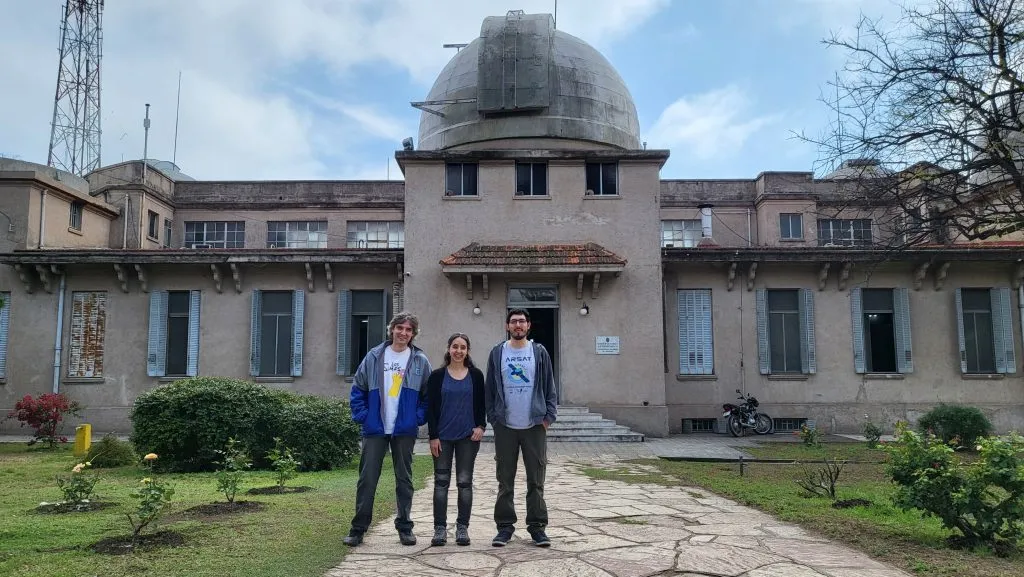
From right to left: Luciano García, Romina Petrucci, Emiliano Jofré. Research team from the Astronomical Observatory of Córdoba.