From the smallest to the supermassive.
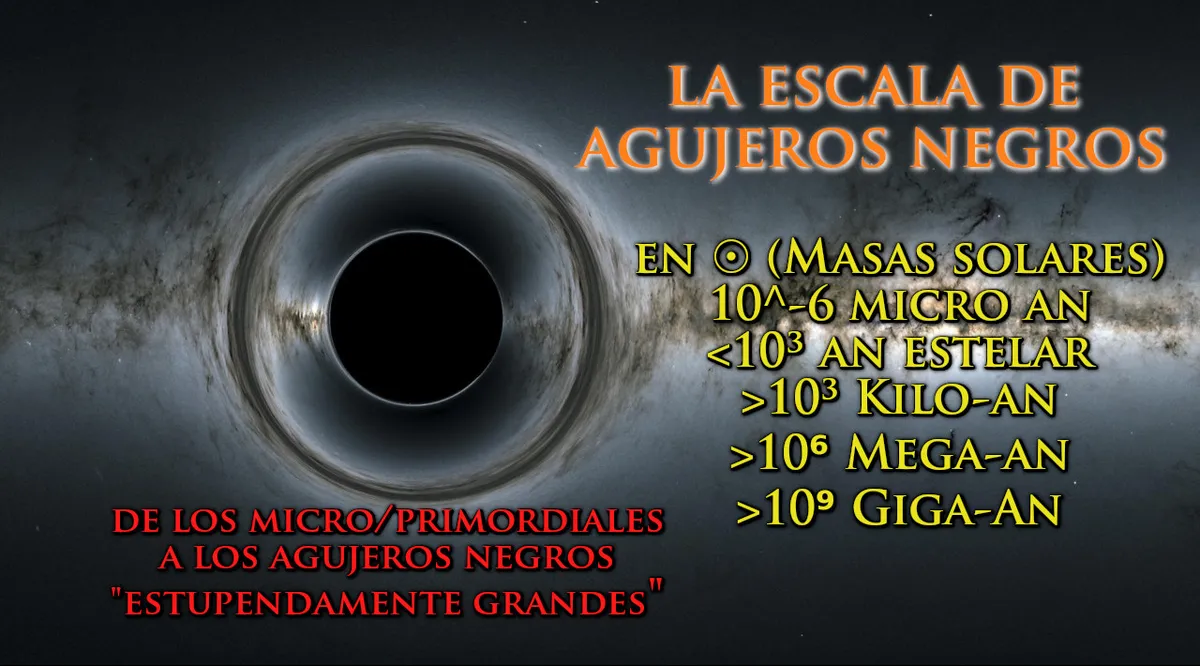
It can be said that there is a spectrum or gradient of black holes, based on their mass (or their diameter). It is known with great certainty that there are stellar-mass black holes, of more than 3 solar masses, the product of the collapse of a massive star.
Intermediate-mass black holes (IMBH) have between 100 and 100,000 stellar masses. These objects were considered a "missing link" because there were few detections of black holes in that mass range. Recently, the possible discovery of an intermediate black hole in the globular cluster Omega Centauri (NGC 5139) was announced.
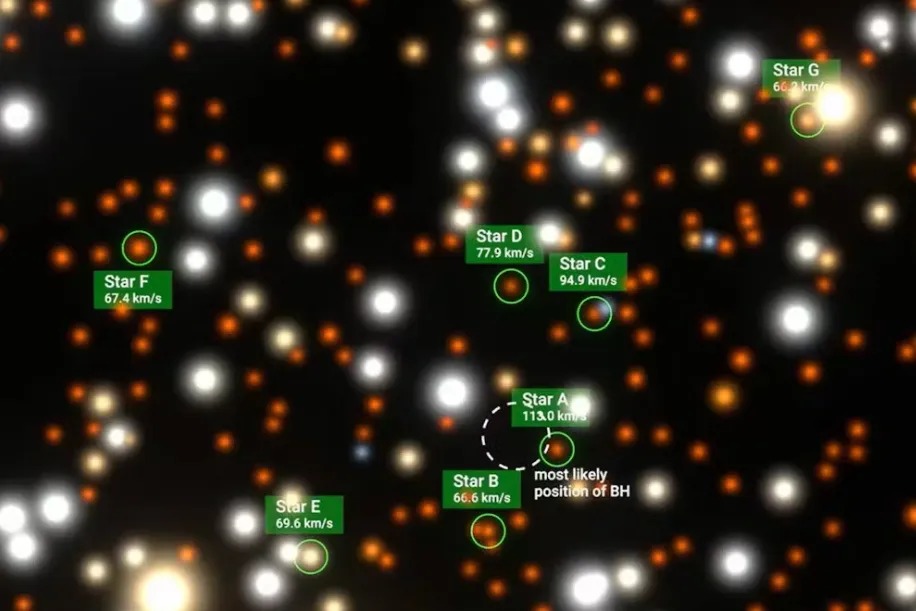
Fig. 1: Representation of the seven high-velocity stars orbiting the intermediate-mass black hole in Omega Centauri. It can be seen how they all exceed 62 km/s, which is the speed needed to escape the globular cluster NGC 5139.
Supermassive black holes have between 10^6 and 10^9 solar masses. Their size can reach 400 AU. Ultramassive black holes, of more than 10^10 solar masses, are also considered. But we skipped the first link: micro black holes, with masses up to the mass of our Moon, also referred to as primordial black holes.
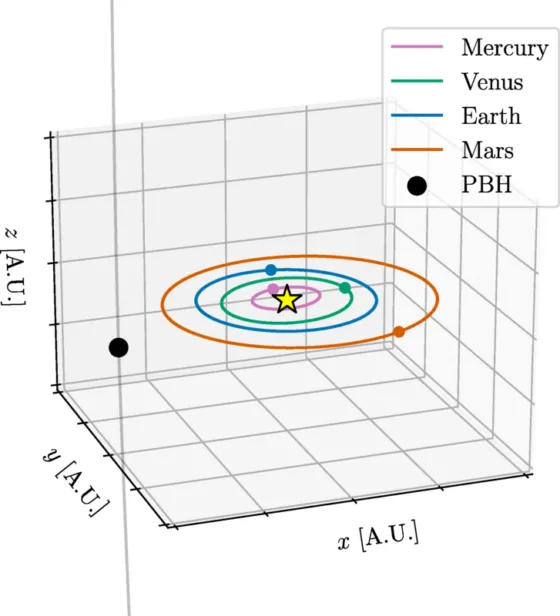
Fig.2: Primordial Black Hole in the Solar System.
Supermassive black holes remain a great mystery: it is difficult to understand that they formed in a single process, so it is expected that their origin is due to the merger of previously existing black holes. However, it would take a very long time -longer than the time currently considered for the entire universe- to form the supermassive black holes detected so far.
One scale to rule them all
I think the prefixes of the International System of Units (SI) should be used to be clearer in the classification. Stellar-mass black holes do not require a prefix and the smallest ones can be classified as micro (<10^-6), always using stellar masses (Me) as the unit of measurement. Then, intermediate-mass black holes, of more than 10^3 Me, could be called Kilo-Black holes; supermassive ones (>10^6 Me) would be Mega-Black holes; ultramassive ones (>10^9 Me) would be Giga-Black Holes and so on, tera, peta, exa, zetta...L
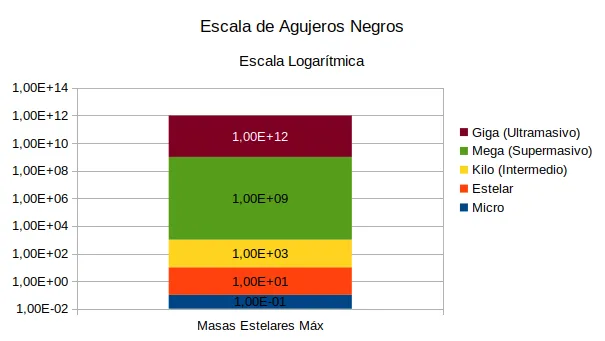
Can black holes of any size exist?
A few years ago, Bernard Carr and others published a paper on what they called "stupendously Large Black Holes" with Me >10^11 and which by their acronym they call SLABs. In the SI they would be Giga-Black Holes. Andrew King also addressed the topic in 2016. The latter considers that in extreme cases the maximum possible is 2.7 x 10^11 Me.
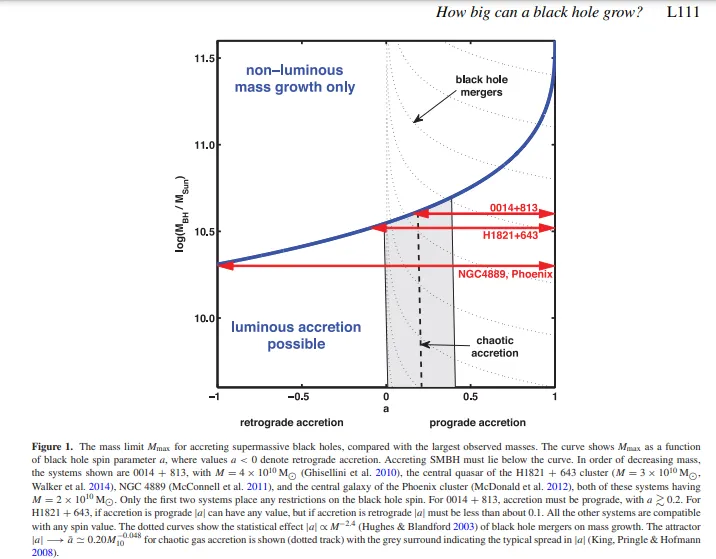
Fig 3: Limits of a black hole.
So now you know: if you read somewhere that someone says there are black holes whose mass is greater than 10^18 Me, you'll know they are an EXAggerator.☉
Sources and related links
The Solar System as a detector of primordial black holes https://culturacientifica.com/2024/10/01/el-sistema-solar-como-detector-de-agujeros-negros-primordiales/
Tung X. Tran, Sarah R. Geller, Benjamin V. Lehmann, and David I. Kaiser (2024) Close encounters of the primordial kind: A new observable for primordial black holes as dark matter Phys. Rev. D doi: 10.1103/PhysRevD.110.063533
An unusual black hole is found in our galaxy (and very few like it have been found in the universe)
Constraints on Stupendously Large Black Holes
Bernard Carr, Florian Kuhnel, Luca Visinelli https://arxiv.org/abs/2008.08077
How big can a black hole grow?
Andrew King
Monthly Notices of the Royal Astronomical Society: Letters, Volume 456, Issue 1,
December 2015, Pages L109–L112, https://doi.org/10.1093/mnrasl/slv186 https://academic.oup.com/mnrasl/article/456/1/L109/2589770?login=false
What are black holes?
https://ciencia.nasa.gov/universo/que-son-los-agujeros-negros/
About the images
Initial image: NASA Goddard Space Flight Center simulation; background image ESA/Gaia/DPAC
Fig 1: ESA/Hubble & NASA, M. Häberle (MPIA), CC BY-SA
Fig 2: Tran et al (2024)
Fig 3: A. King (2015)