Due to an industrial project. Statement from the European Southern Observatory (ESO).
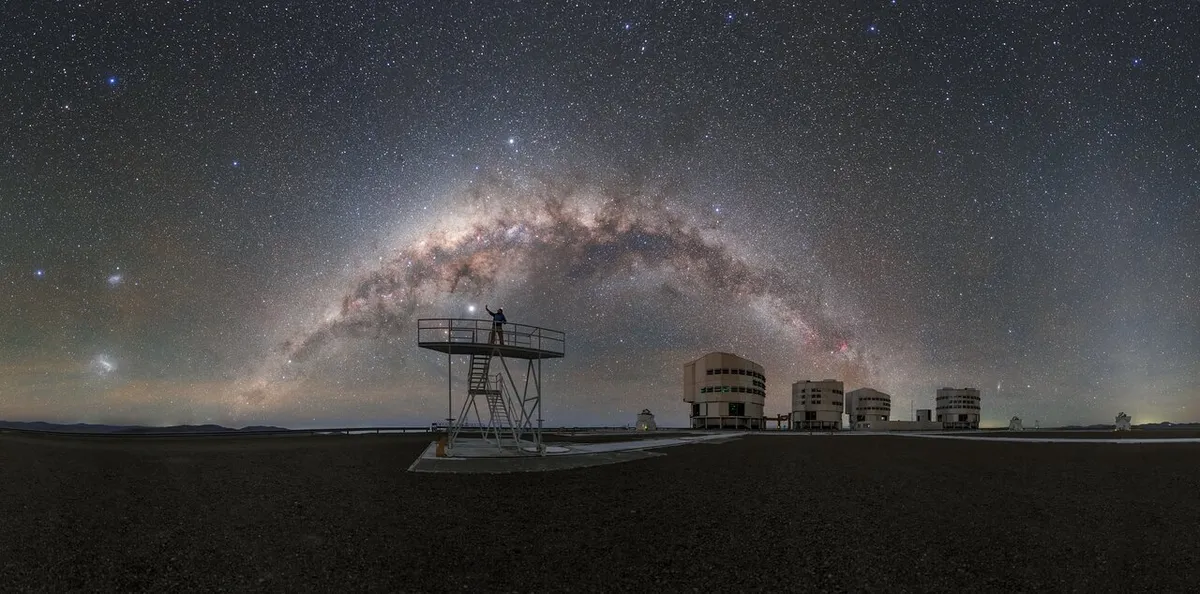
On December 24, AES Andes, a subsidiary of the US electric company AES Corporation, submitted for environmental impact assessment the project for a massive industrial complex. This complex threatens the pristine skies over ESO's Paranal Observatory in the Atacama Desert in Chile, the darkest of all astronomical observatories in the world. The industrial megaproject is planned to be located just between 5 and 11 kilometers from the Paranal telescopes, which would cause irreparable damage to astronomical observations, particularly due to light pollution emitted throughout the project's operational lifetime. Relocating the complex would save one of the last dark and truly pristine skies on Earth.
An irreplaceable heritage for humanity
Since its inauguration in 1999, Paranal Observatory, built and operated by the European Southern Observatory (ESO), has led to major astronomical advances, such as the first image of an exoplanet and the confirmation of the accelerated expansion of the universe. The Nobel Prize in Physics in 2020 was awarded for research on the supermassive black hole at the center of the Milky Way, in which the Paranal telescopes were fundamental. The observatory is a key asset for the global astronomical community, including that of Chile, which has grown significantly in recent decades. Furthermore, the nearby Cerro Armazones hosts the construction of ESO's Extremely Large Telescope (ELT), the world's largest telescope of its kind, a revolutionary facility that will drastically change what we know about our Universe.
"The fact that the AES Andes industrial megaproject is so close to Paranal represents a critical risk to the most pristine night skies on the planet," emphasized ESO's Director General, Xavier Barcons. "Dust emissions during construction, increased atmospheric turbulence, and, especially, light pollution, will have an irreparable impact on astronomical observation capabilities, which until now have attracted multimillion-dollar investments from the governments of ESO's Member States."
The unprecedented impact of a megaproject
The project encompasses an industrial complex of over 3,000 hectares, which is almost the size of a city, district, or municipality like Valparaíso (Chile) or Garching, near Munich (Germany). It includes the construction of a port, ammonia and hydrogen production plants, and thousands of electricity generation units near Paranal.
Thanks to its atmospheric stability and the absence of light pollution, the Atacama Desert is a unique natural laboratory for astronomical research. These attributes are essential for scientific projects that aim to address fundamental questions, such as the origin and evolution of the universe or the search for life and the habitability of other planets.
A call to protect the Chilean skies
"Chile, and particularly Paranal, is a truly special place for astronomy: its dark skies are a natural heritage that transcends its borders and benefits all of humanity," says Itziar de Gregorio, ESO's representative in Chile. "It is crucial to consider alternative locations for this megaproject that do not endanger one of the world's most important astronomical treasures."
Relocating this project remains the only effective way to avoid irreversible damage to Paranal's unique skies. This measure will not only safeguard the future of astronomy but will also preserve one of the last truly pristine dark skies on Earth.
A study by Falchi and collaborators, published in 2023 in the journal Monthly Notices of the Royal Astronomical Society, compared light pollution at the 28 major astronomical observatories, concluding that Paranal was the darkest observing site among those studied.
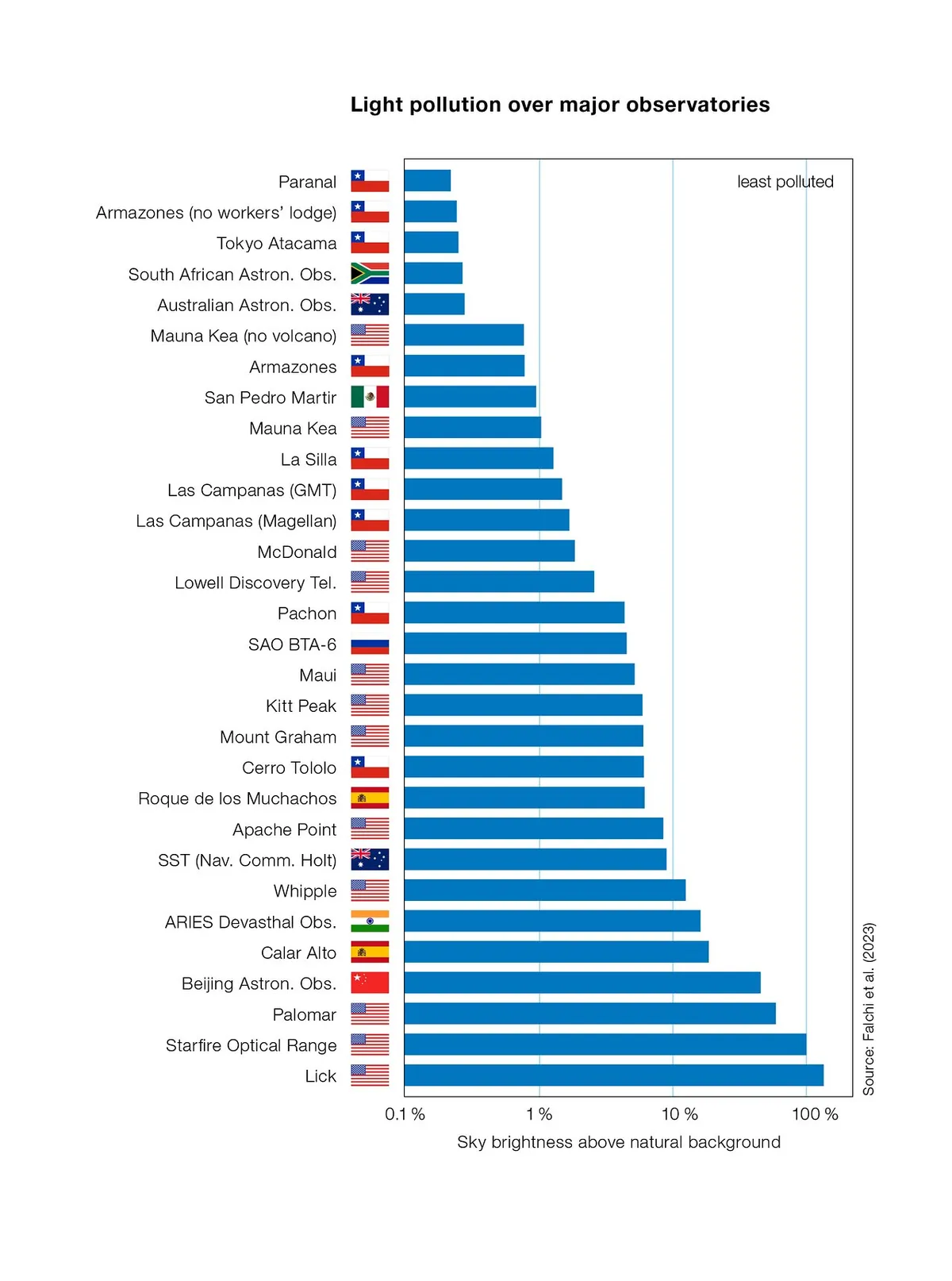
This graph shows the impact of light pollution at the 28 major astronomical observatories, concluding that ESO's Paranal Observatory was the darkest observing site among those studied. It is taken from a study by Falchi and collaborators, published in 2023 in the journal Monthly Notices of the Royal Astronomical Society. It uses a logarithmic scale and compares the brightness directly above the observatories with the natural background brightness (1% means there is 1% more light pollution, 100% means there is 100% more light pollution, i.e., double that without artificial light sources). Note that some observatories appear twice: for example, Armazones, where ESO's Extremely Large Telescope is located, has more light pollution during the telescope's construction (when temporary accommodation for workers is installed).
This graph is a slightly adapted version of Figure 1 from the Falchi et al. study. Here, the site locations are shown on the vertical axis, and the horizontal axis labels have been modified to improve readability.☉
Sources and related links
- The darkest and most pristine skies in the world in danger from an industrial megaproject
https://www.eso.org/public/spain/news/eso2501/?nolang - Light pollution indicators for all the major astronomical observatories
Fabio Falchi et al
Monthly Notices of the Royal Astronomical Society, Volume 519, Issue 1, February 2023, Pages 26–33,
https://doi.org/10.1093/mnras/stac2929
Published: 20 December 2022
https://academic.oup.com/mnras/article/519/1/26/6936422?login=false
About the images
Credits: ESO/P. Horálek/Falchi et al. 2023