About Ariel Magnus's recently published novel.
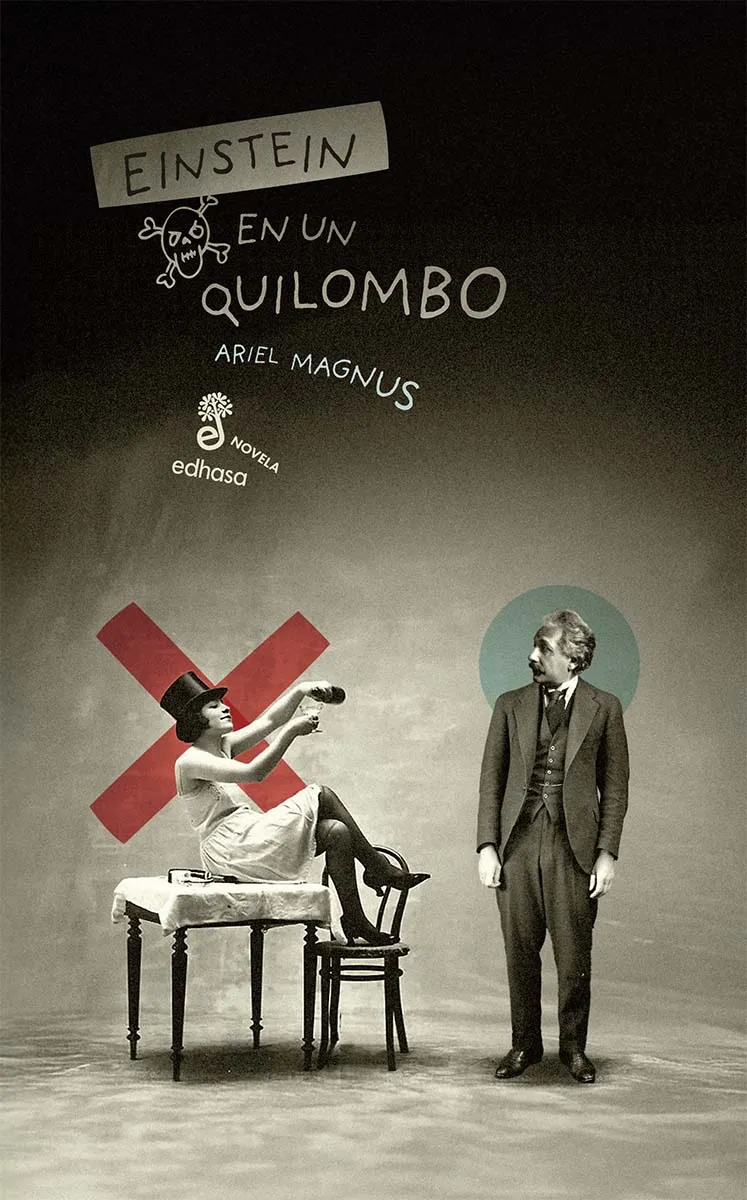
Bibliographic data
Magnus, Ariel
Einstein en un quilombo, 1st edition, Buenos Aires, Edhasa, 2025
212 p, ISBN 978-987-628-765-4 https://www.edhasa.com.ar/product/einstein-en-un-quilombo/
On the back cover of the paperback book, there is a synopsis of the text that includes this excerpt:
"For example, in those same days [of Einstein's visit to Argentina, in March 1925], apparently, two stubborn and charming detectives investigate a mysterious crime. For example, we don't know precisely what Einstein did each night, at each hour. Is it true or is it a legend that he visited a renowned and luxurious brothel where a corpse appeared, exposing him to an uncomfortable situation? He, who discovered relativity, is suddenly subjected to the imprecision of events. What an irony."
According to the flap, the author was born in Buenos Aires in 1975. He is a writer and translator. Since 2020 he has resided in Germany where he works as a literary translator.
I recall a theory developed by an Argentine semiotician, Eliseo Verón, which postulates that texts come from other texts. Those that influence an author to create a new text based on previous ones are called "conditions of production." They could also be called "seed texts" because they generate other texts.
I will use this criterion to analyze this novel, published precisely in the year of the 100th anniversary of Einstein's visit to the country. Based on what was said before and the author's profile, it occurs to me to postulate that the following happened:
Magnus conducted research on what has been published, what is known and not known, about the German physicist's visit to Argentina, added to his knowledge of the historical, cultural, literary context of the time.
These data include some real characters and others fictional, for instance, Leopoldo Lugones, a literary figure with traits of esoteric obscurantism and a son, nicknamed Polo, "che te la voglio dire"... Another person is Agatha Christie, creator of Hercule Poirot, who is a character. Likewise, Captain Arthur Hastings, Poirot's "Watson." Else Jerusalem was an Austrian intellectual who wrote about prostitution and who lived in Argentina at that time. There are also references to Roberto Arlt and his character Silvio Astier.
Other data include a lost, unpublished speech by Einstein in Argentina (see links at the end).
With these elements, evidently Magnus set out to "connect the dots" to create a fictional story from true data. Such a story would be detective-style, like Sherlock Holmes or Agatha Christie. It seems Magnus asked for permission to use Hastings© as a character and was not granted it, so instead he calls that figure "Captain Copyright" which at first is amusing, but its permanent repetition turns a good idea into a tedious cacophony.
It is a text full of references, where French expressions abound. It gives the feeling that the author wants to make clear his bibliographic encyclopedism, even though the relevance of these data to the story is weak.
The author uses an easy joke as many times as he can, in the phrase "this novel is relatively [adjective]," self-qualifying the work as detective, police, scientific, poetic, etc. The joke needs no explanation, since the use of the word "relatively" together with the name of the scientist in question is obvious.
So it is a text full of "seeds," those conditions of production. It includes mentions of contemporary local researchers like Miguel De Asúa or Dr. Alejandro Gangui, an Argentine cosmologist (see links below).
The (real) story of Albert Einstein's visit mixes with other stories to give rise to a fiction in which the visiting physicist takes cocaine and visits a brothel, which in lunfardo is called "quilombo," a word that also means "mess, tangle, problem." In the fiction, a crime occurs in that brothel on the same day, so the title of the work has two meanings: Einstein in a brothel and in a mess, simultaneously.
CONCLUSION
The beauty of works of art is in the eye [and brain] of the beholder. About tastes there is nothing written, another will say, despite there being a library full to disprove it.
As in novels or movies whose plot takes place in known landscapes, which we have traveled, close, familiar, Magnus's text captivated me with that "local flavor," added to the interest that the figure of Einstein arouses for those of us interested in cosmology.
The bibliographic references and some phraseology seemed unnecessary to me, like those long guitar solos in progressive rock that could be labeled "childish virtuosity," to show off.
Perhaps that is what permanently breaks "the fourth wall," and so it is not a story one can believe. It is not clear if it is a literary monograph or a well-documented fantasy, but the author is constantly reminding us that it is his invention.
Maybe that's why I increased my reading speed, cheating and skipping paragraphs and even pages, in a shortcut similar to a wormhole or Einstein-Rosen bridge whose destination is the same origin. Curiously, that reading felt longer to me.☉
Sources and related links
- The scientific impact of Einstein's visit to Argentina, in 1925
Alejandro Gangui, Eduardo L. Ortiz
https://arxiv.org/abs/1603.03792 - Einstein in Argentina: the scientific impact of his visit
Alejandro Gangui, Eduardo L. Ortiz
https://arxiv.org/abs/1712.09734 - Unpublished opening lecture for the course on the theory of relativity in Argentina, 1925
Albert Einstein, Alejandro Gangui, Eduardo L. Ortiz
https://arxiv.org/abs/0903.2401 - Lunfardo Quilombo
https://www.todotango.com/comunidad/lunfardo/termino.aspx?p=quilombo - Einstein saluda en Rosario Norte
https://sumapolitica.com.ar/einstein-saluda-en-rosario-norte/
About the images
Credit: Edhasa.