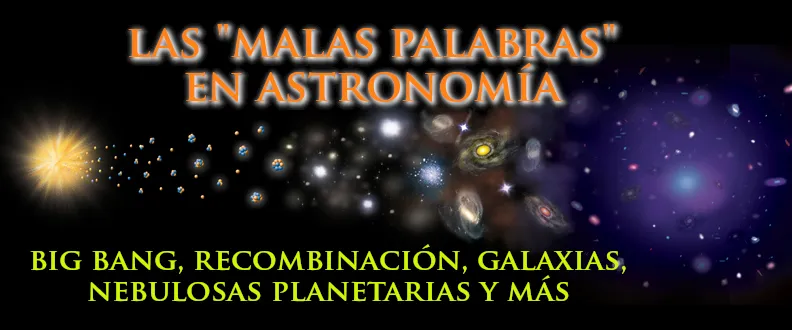
A review of words with controversial meanings.
What’s in a name? That which we call a rose
By any other name would smell as sweet
Romeo and Juliet (Act II, Scene 2)
Introduction
In Romeo and Juliet, Shakespeare invites us to a philological reflection: Would a rose be just as sweet if it were called something else? So what importance do words have? If oranges were called "blue," it wouldn't change their essence at all. But why would they be called blue if they are orange? There is a questioning there about coherence with previous meanings. Contradictions, in many cases, arise after having used a name, which is why examining some contradictory concepts is also examining the history of words and societies.
Here, our Detective of Astronomical Names reviews some questionable terms in their use in astronomy, in no particular order.
1-Recombination
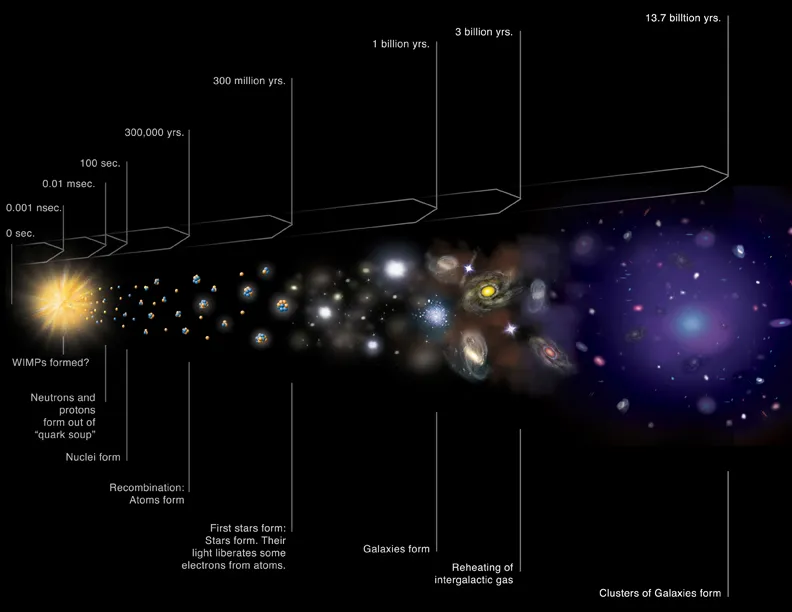
In cosmology, the concept of recombination is used in reference to an epoch during which electrons and protons combined (for the first time) to form neutral hydrogen atoms. The consequence was the Cosmic Background Radiation.
The problem with the word is that there was no prior period of combination to justify the prefix "re".
In his book Cosmological Physics (1999), p284, John A. Peacock says: "The historical origin of the name lies in HII regions: interstellar plasma is ionized by ultraviolet radiation from a hot star, and the region emits characteristic recombination radiation as the electrons and ions continuously re-form atoms before being photoionized once more".
That is, he justifies the use of the word in relation to HII regions, which are regions of ionized hydrogen due to the very energetic radiation from new stars that strips electrons from atoms, ionizing them. Since this process occurs over and over again, in that context it makes sense to use the word.
2-Galaxy/Milky Way
Until Hubble's work in the 1920s, only one galaxy was known, ours, nicknamed Milky Way for its milky appearance in the night sky, associated with the myth of Heracles. But what were later considered galaxies were already observed, although they were mentioned as spiral nebulae and it was speculated that they could be "island universes". The word /galaxy/ comes from Greek and means /circle/+/milky/. But in these structures there is dust, gas, but no milk...
3-Planetary Nebulae
Planetary nebulae are a period in stellar evolution, that is, a passage in the evolutionary cycle of stars. They have nothing to do with planets. The origin of the name comes from when these objects were observed by 18th-century astronomers with less powerful telescopes and they saw nebulous and rounded shapes, similar to planets.
4-Planet
The word was redefined at the 2006 IAU meeting, adding a criterion for classifying these objects. That third criterion, which differentiates planets from dwarf planets, has been questioned for being difficult to quantify.
The origin of the word is in a Greek word similar to "wanderer, vagabond". Well, it happens that there are rogue planets, ejected from their solar system and that wander without a gravitationally associated star. But if /planet/ means /wanderer/, then /rogue planet/ is redundant. On the other hand, the orbits of planets are very regular. The "retrograde motions," we already know, are illusions due to speed changes between Earth and the observed planets.
5-Shooting star
For at least two centuries it has been known that "shooting stars" are not stars, but meteors. It is paradoxical: its meaning is on the one hand ephemeral in that as soon as it is used, it is clarified that they are not stars. But, on the other hand, the term has been used for a long time.
6-Big Bang
It is difficult to decide who could be considered "the father" of the Big Bang Theory: George Gamow, Alexander Friedmann, George Lemaitre. But there is no doubt about who did NOT agree: Fred Hoyle. It was that astronomer who labeled the idea of a primordial fire as "Big Bang," as it was also called in the early 1930s. In Spanish it was translated as "Gran Explosión" (Great Explosion), although it does not refer to an "explosion".
7-Dark matter
There are several discrepancies, detected since the 1930s, between astronomical observations and theories of gravitation. Starting in the 1970s, through the work of Vera Rubin and Kent Ford, it began to be seriously thought that something must exist in galaxies and later also in galaxy clusters to explain those observations. The words "dark matter" are a translation of those proposed by astronomer Fritz Zwicky, in German: dunkle materie.
However, a dark object, in a literal interpretation, implies the absorption of radiation; while the hypothesis assumes a form of matter that does not interact with radiation, according to modern astronomers.
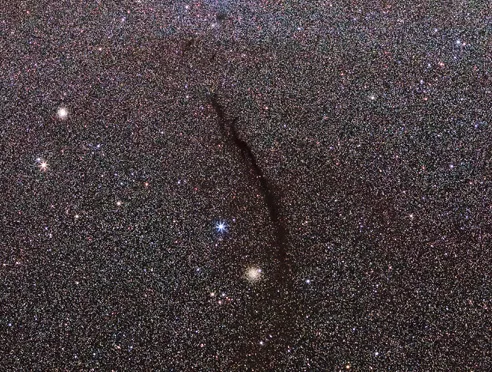
8-Dark Doodad Nebula
A dark nebula, near the globular cluster NGC 4372, has been called -unofficially- as "Dark Doodad Nebula," which has been translated as "Nebulosa del Chisme oscuro" or "nebulosa del adorno oscuro". The word "doodad" can be used as "garabato" (doodle). It has been proposed to call the object "Sandqvist 149" in honor of the astronomer who cataloged it.
9-Brown dwarfs
The problem with the name is that they are not stars and they are not brown either. They are not stars, but sub-stellar objects, as they lack the mass (and therefore the gravity and temperature) to produce nuclear fusion. Due to their temperature they cannot be brown, just as there are no green stars, but they are red, orange or magenta. They are objects more massive than planets, but they differ from them in that they usually have deuterium.
Conclusion
We have reviewed some terms used in astronomy that could be questioned. Does this mean they need to be changed? In some cases, a name change could occur. Here, however, we have not made a proposal in that regard. What is important is to keep in mind their current meaning and it is interesting to know the history of the words. We navigate in a world of words, in an ocean of Babel. Language is fluid like water, but words and meanings can be as solid as steel.
According to Helge Kragh, astrophysicist Fred Hoyle, in an interview given to Horgan in 1995 published in SciAm, said: "Words are like harpoons: Once they go in, they are very hard to pull out."☉
Sources and related links
- Ask Ethan: What are the worst cosmic misnomers?
https://bigthink.com/starts-with-a-bang/worst-cosmic-misnomers/ - Interview with Fred Hoyle by Alan Lightman, 15 August 1989, Niels Bohr Library & Archives, American Institute of Physics
https://www.aip.org/history-programs/niels-bohr-library/oral-histories/34366 - What's in a Name: History and Meanings of the Term "Big Bang"
Helge Kragh
https://arxiv.org/abs/1301.0219
About the images
Credit: ESO/P. Grosbøl
NASA/CXC/M.Weiss
Credit: Naskies/Wikimedia Commons
By The Hubble Heritage Team (AURA/STScI/NASA) - https://hubblesite.org/contents/news-releases/1999/news-1999-01.html (direct link), Public Domain, https://commons.wikimedia.org/w/index.php?curid=401569