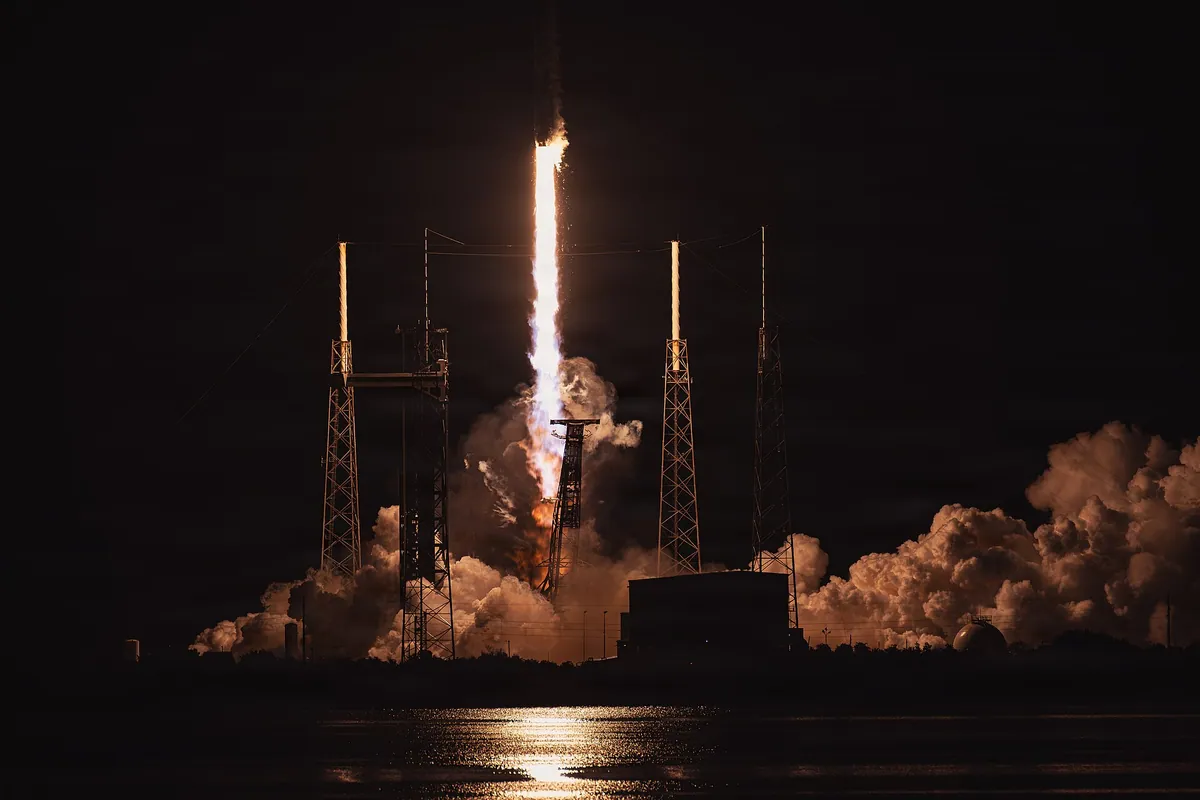
The US company AST SpaceMobile announced the development of its own reusable rocket named Blacklift. This vehicle will have a capacity of 20 metric tons to low Earth orbit, and the company plans to begin its commercial launches by late 2028. The Texas-based firm seeks to guarantee regular access to space for its large direct-to-cell phone communication satellites. Abel Avellan, its founder and CEO, stated that the Blacklift rocket is the springboard to significantly expand their total addressable market, providing AST SpaceMobile with regular unconstrained access to orbit and providing for most favorable owner’s economics in the industry. Despite widespread industry skepticism, AST SpaceMobile executives expressed confidence in being able to develop the vehicle in just two years.
The company has named its new vehicle Blacklift. The announcement comes amid widespread skepticism about the feasibility of its two-year plan, especially considering conflicting accounts of where the rocket will launch from. The company argues it will not start from scratch, as it has signed an agreement with Firefly to obtain engines and engineering services. However, the Miranda engine, which will power the first stage, is likely still two years away from being tested in flight on Firefly's Eclipse rocket. This does not eliminate the enormous engineering, manufacturing, testing, and regulatory effort required to develop a medium-capacity rocket.
To accelerate development, AST SpaceMobile signed an agreement with the company Firefly Aerospace. The agreement includes the delivery of engines for the first three Blacklift rockets, engineering services for three years, and the acquisition of a perpetual license to manufacture the Miranda engines and their vacuum variant Vira. The first stage of Blacklift will be powered by nine Miranda engines. AST SpaceMobile has committed to paying 1.3 billion dollars to Firefly for this agreement, which includes 800 million for the engine license, 250 million for 27 Miranda and nine Vira engines, and another 250 million for engineering support. This means the cost of engines alone for one Blacklift rocket would be about 83 million dollars for the first three vehicles.
The development of a new medium or heavy-lift rocket typically takes between five and nine years, according to the track record of companies like SpaceX and United Launch Alliance. SpaceX set the fastest record with 4.7 years for the Falcon 9, but it had significant prior experience. Other examples include Rocket Lab with Neutron and Relativity Space with Terran R, whose developments are ongoing. AST SpaceMobile needs to launch approximately 90 more BlueBird satellites, which are very large and provide direct-to-mobile connectivity. The company already has launch contracts with external providers like SpaceX and Blue Origin for more than 100 satellites between 2027 and 2028. This existing launch portfolio raises questions about the immediate need to invest in its own rocket.
The recent history of other rocket developments offers additional context. SpaceX announced its Falcon 9 in 2005 and took 4.7 years to reach orbit, but it already had significant experience with its Merlin engine. United Launch Alliance's Vulcan rocket needed 8.7 years to reach space, with a very experienced team and around 2 billion dollars in cumulative federal support. Companies like Rocket Lab, Relativity Space, and Stoke Space have also announced medium or heavy-lift vehicles since 2015, with payload capacities ranging from 7 to 27 metric tons. The overall record suggests that developing a new rocket of this type takes five to nine years from public announcement to first orbital launch.
AST SpaceMobile's decision reflects a broader trend in the industry, where operators of large satellite constellations, unable to secure launch capacity on favorable terms years in advance, consider the extraordinary option of developing their own vehicles. Another company, Cowboy Space, announced plans in October for a large rocket named Big Iron, also with a first flight planned for 2028. The apparent availability of capital for new entrants in the medium-lift launch market suggests investors recognize the growing capacity crisis in the sector. Since 2015, other US companies like United Launch Alliance with Vulcan, Rocket Lab with Neutron, Relativity Space with Terran R, and Firefly in collaboration with Northrop Grumman for Eclipse, have announced medium to heavy-lift vehicles. Of all these, only Vulcan has reached orbit, a process that took 8.7 years and involved an experienced team and about 2 billion dollars in aggregated federal support.