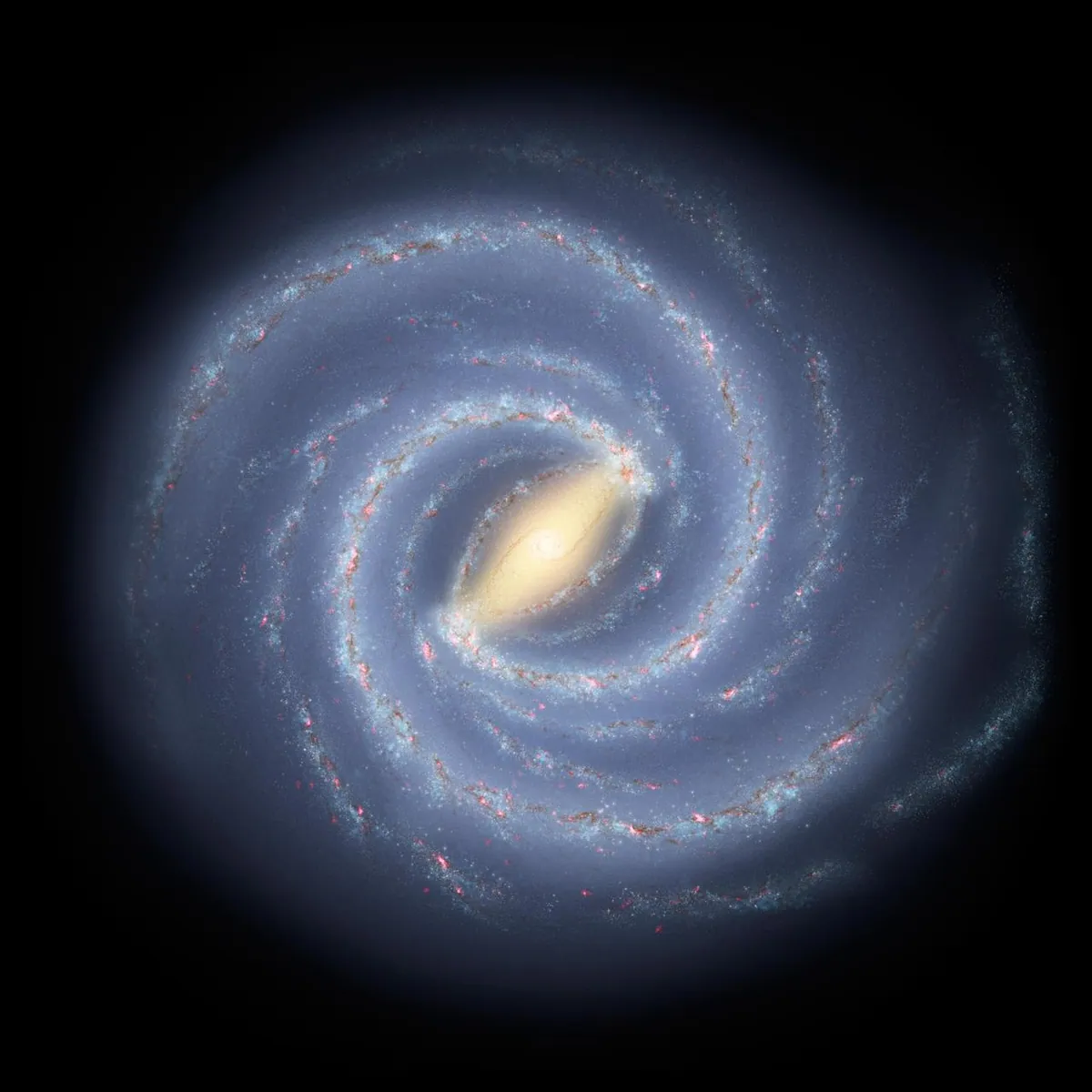
A team of astronomers discovered that the central stellar bar of the Milky Way is the site of intense star formation, which distinguishes it from most nearby barred spiral galaxies. The research, published in Nature Astronomy on November 23, 2026 and led by Dr. Hillary Davis from the University of Sydney, also suggests that the structure called the Norma arm might not be an independent spiral arm. Instead, it would be the shock front of the galactic bar where stars are born. The findings are based on large-scale computational simulations and observations of cosmic masers, which are microwave emissions from young massive stars. The study provides new constraints on the size, orientation, and rotation speed of our galaxy's central bar.
The study combines maser observations with sophisticated hydrodynamic simulations of galactic evolution spanning billions of years. The researchers found that the positions and velocities of the masers, previously associated with the Norma arm, align closely with the shock front predicted by their models. Davis explained that this suggests at least part of the so-called Norma arm may not be a spiral arm at all, but a region of star formation along the leading edge of the galactic bar. This finding questions the traditional model of the Milky Way as a galaxy with four main spiral arms, including the Norma-outer arm.
Davis noted that, at its heart, star formation is a process we understand from everyday physics. Forces set matter in motion. In this case gas is compressed, and that compression can create the conditions for new stars to be born on a massive scale. She added that in most similar galaxies, star formation very commonly occurs along spiral arms. What is extraordinary is seeing this happen in a different region of our Galaxy, where shocks are usually so strong that star formation is often suppressed.
The research also provides new and precise constraints on the properties of the central bar, which have been debated for decades due to the difficulty of observing it directly. Davis explained that the Galactic bar cannot be easily observed because of a combination of our position in the Galaxy and dust obscuring our view. As a result, the bar's properties have been highly debated. According to the study, the bar extends approximately 4.3 kiloparsecs (about 14,000 light-years) from the galactic center along its semi-major axis, with a semi-minor axis of about 2.3 kiloparsecs. Its orientation angle is estimated at 20 degrees and its pattern speed is under 40 kilometers per second per kiloparsec, supporting a relatively long and slowly rotating structure.
Dr. Thor Tepper-Garcia, a co-author from the University of Sydney who performed the simulations, highlighted the power of combining numerical modeling and astronomical observations. He said that it is particularly rewarding to see computational astrophysics challenge our understanding of the very structure of our Galaxy. This is a wonderful example of the power of bringing numerical modeling and astronomical observations together. The simulations were run at the National Computing Infrastructure in Australia and at the LUNARC supercomputing center at Lund University in Sweden.
The authors explain that the Norma masers trace very young star-forming regions, less than one million years old, that are still close to the gas clouds in which they formed because they have not had enough time to migrate. Therefore, the association of these masers with the galactic bar's shock front suggests that star formation is occurring along the bar's dust lane. The work implies that the Milky Way belongs to a rarer class of barred spiral galaxies where gas compression in the shock front overcomes shear barriers, allowing star formation. This resolves long-standing kinematic anomalies and simplifies models of galactic structure. The authors conclude that their findings shed new light on our understanding of star formation processes in the Milky Way and raise questions about the Galaxy's spiral structure that need further investigation.