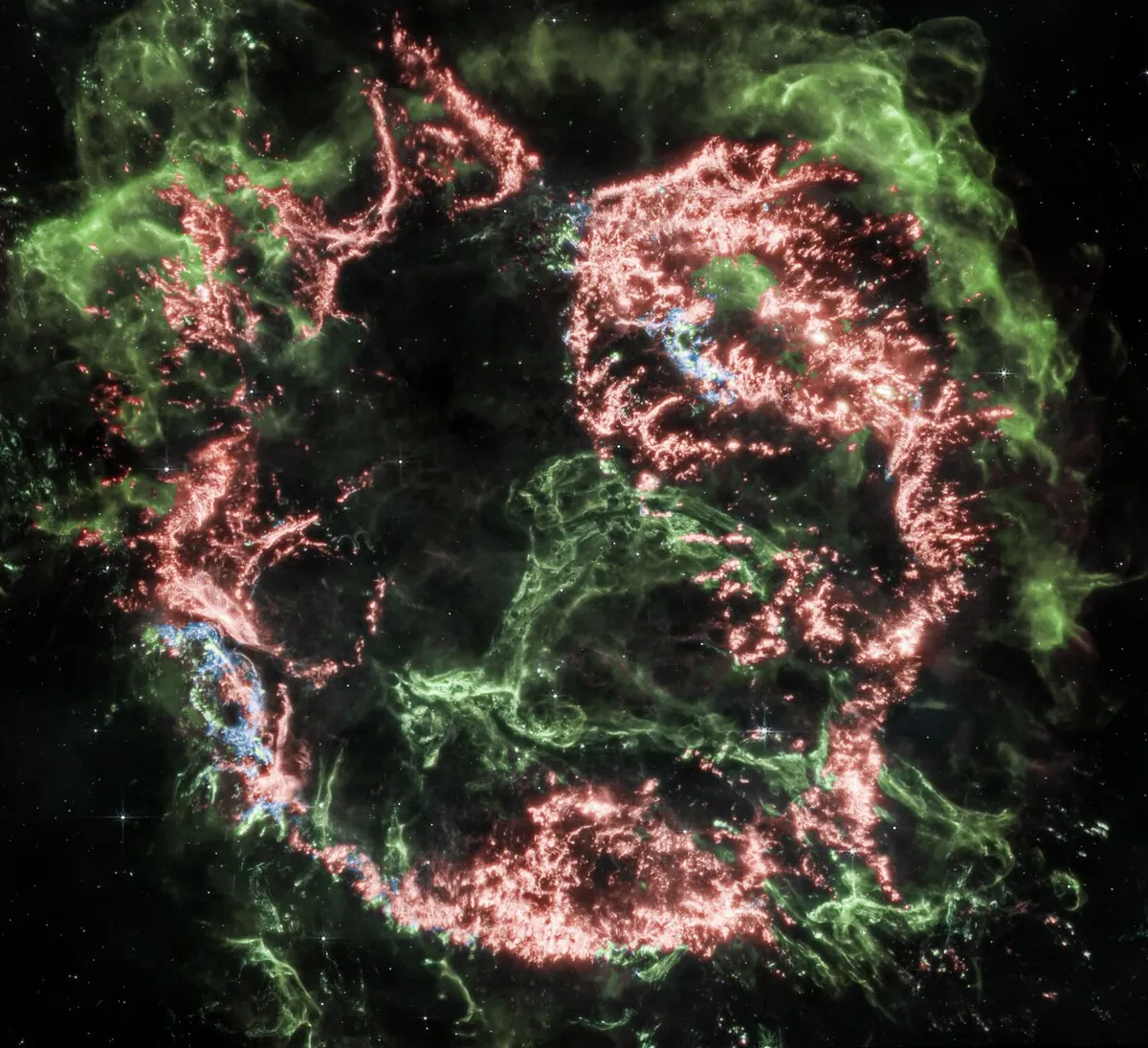
The James Webb Space Telescope has provided new observations of the Cassiopeia A supernova remnant that reveal details about the structure and evolution of the star that originated it. The mid-infrared data, published in The Astrophysical Journal Letters, support a scenario in which the star's interior underwent a dramatic change, possibly just hours before its collapse and explosion. By mapping the dust composition in the remnant, astronomers have found evidence of a phenomenon known as a shell merger, where the different layers of elements inside a star mix just before the supernova. The Webb telescope, with its high resolution, has been able to study and map the composition of individual, solar-system-sized dust clumps within the remnant, which has allowed researchers to detect the signature of a shell merger that occurred in the progenitor star.
Tea Temim, lead author of the study and a researcher at Columbia University, explained that material within these shells churns and circulates, which can cause the shells to merge shortly before the supernova explosion. According to Temim, this would be something like the oxygen- and carbon-burning shells in a star merging together and changing the structure of the star significantly, which in turn would alter the chemical abundances seen after the explosion in the ejecta of the remnant. To know where to focus their observations, the team used previous data from NASA's retired Spitzer Space Telescope. Spitzer identified three specific regions within Cassiopeia A to be studied with Webb's unprecedented detail. Two of the targets were inside the remnant's reverse-shocked region, where an inward-moving shock wave collides with the ejected debris. Webb observed that the ejecta in one of these regions contained mostly silica dust, while the other was dominated by carbon dust.
Ilse De Looze, co-author of the paper and associate professor at Ghent University in Belgium, noted that identifying the different types of dust grains formed in the chemically distinct layers of a supernova brings us one step closer to understanding how much dust supernovae contribute to the interstellar dust reservoir in our galaxy. The third observed region was the so-called Green Monster, a structure rich in complex magnesium silicates that was first discovered by Webb. Unlike the other two, the Green Monster originated from material that the star shed before it exploded, not from the material ejected by the supernova. Combining Webb's observations with X-ray data from NASA's Chandra Observatory and the JAXA-led XRISM telescope, astronomers have mapped the dust composition across the entire remnant. Together, these observations indicate that the shell merger was underway very shortly before the supernova explosion. Webb's dust map also reveals that the signatures of this merger are present throughout much of the Cassiopeia A remnant.
Webb's work builds on previous observations from NASA's retired Spitzer Space Telescope. Although Spitzer could not resolve the finest details of the region, it identified three key areas for Webb to examine with its sharp vision. Two of these targets were inside Cassiopeia A's reverse-shocked region, where an inward-moving shock wave collides with the ejected debris. The third area was the structure called the Green Monster, first discovered by Webb and rich in complex magnesium silicates.
Dan Milisavljevic, associate professor and co-author of the study from Purdue University, said that with Webb, the vast improvement in being able to resolve at the individual clump level helps us do more sophisticated dust chemistry. As a result, we can tie the explosion back to the makeup of the progenitor star hundreds of years afterward. According to Milisavljevic, this is telling us about what was happening, it is believed, in the hours leading up to core collapse. Understanding this process is essential to explaining which elements the supernova explosion will release into the galaxy and how those elements enrich future generations of stars and planets. These efforts provide a new method for other astronomers to infer characteristics about a progenitor star's structure using the dust from a supernova remnant.
The James Webb Space Telescope is the largest and most powerful observatory ever launched into space. It is an international program led by NASA with its partners, ESA (the European Space Agency) and CSA (the Canadian Space Agency). ESA provided the telescope's launch service using the Ariane 5 vehicle and contributed key instruments such as the NIRSpec spectrograph and 50% of the MIRI mid-infrared instrument. Webb serves thousands of astronomers worldwide, studying every phase of our universe's history.