Using the Hubble Space Telescope and the one from the W.M. Keck Observatory, they found a debris disk around the young star HD 15115. Seen from Earth, the edge of the disk resembles a needle coming out of the star.
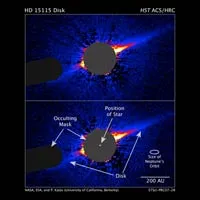
HD 15115. Credit: NASA, ESA, and P. Kalas (University of California, Berkeley)
Astronomers think the rare disproportionate shape of the disk is caused by dust following an elliptical orbit around the star. The unbalanced disk has been caused by the gravity of planets or by the gravity of a nearby star.
The observations were made by Paul Kalas, James Graham and Michael P. Fitzgerald, all from the University of California at Berkeley. Their paper appeared in The Astrophysical Journal Letters.
Debris disks are produced by dust from collisions between protoplanetary bodies, which are the building blocks of planets. These dusty disks can be affected by planets close to the star, just as Jupiter's gravity affects objects in the asteroid belt.
The discovery is consistent with models of planetary disturbance in our solar system, where Neptune could have originally been formed between Saturn and Uranus. Neptune was eventually pushed to its present location by the gravitational dance between Saturn and Jupiter before their orbits stabilized. "Therefore, we speculate that if a planetary disturbance were occurring around HD 15115 at this time, it could explain the highly asymmetric disk," says Kalas.
This could happen through a powerful gravitational interaction between planets that pushes one or more planets into very elliptical orbits, or even ejects them into interstellar space. When the planet's orbit becomes elliptical due to a violent disturbance, the rest of the disk can be perturbed into an elliptical shape, according to Kalas.
The scientist is also studying whether the gravity of the star known as HIP 12545, located about 10 light-years from HD 15115, could have created the rare disk due to a close encounter in the past.
The two stars are among the about 30 stars that belong to the Beta Pictoris moving group. Moving groups are expanded clusters of stars that are thought to have had a similar birth (in place and time) and are traveling together through space.
The dust disk around HD 15115 was first inferred by observations at infrared wavelengths in the year 2000 and its existence was confirmed in 2006 when Hubble found the disk in reflected light for the first time. Then the disk was studied more deeply by Keck's adaptive optics in 2006 and 2007.
"The disk was seen in Hubble data, but its appearance was so extraordinary that we couldn't be sure it was real. Follow-up observational data from Keck was needed to confirm it was a real disk," Kalas finally added.
Sources and related links
- HubbleSite press release
- Keck press release
- Paper: The AUMicroscopii Debris Disk: Multiwavelength Imaging and Modeling, Michael P. Fitzgerald, Paul G. Kalas, Gaspard Duchene, Christophe Pinte, James R. Graham
About the image:
Object Name: HD 15115
Object Description: Star with Debris Disk
Position (J2000): R.A. 02h 26m 16s.28
Dec. +06° 17' 32".9
Constellation: Cetus
Distance: 150 light-years (45 parsecs)
Dimensions: This image is 23 arcseconds (roughly 1000 Astronomical Units) across.
About the Data
Data Description: This image was created from data from the HST proposal 10896: P. Kalas, J. Graham, M. Fitzgerald (University of California, Berkeley).
Instrument: ACS/HRC
Exposure Date(s): July 17, 2006
Exposure Time: 35 minutes
Filters: F606W (V)
About the Image
Image Credit: NASA, ESA, and P. Kalas (University of California, Berkeley)