Now it's possible, in addition to classifying galaxies online, to discover exploding stars that no one has seen before. And you don't need a telescope, supernovae are just a click away.

This is a new project from the team behind Galaxy Zoo, an initiative that allows classifying galaxies online. In this case, they have joined the Palomar Observatory which is conducting the "Palomar Transient Factory" (PTF) survey in search of brightness changes in different areas of the sky. The partnership with Galaxy Zoo this time focuses on the search for Type Ia supernovae.
Thus, we users can register at Galaxy Zoo and browse through the PTF data. Waiting for the results are two intrepid astronomers, Mark and Sarah at Roque de los Muchachos, on the Canary Island of La Palma. The astronomers have time allocated on the William Herschel Telescope to focus on the best discoveries.
The project tries to find examples of Type Ia supernovae that arise in binary systems when a white dwarf is near a companion from which it extracts material. That happens until it reaches a critical mass that triggers a huge explosion. What is particularly interesting about this type of event is that they seem to have the same luminosity. That's why knowing the luminosity of a supernova allows estimating the distance, so they are used as standard measures used, for example, to learn more about the expansion of the universe.
How it works
The task is to find supernovae in images taken with the PTF survey. That search works like this: they repeatedly observe the same region of the sky in a series of images taken twice every five days (approximately), over a period of several months. The first images in these series are added together and create a reference image, a deeper image that shows what the sky looks like at the beginning. For each new image taken after that reference, they try to find differences. To do this, they subtract the reference image from each new image, creating an image with only the differences between the two and they search that for any changes there might be.
There are automatic search routines, but the process is not perfect, so the supernova candidates presented by these routines can be anything else: errors, asteroids, variable stars, active galaxies, etc., and not supernovae. That's where users come in, for which the site has a tutorial.
What do supernovae look like in the data? Unlike galaxies, supernovae vary little from image to image. They are typically small, compact and circular, almost like stars. They are usually (but not always) associated with nearby galaxies. When classifying supernovae we will be shown a series of three images. The first is the new image. The second is the reference image that contains the event to classify. And the third is a subtraction image, meaning it is the reference image subtracted from the new image, therefore, it is "the different things" between the first and second images.
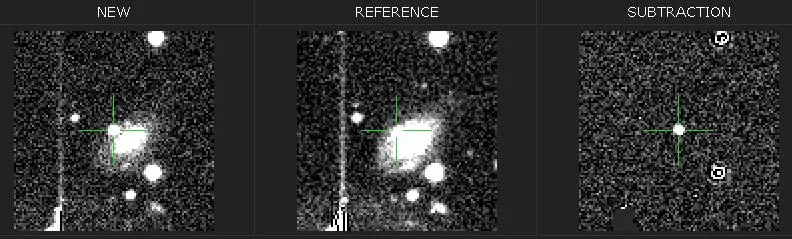
It is very common for the SN not to be visible in the new image due to contrast with the host galaxy and it is only noticeable in the subtraction image, after the galaxy has been subtracted. This is an example:
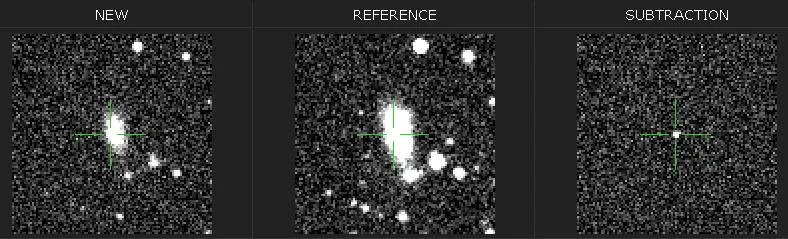
In other cases it may be more difficult to decide. To help us, we will be asked some questions about each candidate. Most images have a single, obvious candidate in the center of the subtraction image. But sometimes the subtraction routines work poorly and the image appears to contain many strange objects.
So when they ask us if the subtraction image is clean and there is a single, obvious candidate, we will say NO in those cases.
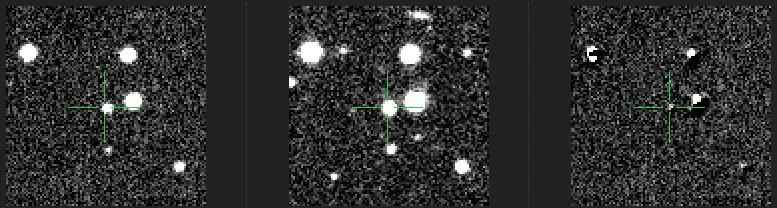
If we answer yes, then they will ask us if the candidate has been subtracted correctly. To answer the question affirmatively all the candidate's pixels are white.
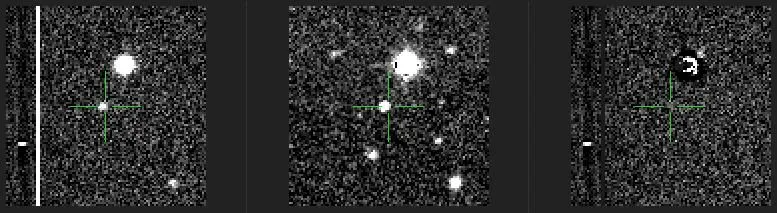
If we answer affirmatively, we reach a stage where we might have a real supernova. However, it still might not be, so they will ask us if the candidate is star-like and approximately circular.
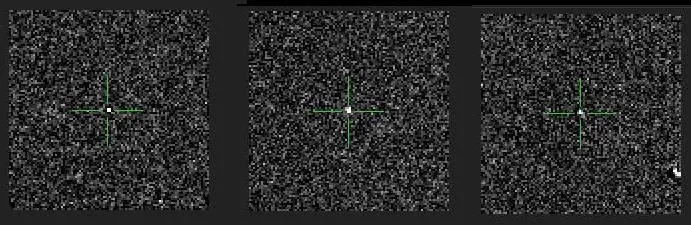
If we answer no, they will ask us to describe what is wrong, choosing from the options:
Not circular, elongated; Not circular, very small; Not circular, distorted; Not circular, diffuse.
If the previous answer was positive, they need to check if the candidate's position is significantly different from the reference image.
Finally, we must decide if the candidate is centered on the host galaxy. If we see a galaxy in the reference image and the candidate in the subtraction image is centered, we will say yes.
If our candidate passed all the questions, it could well be a real supernova and will be shown to other users. The best candidates will have follow-up and if confirmed, they will let us know. And perhaps we can feel proud to say: "Hey, I discovered that supernova!"
Now answer: Are you interested?
If the answer is yes, you should follow this link:
Galaxy Zoo: Supernovae
Sources and related links
- Supernovae: Galaxy Zoo
- The humor of Galaxy Zoo
- Help wanted to classify never-before-seen galaxies
- A rare blue object
About the images
- All images belong to the Galaxy Zoo: Supernovae tutorial