Using two NASA satellites, astronomers have discovered a black hole even larger than the one found two weeks ago. The new black hole, with a mass between 24 and 33 times that of our Sun, is the heaviest known orbiting a star.
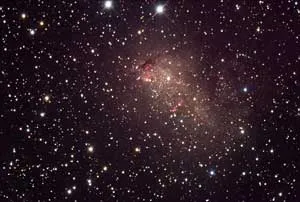
IC 10, the dwarf irregular galaxy that hosts the heaviest black hole. Adam Block/NOAO/AURA/NSF
It is a stellar-mass category black hole. Formed in the death of a massive star, these black holes are smaller than the monstrous black holes in galactic nuclei. The previous record, announced recently, is 16 solar masses in galaxy M33.
"We did not expect to find a stellar-mass black hole this massive," says Andrea Prestwich of the Harvard-Smithsonian Center for Astrophysics, author of the paper to be published on November 1 in Astrophysical Journal Letters.
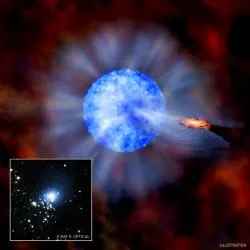
The black hole is located in the nearby dwarf galaxy IC 10, 1.8 million light-years from Earth in the constellation Cassiopeia. The team was able to measure the mass of the object because it has an orbiting companion: a hot, evolved star that ejects gas in the form of a wind. Some of this material falls into the black hole, heats up, and emits X-rays before crossing the point of no return.
In November 2006, Prestwich and her colleagues observed the dwarf galaxy with the Chandra X-ray Observatory. The group discovered that the brightest X-ray source, IC 10 X-1, exhibits clear changes in its brightness. Such behavior suggests a star periodically passing in front of a black hole and blocking the X-rays, creating an eclipse. In late November, the Swift satellite confirmed the eclipses and revealed details about the star's orbit. The star in IC 10 X-1 appears to orbit in a plane that lies close to Earth's line of sight, allowing the calculation that the black hole has a mass of at least 24 Suns.
There are some uncertainties about this estimate, but as Prestwich notes, "future optical observations will provide a final check. Refinements in the measurement will likely increase the black hole's mass more than reduce it."
The black hole's mass is surprising because massive stars generate powerful winds that eject a lot of material before the star explodes. Calculations suggest that massive stars in our galaxy leave behind black holes no larger than 15 Suns.
IC 10 X-1 has gained mass thanks to its companion, but the rate is so small that the black hole would only have gained 1 or 2 solar masses. "This black hole was born fat," says astrophysicist Richard Mushotzky of the Goddard Space Flight Center.
The progenitor star probably began its life with 60 or more solar masses. Like its host galaxy, it was surely deficient in heavy elements. In massive stars with a large fraction of elements heavier than hydrogen and helium, the extra electrons from, for example, carbon and oxygen "feel" the external pressure of light and are more susceptible to being swept away in stellar winds. But with a low fraction of heavy elements, the progenitor of IC 10 X-1 expelled comparatively little mass before exploding, so it could leave a heavier black hole.
Sources and related links
- Note at CfA
- Note at UniverseToday
- Note at Goddard