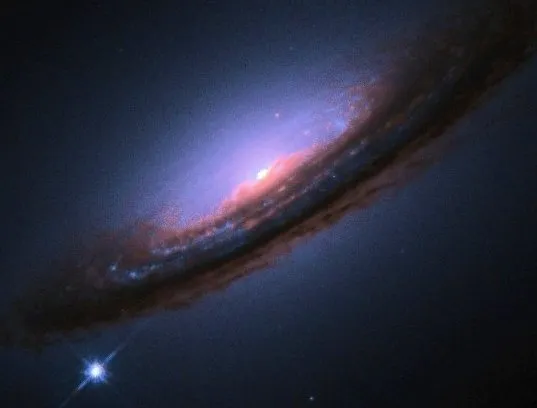
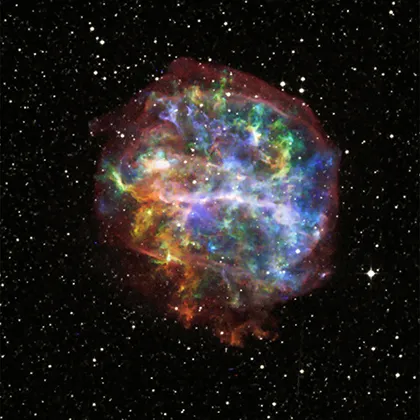
A new stellar explosion appears to break all existing records: SN2005ap is almost 5 billion light-years away.
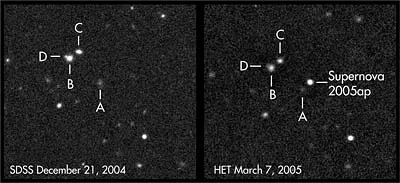
SDSS, R. Quimby/McDonald Obs./UT-Austin
On the left of the image, a field of galaxies is seen (from A to D). On the right, the same field is seen, showing a new point of light.
It is a supernova, an exploding star 4.7 billion light-years away.
Of course, this is not an ordinary supernova. It is the most powerful ever detected, twice as powerful as the most powerful detected until now. It was found by astronomer Robert Quimby at McDonald Observatory using a relatively modest 18" telescope and later followed up with the monstrous 10-meter telescope.
In general, by taking a spectrum of the object, its distance can be determined. Supernovae emit light at specific wavelengths (colors). Since the Universe is expanding, the lines redshift, the wavelengths become longer the farther away the object is. If some lines can be identified (some of oxygen, hydrogen, etc.), the object's distance can be established with good precision. Initially, Quimby saw a line, but he wasn't sure which one it was, so the distance was not well determined. Until later observations identified a magnesium line with the same redshift, it could be established that it is indeed 4.7 billion light-years away.
Taking this distance into account, supernova 2005ap is the most powerful of those found, taking the throne from SN2006gy, also found by Quimby!
The discovery has been accepted for publication in the October 20 edition of The Astrophysical Journal Letters.
According to Quimby, it is a Type II supernova because it contains hydrogen. It is believed that most of these Type II explosions are the result of massive stars (more than 7 times the mass of our Sun) whose cores collapse under their own weight. This particular supernova is 300 times brighter than average, according to the scientist, and lies in a dwarf galaxy in the constellation Coma Berenices.
If SN2006gy already proposed some headaches, these are sharpened with the new finding. It's that until a few years ago, it was thought that a stellar explosion of this type could not be so powerful. But these recent discoveries highlight that, evidently, there is no complete understanding of this phenomenon.
Apparently, the idea that is being floated is that the supernova becomes so hot that it creates antimatter that adds energy to the explosion.
Without a doubt, supernovae will continue to fascinate us, for being extremely extreme events in terms of temperatures, pressures, and energies released. And for their complexity, which, it is clear, will have to continue to be studied to achieve a greater understanding of these fantastic cosmic flashes.
Sources and related links
- Note on BadAstronomy
- Press release at McDonald Obs.