Groups of scientists propose theories that could explain the enormous brightness of supernova SN 2006gy, one of the brightest ever detected.
SN 2006gy
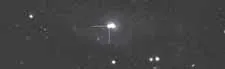
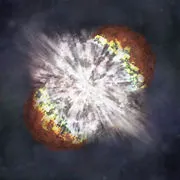
A supernova observed last year was so bright -about 100 times more luminous than a typical supernova- that it challenges the theoretical understanding of what causes these explosions. But Stan Woosley, professor of astronomy and astrophysics at the University of California, Santa Cruz, had an idea he thought could account for it: a very massive star that undergoes repeated explosions. When Woosley and two colleagues performed the detailed calculations for their model, the results matched the observations of the supernova known as SN 2006gy.
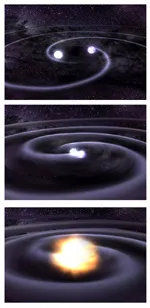
Another study led by Simon Portegies Zwart of the University of Amsterdam, instead proposes that the supernova was created during a collision between two massive stars.
Both papers will be published in the next edition of the journal Nature.
"We usually think of a supernova as the death of a star, but in this case the same star can explode half a dozen times."
The first explosion ejects the outer layers and produces a not very bright supernova. The second explosion generates energy in a layer that expands at high speed until it collides with the first, producing extraordinary brightness.
"The two layers collide at such a distance that the kinetic energy is converted to light, so it is up to 100 times brighter than ordinary supernovae. Usually, a supernova only converts 1% of its kinetic energy into light because it must expand a lot before the light can escape," says Woosley.
The mechanism requires a very massive star, between 90 and 130 times the mass of the Sun. At the end of its life, the temperature in the core is so high that part of the energy of the gamma radiation is converted into pairs of electrons and their antimatter counterpart, positrons. The result is a phenomenon called "pair instability" in which the conversion of radiation into electron-positron pairs causes the radiation pressure to drop and the star begins to contract rapidly.
"As the core contracts it rapidly goes towards instability until it collapses and burns fuel explosively. Then the star expands violently, but not enough to tear the star apart. For stars between 90 and 130 solar masses, you get pulses," adds Woosley and continues, "It hits this instability, expands violently, then radiates and contracts until it becomes hotter and hits the instability again. And so on until it loses enough mass to become stable again."
Stars in this size range are rare, especially in our galaxy, but they would have been more common in the early Universe. "Until recently, we would have said that such stars do not exist. But any mechanism that can explain this event requires a very large mass," adds the scientist.
Other researchers have suggested pair instability as a possible mechanism for some supernovae, but the idea of repeated explosions -called "pulsational pair instability"- is new.
"A great variety is possible and it becomes more complicated because what remains is still about 40 solar masses and continues evolving and eventually generates an iron core and collapses, so you can end up with a gamma-ray burst. The possibilities are exciting."
Portegies Zwart, on the other hand, believes that in the chemical signature of the supernova there is a lot of hydrogen. Stars of more than 40 solar masses expel their hydrogen layer long before exploding.
And since the supernova occurred near the center of its galaxy, where collisions are frequent, this group leans towards the collision scenario.
A star 100 times more massive than the Sun, in its phases of exhausting the hydrogen in its core, collides with a hydrogen-rich star of about 10 to 40 solar masses.
The papers
A runaway collision in a young star cluster as the origin of the brightest supernova p388
Simon F. Portegies Zwart & Edward P. J. van den Heuvel doi:10.1038/nature06276
Pulsational pair instability as an explanation for the most luminous supernovae p390
S. E. Woosley, S. Blinnikov & Alexander Heger doi:10.1038/nature06333
Sources and related links
- Note on EurekAlert
- Press release from UC Santa Cruz
- A quark star?
- The most powerful supernova
- Note in National Geographic