Perhaps the first stars in the Universe did not shine but were "dark stars" between 400 and 200,000 times larger than our Sun and powered by the annihilation of mysterious dark matter, according to a new study.
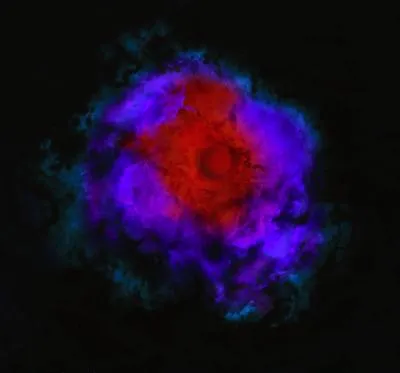
The study - to be published next month in Physical Review Letters – calculated how dark matter would have influenced the birth of the first stars, almost 13 billion years ago.
The findings "drastically alter the current theoretical framework for the formation of the first stars," says the study's author and astrophysicist Paolo Gondolo, an associate professor of physics at the University of Utah.
It is possible that gigantic dark stars exist today, and although they do not emit visible light, they could be detected because they should emit gamma rays, neutrinos and antimatter and be associated with clouds of cold molecular hydrogen".
"Without detailed simulations we cannot determine the evolution of dark stars. They could last months or 600 million years or billions and still be out there. We will have to look for them," says Gondolo.
The scientist conducted the study with Katherine Freese, Ann Arbor and Douglas Spolyar.
Gondolo says he wanted to call this new class of theoretical stars "brown giants" but his co-authors insisted on calling them "dark stars" after the song "Dark Star" by The Grateful Dead.
Scientists know of the existence of dark matter because galaxies rotate faster than can be explained by the visible matter in them. Furthermore, observations by satellites, balloons and telescopes have led to estimates that visible matter represents only 4% of the Universe. The rest would be composed of 23% dark matter and 73% dark energy.
WIMPs - acronym for weakly interacting massive particles - are the leading candidates for dark matter. According to Gondolo, "neutralinos" are a type of WIMP that should exist under particle physics theories that seek to explain the origin of mass in the Universe.
Scientists also believe that the Universe formed just over 13 billion years ago in an expansion of time and space known as the Big Bang.
The remnant of that "initial explosion" is the cosmic microwave background radiation which developed some small temperature fluctuations causing the primordial matter to gravitationally clump together and eventually collapse into stars and galaxies. The matter was then dark matter but also hydrogen and helium.
The conventional theory of how the first stars were born holds that as hydrogen and helium atoms came together in protostellar clouds, they began to cool, making the cloud denser. The clouds shrank and cooled until hydrogen fusion into helium began, igniting the combustion engines of the stars.
For the new study, the astrophysicists calculated how dark matter would have affected the temperature and density of the gas that clumped together to form the first stars.
The findings suggest that neutralinos interacted by annihilating each other, producing quarks and antiquarks and generating heat. The protostellar cloud of hydrogen and helium would try to shrink and cool, but the dark matter would keep it hot and large, preventing fusion.
"The heat could counteract the cooling and the star would stop its contraction for a time, forming a dark star," after 80 or 100 million years after the Big Bang. "That is our main result," says Gondolo.
Dark stars would contain mostly normal matter, in the form of hydrogen and helium molecules, but would be very large: between 4 AU and 2000 AU, large enough to occupy 15,000 solar systems like ours!
The quarks and antiquarks produced would generate gamma rays, neutrinos and antimatter such as positrons and antiprotons, says Gondolo.
The scientist says these dark stars would have some important implications for astrophysics:
-They represent a new phase in the evolution of stars
-Their possible existence could help find and identify dark matter.
-They could improve the understanding of how heavy elements form. The first stars supposedly lack heavy elements that are produced in nuclear fusion. But if dark stars exist and did not later evolve into normal stars, they did not form carbon. "Perhaps carbon came from other stars," perhaps conventional stars that formed without dark matter, says Gondolo.
-Dark stars could explain why black holes formed faster than expected, only a few hundred million years after the Big Bang.
Another possibility is that dark stars eventually became normal. The team thinks the balance between cold gas and dark matter heating could remain in balance and last, but that depends on certain assumptions about the mass of neutralinos.
Sources and related links
- Note on EurekAlert
- Note on Univ. Utah
About the images
Artistic illustration of how a "dark star" would look in the infrared.
Credit:The University of Utah.