A star cluster traveling so fast it's hard to explain has been detected.
The new measurement of its orbit, made with the 10m Keck telescope in Hawaii, also deepens a mystery about the central black hole of our Milky Way.
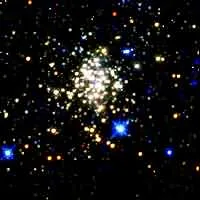
The Arches cluster is a group of young stars just 100 light-years from the center of the galaxy, a dangerous region where the strong gravitational pull can tear apart a star cluster. "Arches will survive only 10 or 20 million years," says Andrea Stolte of the University of California, Los Angeles.
Stolte is a member of a team that has tracked the cluster's trajectory. They took an image of the cluster in 2002 using the 8m VLT telescope in Chile and then another in 2006 using the Keck.
The team found that after four years the cluster, which lies 25,000 light-years away, moved seven millionths of a second. That corresponds to a speed of 200 kilometers per second.
The cluster is thought to have formed when two gas clouds collided, but the candidate clouds travel much more slowly than the cluster.
Could it have formed from the collision of two rare and exceptionally fast clouds? Stolte and her colleagues plan to take another cluster in the region, the so-called Quintet, to see if it is also traveling at such a speed.
The study also adds some data about the innermost stars of the galaxy that surround the monstrous central black hole. Many of these stars are young, only 6 million years old, and astronomers wonder how they were able to form. The gas clouds should have been torn apart by the black hole's gravity before collapsing into stars.
One theory is that the young stars were brought to the central cluster by other clusters that formed farther away. According to recent calculations, however, most clusters are destroyed before getting close enough. The new measurements now show that at least the Arches cluster cannot perform that kind of "delivery" because its orbit does not come close enough to the black hole.
Another possibility is that a herd of stars was guided by an intermediate black hole, 1000 times the mass of the Sun. A more popular alternative, however, is that these unusual stars formed where they are, out of a dense disk of gas. Under its own powerful gravity, this gas could have collapsed into stars.
Sources and related links
- Note in NewScientist
- Paper: "The proper motion of the Arches cluster with Keck Laser-Guide Star Adaptive Optics"; Andrea Stolte, Andrea M. Ghez, Mark Morris, Jessica R. Lu, Wolfgang Brandner, Keith Matthews
- Hubble spies giant clusters near the center of the galaxy
About the images
Credit: Don Figer (STScI) and NASA