Astronomers have finally found definitive evidence that the dust of the early Universe - which allowed the formation of stars and planets - was forged in the explosions of massive stars, by finding enough dust to make ten thousand planets like ours in the supernova remnant Cassiopeia A.
"We can now say without ambiguity that the dust was formed in the ejecta of the Cassiopeia A explosion. This discovery was possible because Cassiopeia A is in our galaxy, where it is close enough to study in detail," says Jeonghee Rho of the Spitzer Science Center at the California Institute of Technology. Rho is the author of a new report on the discovery that will appear in the January 20 edition of Astrophysical Journal.
Space dust is everywhere in the cosmos, both in the nearby Universe and in the early one. The development of stars needs dust to cool enough to collapse. In our nearby Universe, dust is supplied by the death of stars like our Sun. But back in time, when the Universe was young, stars like the Sun had not had enough time to die and leave dust.
That is where supernovae come in. These violent explosions occur when the most massive stars die. Since these stars do not live long, theorists reasoned that the first massive stars could have been the suppliers of the necessary dust. Those first stars, called Population III, are the only ones that formed without dust.
Other objects could also contribute: Spitzer found recent evidence that the highly energetic black holes, quasars, could -along with supernovae- create dust in their winds. (See note Dust in the wind of black holes)
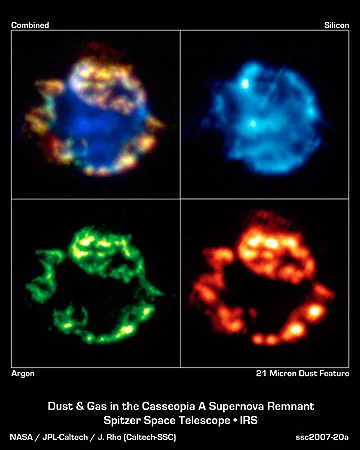
Rho and his colleagues analyzed the supernova remnant Cassiopeia A, located 11,000 light-years away. Since this remnant is not the early Universe, its proximity allows establishing whether supernovae have the ability to synthesize significant amounts of dust. Astronomers analyzed the infrared light from the remnant using Spitzer's infrared spectrograph. "Because Spitzer is extremely sensitive to dust, we were able to make high-resolution maps of the dust throughout the structure," says Rho.
The map reveals the amount, location and composition of the remnant's dust, which includes proto-silicates, silicon dioxide, iron oxide, pyroxene, carbon, aluminum oxide and other components. One of the first things astronomers noticed is that the dust matches the gas expelled in the explosion, indicating that the dust was created in that event. "The dust forms from a few days to hundreds of days after the explosions, when the gas temperature cools," adds co-author Takashi Kozasa.
The team was surprised to find fresh dust also deep within the remnant.
All the dust around the remnant, both cold and hot, amounts to up to 3% of the Sun's mass, or 10,000 Earth planets. This is enough to explain where a large part, though not all, of the Universe's dust came from. "Perhaps at least some of the dust comes from much colder dust that could be observed with the next generation of telescopes, like Herschel," adds Haley Gomez, also a co-author of the study.
The Herschel space observatory, scheduled for launch in 2008, is an ESA mission with NASA participation.
Rho notes that further studies of other supernovae are required. The dust destruction rate -a factor in determining how much dust is needed to explain the dusty beginning of the Universe- is still poorly understood.
Sources and related links
10,000 Earths' Worth of Fresh Dust Found Near Star Explosion
About the images
The upper left panel is a composite that combines the images from the remaining panels. The lower left panel shows argon gas (in green) that was synthesized in the stellar ejecta. Below on the right is shown the dust (in red), including proto-silicates, silicon dioxide and iron oxide. The upper right panel shows silicon gas (in blue) deep within the remnant.
The data for these images were taken with Spitzer's infrared spectrograph which separates light to reveal the fingerprints of molecules and elements. In total, Spitzer collected separate "spectra" from more than 1700 positions across Cassiopeia A. Astronomers then created maps from this large amount of data, showing the remnant in multiple colors.
Credit: NASA/JPL-Caltech/J. Rho (Spitzer Science Center)