Astronomers from SRON discovered a new galaxy cluster, hidden behind a previously identified cluster. The recently discovered cosmic giant is apparently as bright as the first group, but is six times farther away. The astronomers made the discovery as part of an international team using the XMM-Newton Space Telescope.
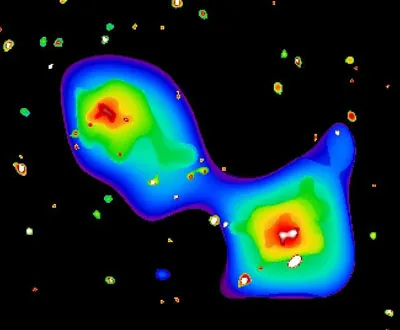
Galaxy clusters are the largest structures in the Universe. They consist of tens to hundreds of massive galaxies, each of which is formed by billions of stars. Gravity is the factor that binds them. The hot gas at tens of millions of degrees Celsius, present in the clusters, emits X-rays that make the clusters detectable for space telescopes like XMM-Newton. Detailed analyses of these rays tell astronomers more about the composition of the gas and its origin.
For years, astronomers were intrigued by the relationship between two equally bright X-ray regions in the galaxy cluster known as Abell 3128.
Norbert Werner, a PhD student at SRON says: "While one was clearly caused by a cloud of hot gas rich in metals released by supernova explosions in the galaxies, the other seemed to contain a much smaller amount of metals than any other cluster previously observed. What we observed completely contradicted the current theories about the origin of the large structures in the Universe."
The observations made with XMM-Newton revealed the surprise. The gas cloud behind the X-ray region is 4.6 billion light-years away, at least six times farther than Abell 3128. "We were seeing two completely different objects, which from our perspective were on the same line of sight," said Werner.
"The research on this large galaxy cluster focuses mainly on the question of how the large structures of the Universe formed," explains project leader Jelle Kaastra. According to current beliefs, material is spread across the Universe like a network of filaments of rarefied gas, the cosmic web. Between these filaments there are voids that become increasingly larger as the Universe expands. The density of material is greater at the intersections of the web. Therefore, that is where galaxies develop.
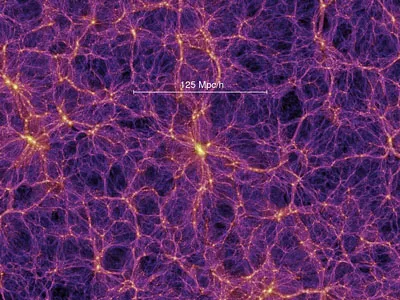
Fig. B - The cosmic web of filaments
Due to the enormous mass and gravitational attraction, clusters have their own dynamics. They attract each other, collide and pass through each other, a lot of events occur that we can study with X-ray telescopes, explains the scientist.
XMM-Newton is an X-ray telescope from the European Space Agency (ESA) for which SRON (Space Research Organisation of the Netherlands) built an instrument (RGS, Reflection Grating Spectrometer), capable of analyzing the X-ray data in detail.
The results of the research by Norbert Werner and Jelle Kaastra were recently published in Astronomy & Astrophysics.
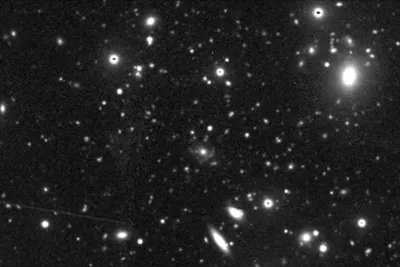
Fig. C
Sources and related links
- SRON Netherlands Institute for Space Research. "Hidden Cosmic Giant: New Cluster Of Galaxies Discovered." ScienceDaily 16 December 2007. 17 December 2007
- SpaceNewsFeed
- Note at SRON
- Note at ESA
- Paper:
“Complex X-ray morphology of Abell 3128: a distant cluster behind a disturbed cluster” A&A 474, 707–716 (2007).
About the images
A - First image of the note:
X-ray image of the area around Abell 3128 taken by XMM Newton. The bright region on the left is the hot gas in the discovered cluster. Courtesy ESA/ XMM/ EPIC/ SRON (N. Werner et al.)
Figure B:
Model of "cosmic web". Galaxy clusters are expected to develop at the intersections of the web. Courtesy of Springel et al., Virgo Consortium.
Figure C:
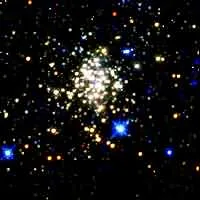
Image of the area in visible light made with the 6.5-meter Magellan telescope in Chile. Visible in the center of the image is the arc of light around the very massive galaxy at the center of the newly discovered cluster. The arc of light is caused by the gravitational field of the galaxy acting as a lens, magnifying the object that lies behind, at a great distance. Courtesy Werner et al. 2007